
META DESCRIPTION (156 chars): Pool handrails compared: 304 and 316 stainless, polymer and powder-coated rails. Verified prices, code heights, grip sizes, install steps and 10-year costs.

SLUG: pool-handrails

CATEGORY: TBD on publish -- check live site categories first.
A pool handrail is the cheapest safety buy on your deck, and the easiest to get wrong. For most chlorine pools, a 304 stainless 3-bend rail at $256 is the right call. If your pool runs salt water, step up to 316L at $390. If bare feet and hot sun are the daily problem, a polymer rail at $380 stays cool enough to hold. The sections below put real prices, real code numbers, and a 10-year cost table next to each option so you can pick once and be done.
Quick Comparison: 4 Pool Handrails Side by Side
Four rails cover most residential pools. A 304 stainless stair rail is the default. A 316L rail is the same shape in a tougher alloy for salt water. A polymer rail trades the metal look for a cool grip. A powder-coated rail trades raw steel for color. Prices below are the rail only; anchors and install are added in the 10-year table.
| Material | Example product | Rail price | Tube | Grip OD | Best for |
|---|---|---|---|---|---|
| 304 stainless | S.R. Smith 3-bend 5 ft (3HR-5-049) | $256 | 1.90 in, 0.049 wall | 1.90 in | Chlorine pools, tight budgets |
| 316L stainless | S.R. Smith 3-bend 4 ft marine grade (3HR-4-049-1-MG) | $390 | 1.90 in, 0.049 wall | 1.90 in | Saltwater and salt-chlorine pools |
| Polymer over aluminum | Saftron return-to-deck 48 x 32 in (RTD-348-W) | $380 | Aluminum core, polymer shell | 1.90 in | Hot sun, kids, bare feet |
| Powder-coated stainless | Inter-Fab 3-bend 50 in coppervein (D3D500654) | $475 | 1.90 in, 0.065 wall | 1.90 in | Matching deck colors |
Every rail in the table uses 1.90 in outside-diameter tubing, inside the 1.25 to 2 in grip range the code allows. Your choice is material and mount, not diameter. Read the full guide on pool deck railing ideas if you also need a guard along the open deck edge.
304 Stainless Steel Pool Handrails: What $256-$400 Buys
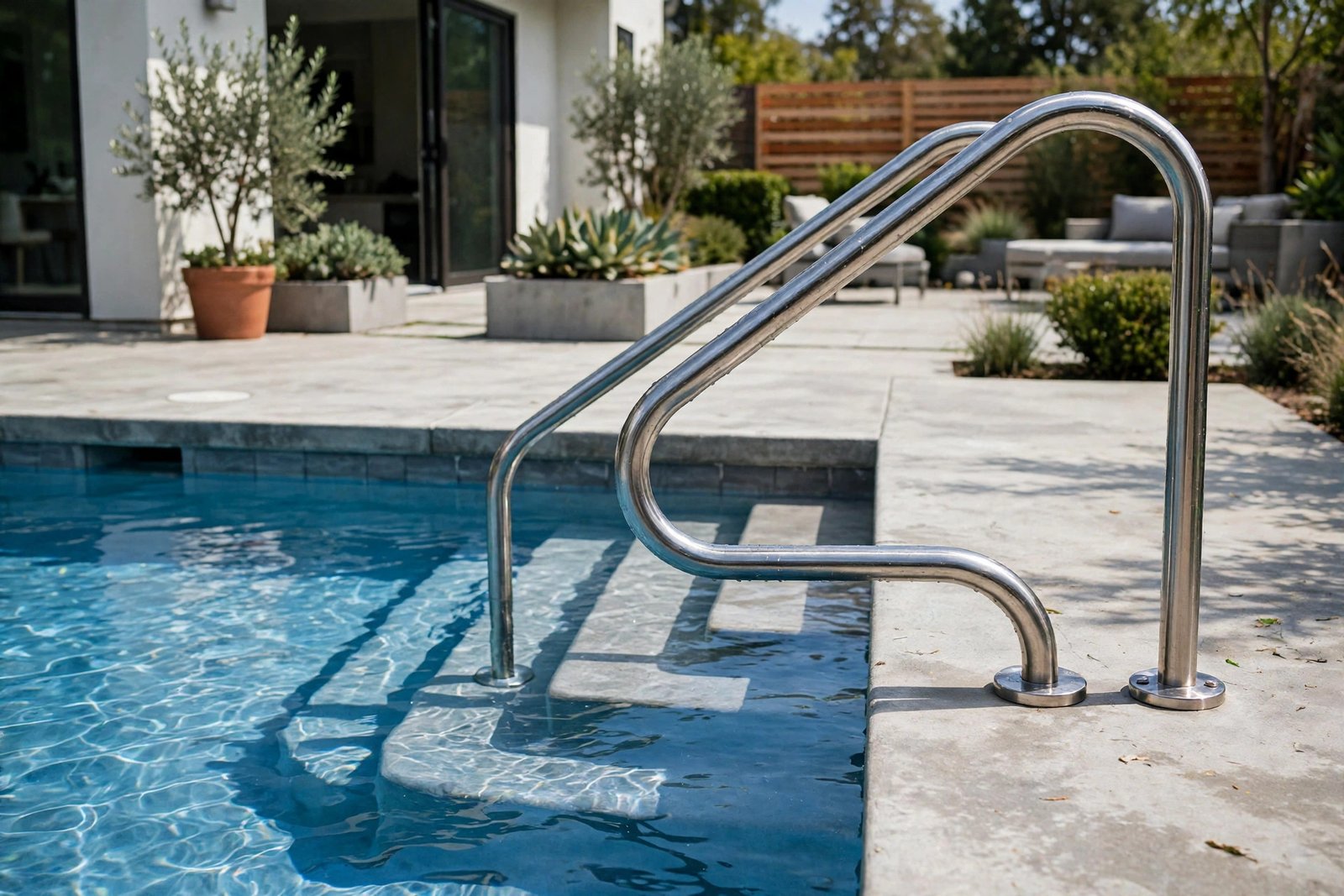
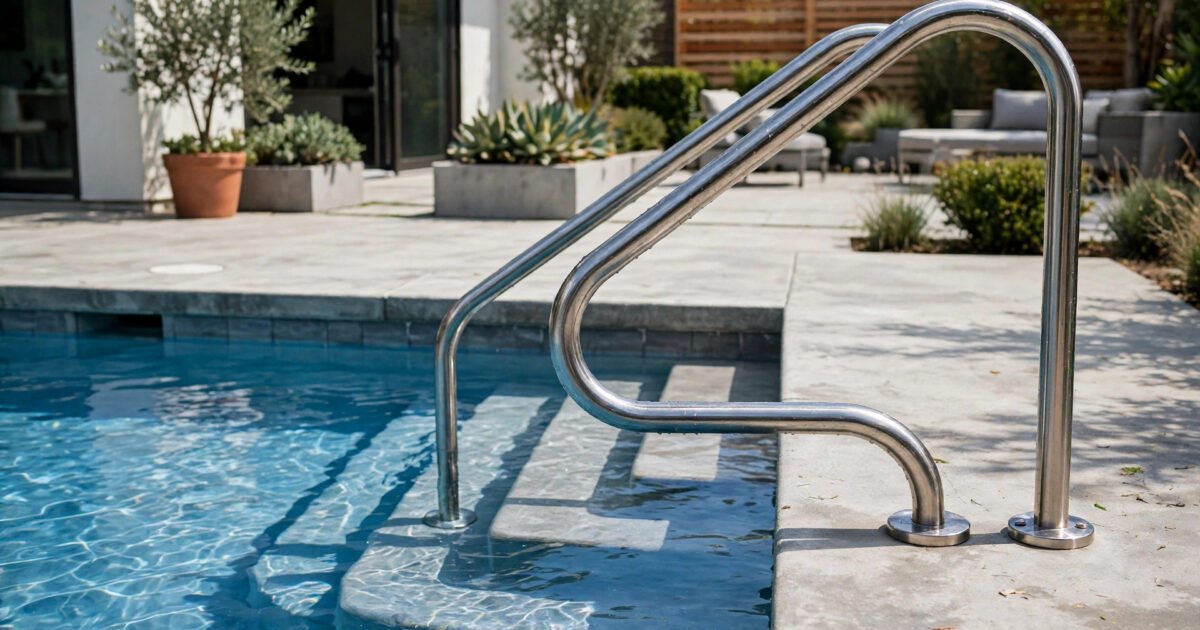
A 304 stainless rail is the default pool handrail in the United States, and the price range is tight. A S.R. Smith 2-bend 4 ft rail (2HR-4-049) costs $296. A 3-bend 5 ft rail (3HR-5-049) costs $256. A 2-bend 6 ft rail (2HR-6-049) costs $350. A 3-bend 7 ft rail (3HR-7-049) costs $400. All four are 304 stainless with a 1.90 in outside diameter and a 0.049 in wall, except the 6 ft 2-bend, which uses 1.65 in tubing. The 3-bend shape suits a sloped entry or a 3-step stair; the 2-bend shape suits a straight drop from deck to water.
304 handles chlorinated water well and needs no finish; rinse it when you rinse the deck. Its two real limits are salt and heat. In a saltwater pool, or one with a salt-chlorine generator, 304 can pit and show rust spots within a few seasons. In full sun, bare 304 gets hot enough to be uncomfortable to grip. If either condition applies, skip to the 316L or polymer sections below.
316L Marine-Grade Stainless: When Is $390-$630 Worth It?
316L is 304 with added molybdenum, and that one alloy change is the whole story. Molybdenum resists chloride pitting, which is what eats 304 in salt water. A S.R. Smith 3-bend 4 ft marine-grade rail with a 1 ft pool-side extension (3HR-4-049-1-MG) costs $390. A 4 ft marine-grade 3-bend with a heavy 0.065 in wall (3HR-4-065-MG) costs $630. A 30 in figure-4 marine-grade grab rail (F4H-101-MG) costs $615. All three are 1.90 in outside diameter.
Buy 316L when your pool uses salt water or a salt-chlorine generator. Buy it when the pool sits near the coast and gets salt spray. For a standard chlorine pool, 316L buys nothing you will notice, and the $134 to $374 premium over the equivalent 304 rail is wasted money. Wall thickness matters too: 0.049 in is the residential standard, while 0.065 in is the heavy-duty commercial wall. A home pool does not need it unless the rail takes daily abuse from a large family or a rental property.
Polymer Pool Handrails: Cool Grip for $340-$431
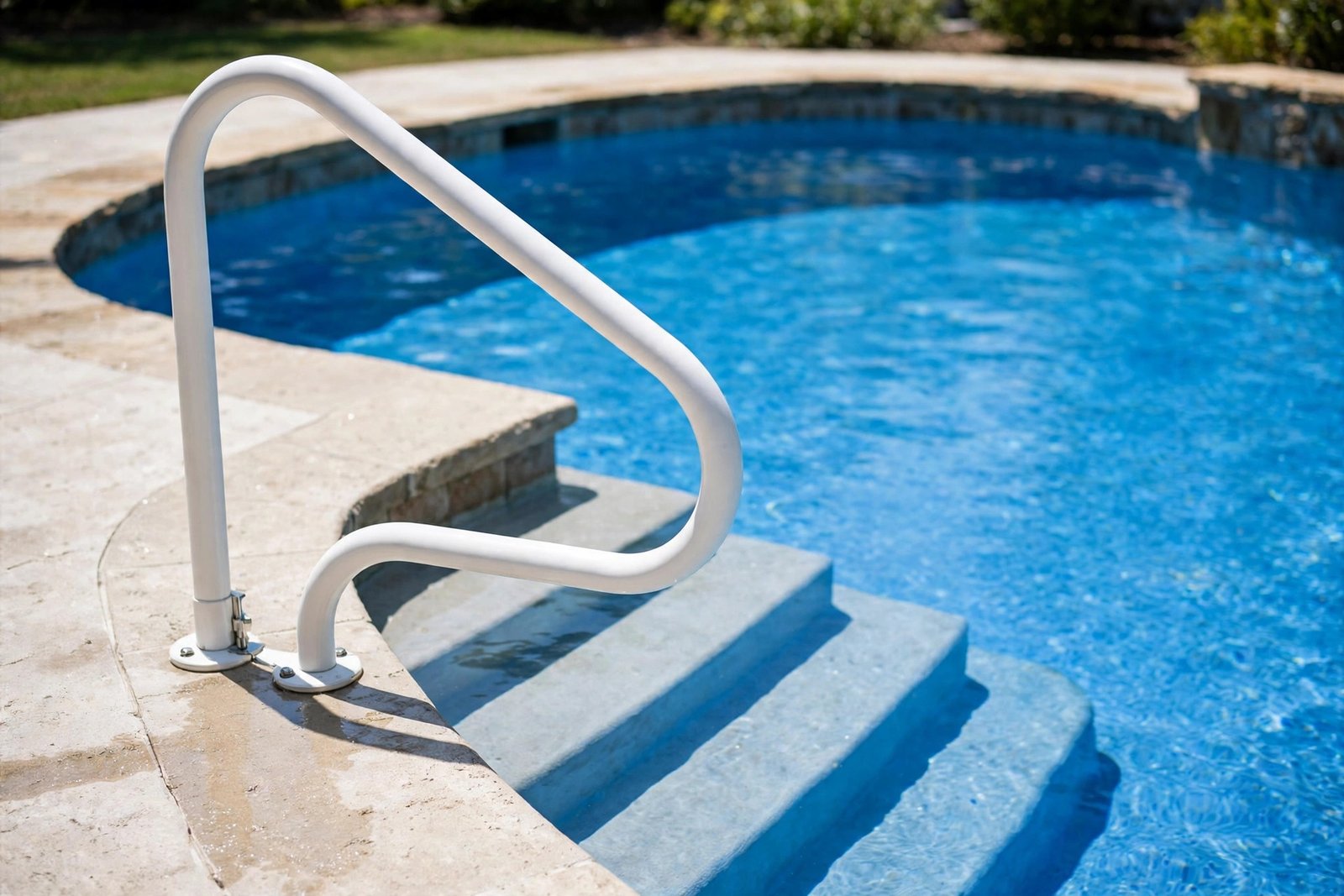
A polymer rail is an aluminum core inside a high-impact polymer shell. Saftron is the brand most pool stores carry. A 48 x 32 in 4-bend figure-4 rail costs $340. A 48 x 32 in 3-bend return-to-deck rail (RTD-348-W) costs $380. A 48 x 32 in 4-bend return-to-deck rail (RTD-448-W) costs $431. All three carry a 5-year manufacturer warranty and come in 6 colors: white, gray, taupe, beige, black, and graphite gray.
The polymer shell solves the two problems stainless steel cannot: it stays cool to the touch in full sun, and it never shows rust. The shell resists pool chemicals, salt, and UV, and the aluminum core carries the load. The trade-offs are price and bulk. A cross-braced 54 x 32 in polymer rail (CBRTD-354-T) costs $806, nearly double the equivalent stainless rail, and the tube looks thicker than polished steel. If your pool gets full afternoon sun and kids use the steps barefoot, the cool grip is worth the premium. If your pool is shaded, it is not.
Powder-Coated Handrails: 5 Colors and 1 Weakness
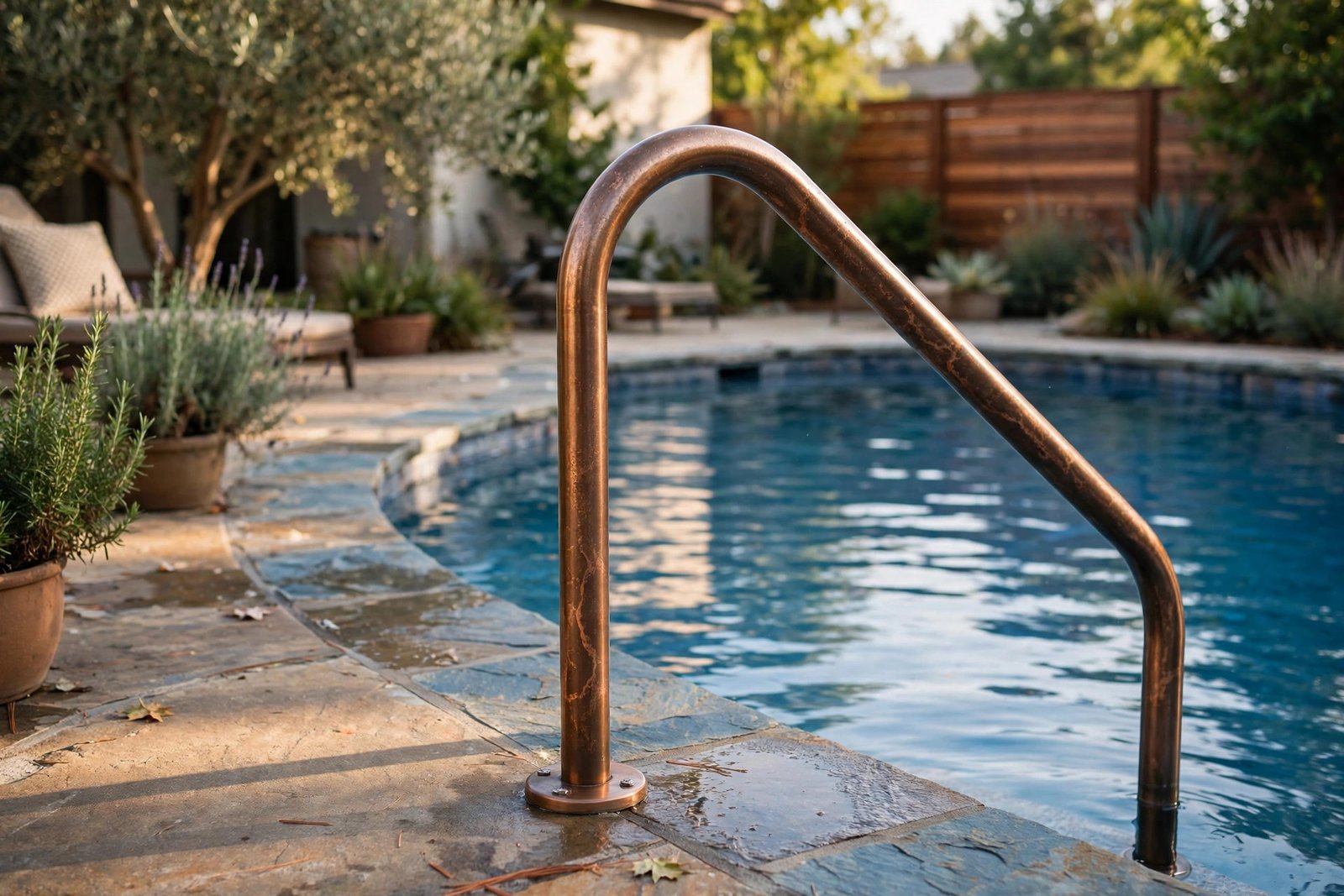
A powder-coated rail is a stainless steel rail with a baked-on color finish. Inter-Fab sells 5 finishes: white, earth, coppervein, light gray, and hammerstone gray. A 3-bend deck-to-deck rail in 0.049 in wall costs $140. A figure-4 grab rail in coppervein (G3D049-4) costs $373. An economy figure-4 grab rail (G3DE049) costs $440. A 50 in 3-bend rail in coppervein with a 0.065 in wall (D3D500654) costs $475. A 4-bend braced rail in hammerstone gray costs $790. Powder-coated rails include the matching escutcheons; bare stainless rails sell them separately.
The finish is the selling point and the weakness. It matches the deck and furniture, and the coating adds a layer against surface rust. But a chip exposes bare steel, and that spot rusts first. Check the coating every spring and touch up chips before swim season. If you want color and low maintenance, polymer beats powder-coat on upkeep. If you want color on a steel budget, powder-coat is the cheaper route.
How Much Does a Pool Handrail Cost Over 10 Years?
The rail price is only half the cost. Every rail needs 2 anchor sockets, and most owners pay for core drilling and setting. The table below adds it up for one rail over 10 years. Anchor price is the S.R. Smith AS-100B bronze socket at $80 each, 2 per rail. Pro install is the $200 to $400 range verified this session, shown at a $300 midpoint. The 10-year total counts one purchase: a stainless or polymer rail has no finish to renew and no part that wears out on a schedule, so a second purchase inside 10 years is not part of the math.
| Rail | Rail price | 2 anchors | Install DIY | Install pro | 10-year total, DIY | 10-year total, pro | Cost per year, DIY |
|---|---|---|---|---|---|---|---|
| 304 stainless 3-bend 5 ft | $256 | $160 | $0 | $300 | $416 | $716 | $42 |
| 316L stainless 3-bend 4 ft | $390 | $160 | $0 | $300 | $550 | $850 | $55 |
| Polymer return-to-deck 48 x 32 in | $380 | $46 | $0 | $300 | $426 | $726 | $43 |
| Powder-coated 3-bend 50 in | $475 | $160 | $0 | $300 | $635 | $935 | $64 |
Two things jump out. First, install is the swing factor: pro install adds $300, more than the price gap between the 304 and 316L rails. If you can core-drill 2 holes yourself, the 316L rail costs only $134 more than the 304 rail over 10 years. Second, the polymer rail matches the 304 rail on 10-year cost because its sockets cost $23 each instead of $80. If you hire a pro, the cheapest 10-year option is the 304 rail at $716, and the most expensive is the powder-coated rail at $935. Buy the rail for your water and your sun, not for the sticker price.
How High and How Thick Must a Pool Handrail Be? 34-38 Inches
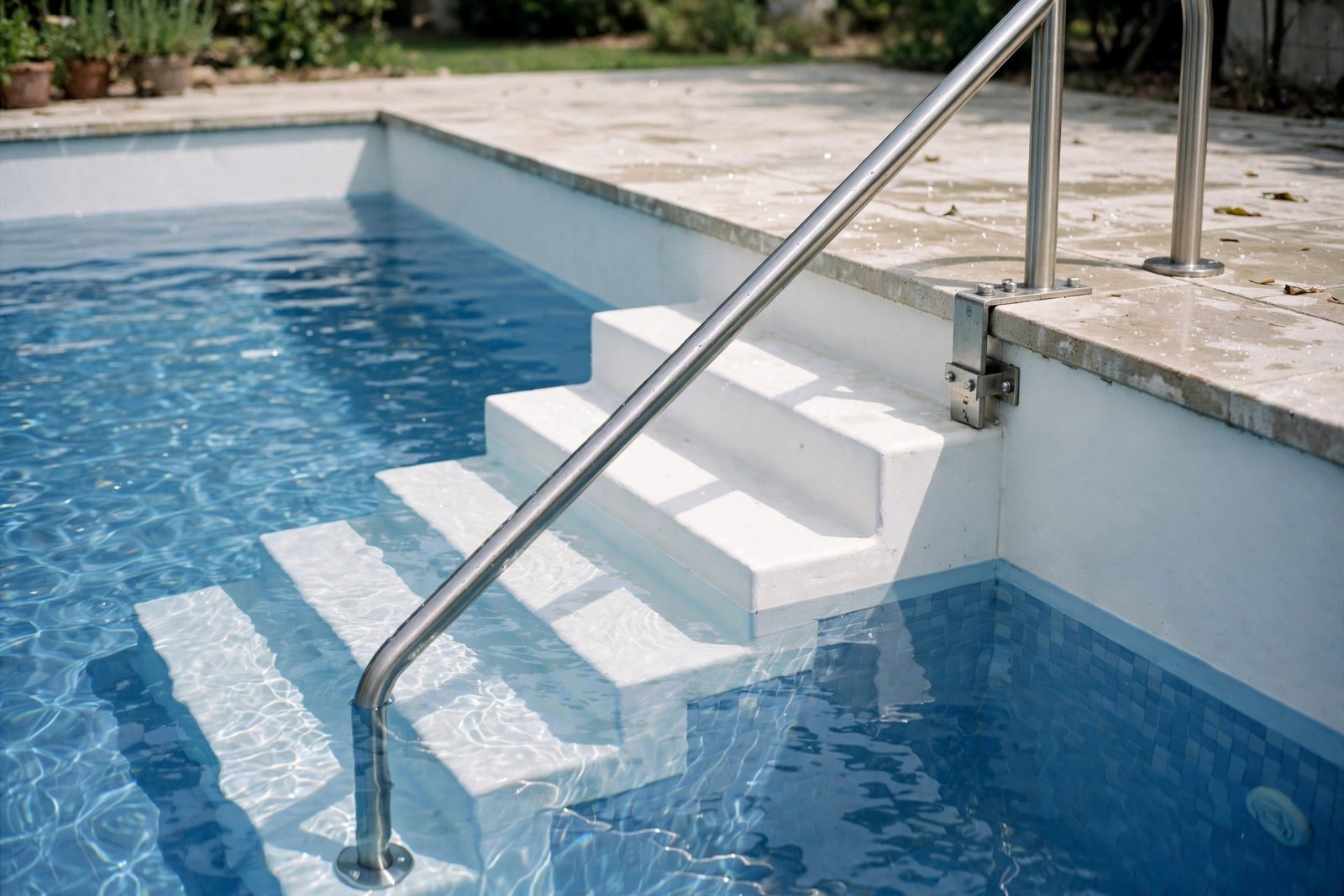
A pool stair handrail must grip at 34 to 38 in above the stair nosings, and the grip itself must measure 1.25 to 2 in in outside diameter. Those two numbers come from the accessibility standard for pool stairs, and the pool code repeats the same 1.25 to 2 in grip range for handrails and handholds. A standard 1.90 in rail tube fits. A decorative 2.5 in tube does not, and an inspector can fail it.
The rest of the geometry matters just as much. Keep 1.5 in of clear space between the rail and any wall. Put a handrail on both sides of an accessible stair, with 20 to 24 in of clear width between the two rails. Extend each rail 12 in horizontally past the top step at deck level. On in-pool stairs, the handrail or handhold must sit at least 20 in above the platform or the top tread. Set the leading edge of the rail 18 in, plus or minus 3 in, from the vertical plane of the bottom riser. If the rail is removable, it must need a tool to come out. Ladder grab rails sit 17 to 24 in apart, with 3 to 6 in of clearance between the treads and the pool wall.
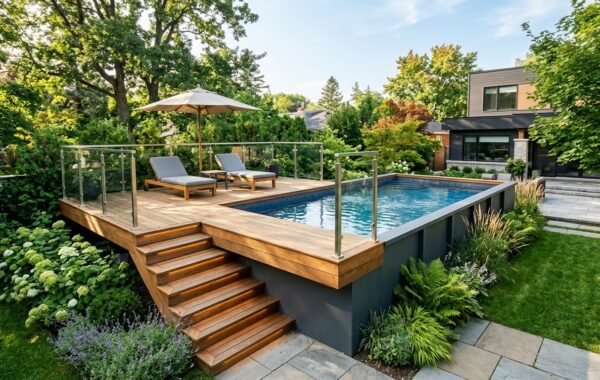
Do not confuse a handrail with a guard. A guard is the barrier along an open deck edge. The residential code requires a guard where the deck surface sits more than 30 in above the ground within 36 in of the edge, and that guard must stand at least 36 in high, with no opening a 4 in sphere can pass through, and it must hold a 200 lb push on the top rail. The handrail numbers above are for the grip at the steps. Your local code adopts a specific edition of these model codes and can add stricter rules, so confirm the edition with your building department before you buy.
How Do You Install a Pool Handrail in 5 Steps?
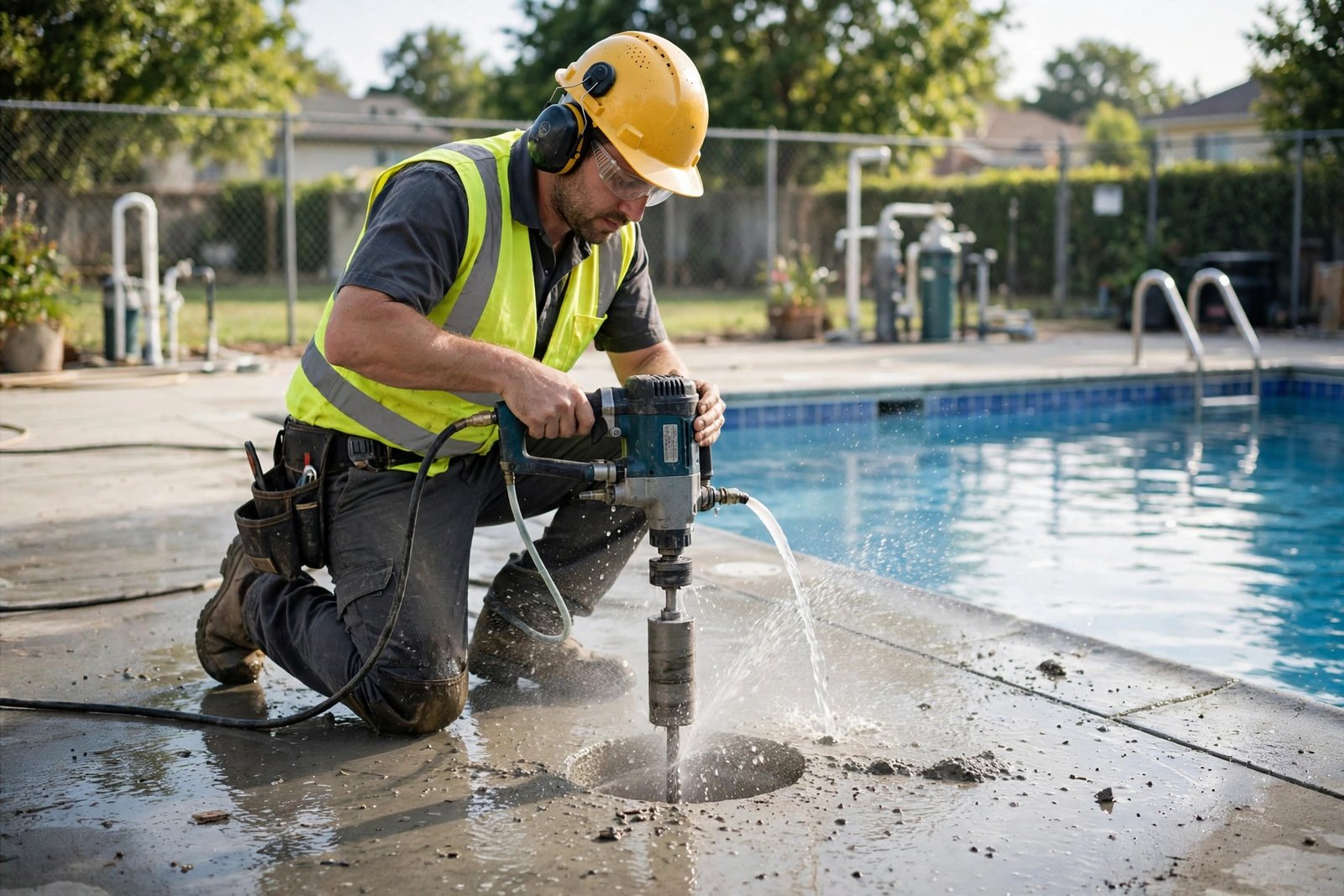
Install one 3-bend rail on a concrete deck in about 3 hours of hands-on work, plus the cure time on the anchoring cement. The worked example below uses a S.R. Smith 3-bend 5 ft rail (3HR-5-049), 2 AS-100B bronze anchor sockets, and a #8 AWG solid copper bonding wire. You need a core drill or a hammer drill with a core bit matched to the socket, a tape measure, a level, anchoring cement or epoxy, a wrench, and a licensed electrician for the bonding step. Any metal rail or anchor socket within 5 ft of the inside pool wall must connect to the pool bonding grid.
- Mark the rail position. Set the rail on the deck and mark both socket centers. The grip must land 34 to 38 in above the stair nosings, and the leading edge must sit 18 in, plus or minus 3 in, from the vertical plane of the bottom riser. Check: both marks are level with each other and square to the steps. Time: 15 minutes.
- Core-drill 2 holes. Drill one hole per socket, deep enough for the 4 in socket body plus the anchoring cement bed. Keep the drill plumb; a tilted hole means a tilted rail. Check: the socket drops in straight and sits flush with the deck. Time: 45 to 60 minutes.
- Set the anchor sockets. Pour anchoring cement or epoxy into each hole, seat the socket, and level it. The socket includes a bronze wedge, a washer, a bolt, and a 1/4-20 grounding bolt. Let the cement cure fully per the product label before you load the rail. Check: the socket does not rock when you push it. Time: 30 minutes plus cure time.
- Bond the sockets. Run a #8 AWG solid copper conductor from each socket grounding bolt to the pool bonding grid. This is electrical work near water, so a licensed electrician should make the connection. Check: the bond is continuous and tight at both ends. Time: 20 minutes for the electrician.
- Set the rail and check it. Slide the rail legs into the sockets, tighten the wedge bolts, and fit the escutcheons. Grip the rail and pull hard in every direction. Check: no wobble, no rattle, and the grip height still reads 34 to 38 in above the nosings. Time: 15 minutes.
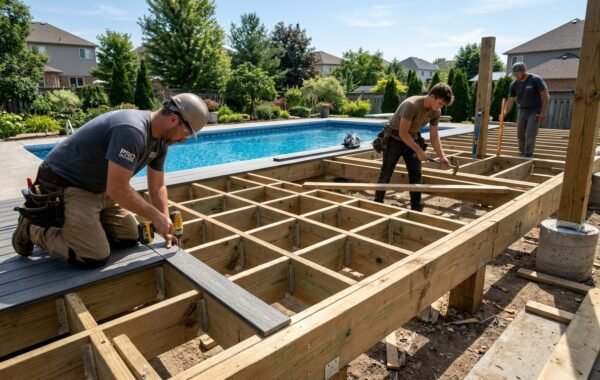
If your deck is wood or composite instead of concrete, core drilling does not apply. Use a flange-mount rail or a surface-mount base bolted through the deck into blocking below. The rail choice changes, but the height and grip numbers do not. For the full deck build around the steps, see how to build a pool deck and the above ground pool stairs with deck guide.
Which Pool Handrail Fits Your Pool? 5 Questions
Answer these 5 questions in order and the rail picks itself.
- Does the pool use salt water or a salt-chlorine generator? Yes: buy 316L stainless or polymer. The chloride pits 304. No: 304 stainless is fine.
- Does the sun hit the steps all afternoon? Yes: buy polymer. Bare steel gets too hot to hold, and kids will not use a rail they cannot grip. No: any material works.
- Is this a new build or a retrofit? New build with open concrete: core-drilled anchor sockets. Existing deck you cannot cut: flange-mount rail or surface-mount base.
- Steps, slope, or flat deck edge? Steps or sloped entry: a 3-bend or 4-bend stair rail. Flat deck edge or a single grab point: a figure-4 grab rail, which is shorter at 30 in and mounts where you pull yourself out.
- What is the rail budget? Under $300: an Inter-Fab 3-bend at $140 or a S.R. Smith 3-bend 5 ft at $256. $300 to $500: a 316L 3-bend at $390 or a Saftron return-to-deck at $380. Over $500: a heavy-wall 316L rail or a large cross-braced polymer rail.
Salt water and full sun means polymer wins outright: it resists salt and stays cool. Chlorine and shade means the 304 stainless 3-bend at $256. For an accessible stair, buy a pair and mount one on each side with 20 to 24 in of clear width between them.
5 Pool Handrail Mistakes That Cost $200-$560 to Fix
1. Bronze anchors in a saltwater pool. Bronze sockets corrode in salt water and the rail starts to wobble. The fix is 2 stainless sockets plus re-coring the holes: $200 to $400 for core drilling and setting, plus the price of the sockets. Buy the stainless socket version (AS-100B-SS) from the start if the pool runs salt.
2. A rail too hot to hold. Bare 304 stainless in full afternoon sun burns hands, so nobody uses the rail. The fix is a new polymer rail at $340 to $431, plus the install all over again. Check the sun on the steps at 3 p.m. before you order steel.
3. A grip too thick to hold. A decorative 2.5 in tube looks good and fails inspection, because the grip range tops out at 2 in. The fix is a replacement rail at $140 to $475. Measure the tube diameter before you buy, not after the inspector leaves.
4. Anchors set in thin or patched concrete. A socket set in a thin patch or a cracked slab works loose under load. The fix is re-coring in sound concrete: $200 to $400 for drilling and setting, plus $160 for 2 new sockets. Drill a test hole first if the deck has patches near the steps.
5. A metal rail with no bond wire. An unbonded metal rail within 5 ft of the water is a shock hazard, and an inspector will flag it. The fix is an electrician running a #8 AWG copper bond to the grid. Get a quote before the inspection, not after a failed one. The pool safety code guide at pool deck safety codes and standards covers the bonding rule in more detail, and the pooldeck ladder guide covers ladders, which share the same anchor and bonding rules.
Pool Handrail FAQ: 6 Questions Answered
Can you add a handrail to an existing pool deck without cutting the concrete?
Yes. Use a flange-mount rail or a surface-mount base that bolts through the deck into blocking below. The rail still needs the same 34 to 38 in grip height, and the base needs solid wood or steel blocking under the deck boards.
Are pool handrails required by code for a residential pool?
Model codes require a handrail or handhold on in-pool stairs, and a grip at 34 to 38 in on deck stairs. Enforcement varies by jurisdiction and by whether the pool is new or existing. Ask your local building department which edition it adopted.
How do you keep a stainless pool handrail from rusting?
Rinse the rail with fresh water after heavy use and keep chlorine tablets off the metal. In salt water, use 316L, not 304. Surface rust on 304 can be cleaned, but pitting from salt cannot be polished out.
What is the difference between a grab rail and a stair rail?
A stair rail runs the full slope of the steps with 2 or 3 bends and a continuous grip. A grab rail is shorter, usually a figure-4 shape around 30 in, and gives one pull-out point at the deck edge. Wide steps need a stair rail; a single exit point needs a grab rail.
Can a pool handrail be removed for winter?
Only if it is built to be removable, and the code requires a tool to remove it, so children cannot pull it out. Anchor sockets with covers let you pull the rail and cap the hole. Flange-mount rails unbolt. Check the socket cover before winter so the hole stays clean.
What size anchor socket fits a 1.90 in pool rail?
A 4 in deep socket made for 1.90 in tubing, such as the AS-100B bronze socket at $80. It includes the wedge, washer, bolt, and grounding bolt. For salt water, buy the stainless version of the same socket.
Editorial Note: This guide was researched and written by our small editorial team under the pen name Dave Hendrick. We are homeowners and researchers, not licensed contractors. Prices are typical national ranges, not quotes — confirm locally before you buy.