
A crack in a concrete pool deck lets water under the slab, and water under the slab is what turns a $235 afternoon repair into a $1,500 lift or a $9,600 replacement. This guide answers the exact question — how do you repair a pool deck crack — with a diagnosis step, a 4-step seal, and real 2026 costs for 40 linear feet of cracks. You need a caulk gun, an angle grinder, 4 tubes of self-leveling sealant, and about 5 hours of active work spread over 2 days. A first-timer can do the sealing; the diagnosis decides whether sealing is even the right job, and concrete pool deck resurfacing is the next step up when sealing is not enough.
What 7 Tools and 4 Materials Fix a Pool Deck Crack?
Seven tools and 4 materials cover a 40 linear foot repair, and the whole buy runs about $235 including the sealer for the full deck. Buy the sealant first and the tools second: the sealant choice decides the repair, and a cheap caulk gun that drips will waste more sealant than it saves.
Tools:
- Caulk gun, 10 oz, manual: $9.98 for a basic smooth-rod gun. A $19.98 heavy-duty gun drips less on long runs. Skip the $119 battery gun for one repair.
- Angle grinder with a diamond crack-chasing blade, or a crack-chasing saw. Rent one if you do not own it; routing 40 ft takes about 30 minutes with the right blade.
- Wire brush, stiff bristles, for loose concrete in the crack.
- Shop vacuum, for dust after routing. A broom leaves dust in the crack and dust kills adhesion.
- Utility knife, for cutting the sealant tip and trimming backer rod.
- Painter’s tape, for masking the slab edges on wide cracks.
- Safety glasses and work gloves. Concrete dust and a grinder make these non-negotiable.
Materials:
- Self-leveling polyurethane sealant, 10.1 oz tubes, 4 tubes at $10.97 each: $43.88. The tube must say self-leveling and polyurethane. A 29 oz tube at $17.97 costs less per ounce, but it needs a large gun.
- Foam backer rod, 3/4 in. diameter, 2 packs of 20 ft at $8.50 each: $17.00.
- Pourable concrete crack filler, 1 quart at $13.97, for hairline cracks under 1/8 in. wide. One quart fills about 38 ft of 1/4 in. by 1/2 in. crack.
- Acrylic concrete sealer, 1 gallon at $24.97, 6 gallons for 2 coats on a 600 sq ft deck: $149.82. One gallon covers about 200 sq ft per coat.
Total materials plus the caulk gun: $234.65, about $235. That number is the worked example later in this guide, and every line of it is priced from a current retail listing.
Pool Deck Crack Repair Checklist: 9 Checks Before You Buy Sealant
Nine checks take 20 minutes and stop the most expensive mistake in this job: sealing a crack that is actually a moving slab. Fill in the blanks before you buy anything.
- Longest single crack: ______ ft.
- Widest crack: ______ in.
- Height difference across the widest crack: ______ in. (Lay a straightedge across it. Any lip you can feel with a shoe is a problem.)
- Does any crack run from the pool wall outward? Yes / No
- Does the slab sound hollow when tapped with a hammer near the crack? Yes / No
- Does water pool near the crack after rain? Yes / No
- Control joint spacing: ______ ft. (A 4-in. slab needs joints every 8 to 12 ft.)
- Total linear feet to seal: ______ ft.
- Tubes of 10.1 oz sealant needed (1 tube per 12 ft at 1/2 in. wide): ______
If check 3 shows more than 1/4 in., or checks 4, 5, or 6 answer yes, skip to the decision tree section before buying sealant. Those answers mean the slab is moving, and sealant on a moving slab is a temporary patch at best.
Step 1: How Do You Tell a Cosmetic Crack From a Structural One?

Measure the crack before you touch it. Width and height difference decide the repair, and guessing wrong costs you the whole job twice. A cosmetic crack is under 1/8 in. wide with no height difference across it. A structural crack is over 1/4 in. wide, has one side higher than the other by more than 1/4 in., or runs from the pool wall outward in a straight line.
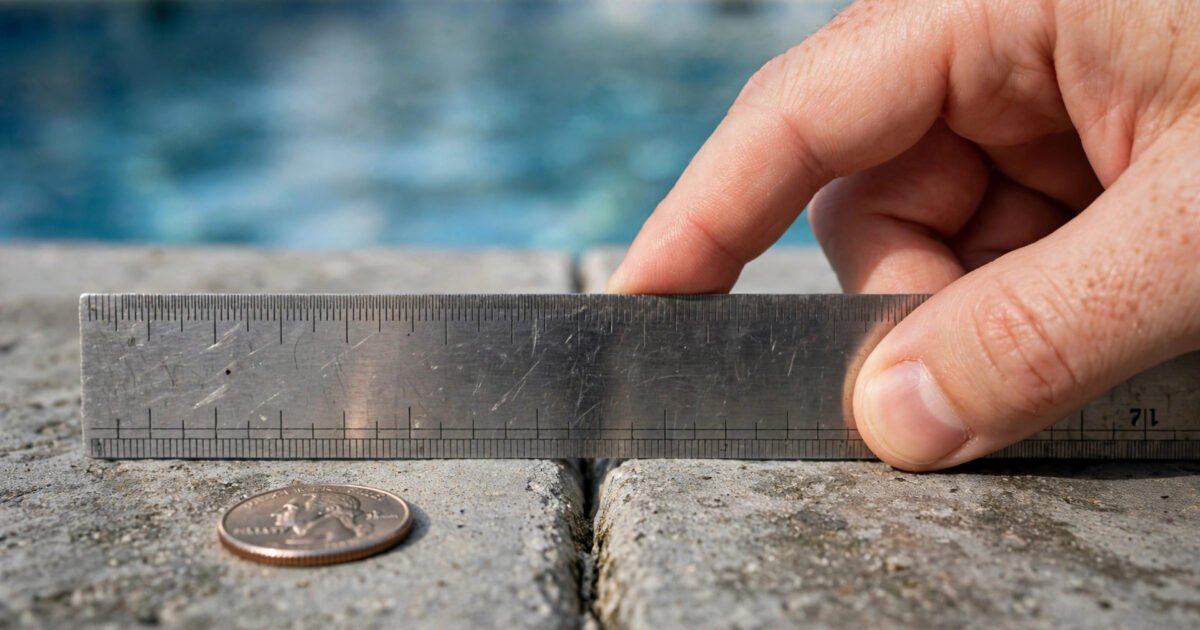
- Measure the width with a steel ruler at 3 points along the crack. Hairline cracks under 1/8 in. are usually shrinkage from curing. Cracks 1/8 to 1/4 in. wide are thermal movement cracks. Cracks over 1/4 in. wide need a pro to look at the slab, not just the crack.
- Check the height difference with a straightedge laid across the crack. Slide a coin under the straightedge on the low side. If the gap is more than 1/4 in., one side of the slab has sunk or heaved.
- Tap the slab with a hammer on both sides of the crack. A solid thunk means the slab sits on its base. A hollow sound means water has washed out the sub-base under the slab, and the slab is spanning a void.
- Watch the crack after rain. Water pooling on one side, or a crack that stays wet hours after the rest of the deck dries, means water is getting under the slab through that crack.
Shrinkage cracks and thermal cracks are the common ones, and both are DIY work. Settlement cracks — the ones with a height difference, a hollow sound, or a line running from the pool wall — are a soil and base problem, and no tube of sealant fixes soil. For a deeper look at how to tell if a crack is structural, see our guide on how to tell if a crack is structural.
Step 2: How Do You Clean and Route a Pool Deck Crack?

Routing means widening the crack into a clean V-shaped channel so the sealant has something to grip. A crack left narrow and dirty gives the sealant a smooth, dusty surface to peel off within a year. Route every crack wider than 1/8 in. Hairline cracks under 1/8 in. skip this step and go straight to pourable filler.
- Cut the crack open with the angle grinder and crack-chasing blade. Aim for 1/2 in. wide and 1/4 in. deep. Keep the blade moving; stopping in one spot cuts a notch that shows through the sealant.
- Wire-brush the channel to knock out loose concrete and dust. Brush along the crack, not across it, so you do not widen the edges.
- Vacuum the channel with the shop vacuum. Run the nozzle slowly along the full length twice. Dust left in the crack is the top reason a sealant bond fails in the first year.
- Check the channel depth with the utility knife: the blade should sit 1/4 in. below the surface. Deeper than 1/2 in. means you need backer rod to fill the depth, which is the next step.
Routing 40 linear feet takes 60 to 90 minutes for a first-timer, including setup and cleanup. Wear safety glasses and gloves for the whole step. Concrete dust in the eyes ends the job faster than any mistake with the sealant.
Step 3: How Much Backer Rod and Sealant Does One Crack Need?
One 10.1 oz tube covers 12 linear feet of crack routed 1/2 in. wide and filled 1/4 in. deep. That number comes from the volume: a 10.1 oz tube holds 18.2 cubic inches, and a 1/2 in. by 1/4 in. channel holds 0.125 cubic inches per inch of length. Divide 18.2 by 0.125 and you get 145.6 inches, or 12.1 feet. Buy 4 tubes for 40 feet and keep one spare; running out mid-crack leaves a cold joint in the sealant.
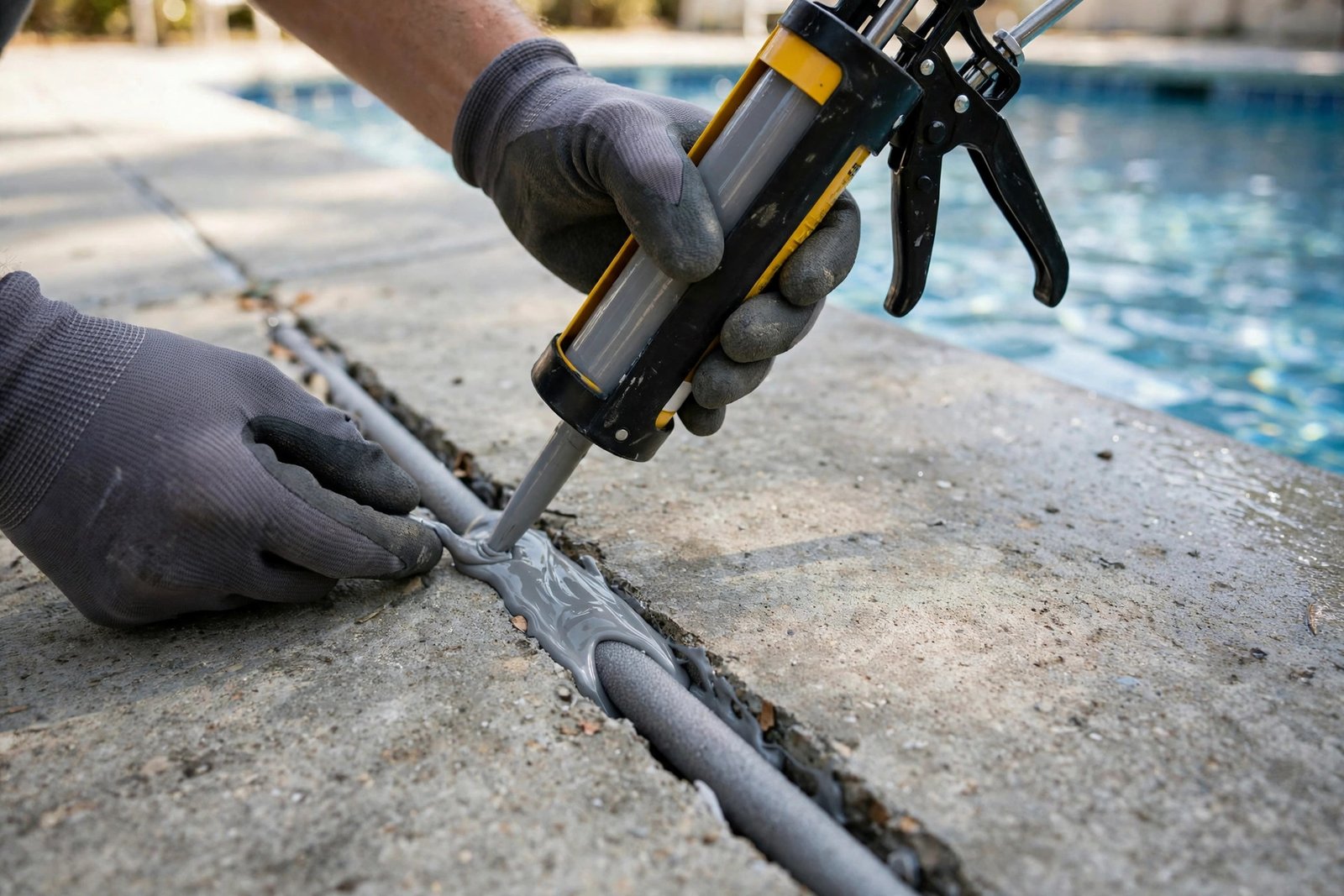
- Press foam backer rod into the routed channel. Use 3/4 in. rod for a 1/2 in. crack; the rod compresses to fit and springs back to hold itself in place. Set the top of the rod 1/4 in. below the slab surface. The rod does two jobs: it stops the sealant from sinking too deep, and it stops the sealant from bonding to the bottom of the crack, which is what lets the sealant stretch when the slab moves.
- Cut the sealant tip small, about 1/4 in. across, at a 45-degree angle. A tip cut too wide floods the crack and wastes a tube in 10 feet.
- Gun the sealant in one slow, steady pass. Keep the tip buried in the sealant bead as you move so no air gets trapped underneath. Self-leveling sealant flows flat on its own; do not tool it with a finger or a putty knife.
- Stop the bead 1/16 in. below the slab surface. Sealant that sits proud of the surface catches bare feet and peels up at the edge within a season.
Work in air temperatures between 40 and 100 degrees F. Below 40 degrees the sealant will not bond properly; above 100 degrees it skins over before it levels. A dry crack bonds best, though this sealant tolerates a damp surface an hour after the water source stops. Sealing 40 feet takes 45 to 60 minutes once the rod is set.
Step 4: How Long Before You Can Walk on a Sealed Pool Deck Crack?
The sealant is tack-free in 1 to 2 hours and fully cured in 3 to 5 days. That gap matters: tack-free means it will not pick up dust, not that it can take weight. Give it 24 hours before foot traffic and 3 to 5 days before moving furniture back or letting pool water splash across the repair.
- Broadcast dry sand over the fresh sealant if you want the repair to blend in. Sprinkle a thin layer while the sealant is still wet, then brush off the excess after it cures. The sand gives bare feet grip and hides the gray line.
- Keep the repair dry for the first hour. A splash after that will not hurt it, but a downpour in the first hour can wash the uncured surface.
- Reseal the deck once the sealant has cured. Roll 2 coats of acrylic sealer over the full 600 sq ft deck at 200 sq ft per gallon per coat, which is 6 gallons. The sealer is what keeps water out of the next crack, and a deck sealed every 2 to 3 years is the cheapest crack prevention there is.
- Mark the calendar. Check the repair after the first freeze and after the first summer heat wave. A sealant line that has split or pulled away from one edge tells you the slab is still moving, and that is a pro call, not a second tube.
Resealing takes 2 to 3 hours including dry time between coats. Do it on a dry day with no rain in the forecast for 24 hours.
When Is a Sealant Fix Not Enough? 4 Signs You Need a Pro

A sealant fix is not enough when the slab itself is the problem. Four signs, any one of which means stop and call a pro, decide that: a crack wider than 1/4 in., a height difference over 1/4 in. across the crack, a crack that reopens within a year of sealing, or a hollow sound when you tap the slab. Each one points to movement or a void under the slab, and sealant cannot fix either.
Follow the branches in order:
- Crack under 1/8 in. wide, no height difference, solid sound: DIY. Clean it, fill it with pourable crack filler, and seal the deck. Cost is about $14 for the filler plus sealer.
- Crack 1/8 to 1/4 in. wide, no height difference, solid sound: DIY. Route it to 1/2 in., set backer rod, and fill it with self-leveling polyurethane. Cost is about $235 for 40 feet including the full-deck reseal.
- Crack over 1/4 in. wide, or height difference over 1/4 in., or the crack reopens after a repair: call a pro. Routing and injection runs $6 to $22 per linear foot, so 40 feet costs $240 to $880. The pro also checks whether the slab is still moving before sealing it.
- One side sunk, water pooling, hollow sound, or a crack running from the pool wall outward: call a pro for a soil and void check. A sunken corner lift runs $500 to $1,500. If the sub-base has washed out across a wide area, the honest answer is partial replacement, not more sealant.
- Spalling over 30 percent of the surface, or a repair quote over 40 to 60 percent of full replacement: replace, do not repair. A full replacement runs $12 to $20 per square foot including demo and pour, so a 600 sq ft deck costs $7,200 to $12,000. Spending $5,000 patching a deck that needs $8,000 of replacement is the most expensive way to get a new deck.
A permit is usually not needed for sealing cracks. A full replacement over 200 sq ft usually does need one. Check your local code before tearing out a slab.
What 5 Mistakes Ruin a Pool Deck Crack Repair?
Five mistakes account for almost every failed repair, and each one costs the full job a second time. Avoid them and a DIY seal lasts years; make one and the crack is back within a season.
- Filling a moving crack with rigid mortar. Hydraulic cement and vinyl patch are rigid. A pool slab moves with heat and cold, and a rigid patch cannot stretch, so it cracks again in the first winter. The sealant in this guide stretches 25 percent in either direction. Redo cost: the full $235 DIY job again, or $240 to $880 for a pro to rout out your patch and do it right.
- Sealing without backer rod. Sealant poured 1 in. deep into a crack bonds to the bottom and cannot stretch. It splits down the middle within a year. Backer rod costs $8.50 a pack and sets the sealant depth at 1/4 in. Redo cost: the full job again, plus grinding out the failed sealant.
- Skipping the cleaning step. Dust in the channel stops the sealant from bonding to the concrete walls. The bead looks fine for a month, then peels away from one edge in a strip. Vacuuming takes 10 minutes. Redo cost: the full job again.
- Sealing a structural crack and hoping. A crack with a height difference or a hollow sound is a soil problem. Sealant hides it for a season while water keeps washing out the base underneath. By the time the slab drops further, the fix is a $500 to $1,500 corner lift instead of a $235 seal. In the worst case, an ignored failed joint turns a $200 repair into a $4,000-plus renovation within two seasons.
- Skipping the reseal. The crack repair is watertight, but the rest of the deck still absorbs water through every pore and every open joint. Water under the slab erodes the base and opens the next crack. Two coats of sealer cost about $150 and take 2 to 3 hours. A deck resealed every 2 to 3 years is the cheapest prevention on this page.
How Much Does Pool Deck Crack Repair Cost? DIY vs Pro for 40 Linear Feet

The same 40 linear feet of cracks on the same 600 sq ft deck costs $235 as a DIY job, $560 as a typical pro routing job, $3,600 to resurface, and $9,600 to replace. The spread is the whole decision: sealing is cheap when the slab is sound, and every step up costs roughly 5 to 15 times the one before it. Here is the 10-year view, including resealing the deck every 3 years at $150 a round.
| Option | Year 0 cost | Reseals years 3, 6, 9 | 10-year total | When it is the right call |
|---|---|---|---|---|
| DIY seal | $235 | $450 | $685 | Cracks under 1/4 in., no height difference, solid slab |
| Pro routing + fill | $560 | $450 | $1,010 | Cracks over 1/4 in., or you want it done in a day |
| Resurface (overlay) | $3,600 | $450 | $4,050 | Sound slab, worn surface, many hairline cracks |
| Full replacement | $9,600 | $450 | $10,050 | Sunk slab, spalling over 30%, repair over 40-60% of replace |
| Do nothing | $0 | $0 | $500-$4,000+ later | Never the right call; water keeps working under the slab |
Ranges behind the midpoints: pro routing runs $6 to $22 per linear foot, so 40 feet costs $240 to $880. Resurfacing runs $4 to $8 per square foot for a basic overlay, so 600 sq ft costs $2,400 to $4,800. Replacement runs $12 to $20 per square foot including demo and pour, so 600 sq ft costs $7,200 to $12,000. The 10-year totals above use the midpoints. The “do nothing” row is the repair you pay for later: a corner lift at $500 to $1,500, or a full renovation over $4,000 when the base has washed out.
Time budget: a first-timer spends about 20 minutes diagnosing, 60 to 90 minutes routing and cleaning, 45 to 60 minutes setting rod and sealing, and 2 to 3 hours resealing, spread over 2 days because of cure time. Total active work is 4 to 5 hours. A pro crew does the same 40 feet in 2 to 3 hours on site, plus cure time. The DIY saving on this job is about $325 at the midpoint pro price, and the skill you need is patience with the grinder, not strength.
What a pro quote usually leaves out: most per-linear-foot quotes cover routing and filling only. Joint resealing at $8 to $20 per linear foot, a sealer coat, haul-off of cut concrete, and a permit if one is needed are often separate lines or missing entirely. Ask for the quote itemized with those 4 lines named before you sign. A quote that is $200 cheaper because it skips the reseal is not cheaper; it is the same job with the protection left off.
Worked Example: What 40 Linear Feet of Cracks Costs to Fix
A 600 sq ft concrete pool deck with 40 linear feet of cracks averaging 1/2 in. wide after routing, on a stable slab with no height difference. Here is the exact buy, with the arithmetic shown so you can scale it to your own deck.
Sealant: the channel holds 0.125 cubic inches per inch of length (1/2 in. wide x 1/4 in. deep). Forty feet is 480 inches, so the job needs 480 x 0.125 = 60 cubic inches of sealant. A 10.1 oz tube holds 18.2 cubic inches. Sixty divided by 18.2 is 3.3, so buy 4 tubes. Four tubes at $10.97 is $43.88.
Backer rod: 40 feet of crack needs 40 feet of rod. Packs are 20 feet, so buy 2 packs at $8.50 each, $17.00 total. Use 3/4 in. rod; it compresses into a 1/2 in. channel and holds itself at the right depth.
Hairline filler: the deck also has about 15 feet of hairline cracks under 1/8 in. wide. One quart of pourable crack filler at $13.97 covers about 38 feet of 1/4 in. by 1/2 in. crack, so one quart covers it with room to spare.
Sealer: 600 sq ft at 200 sq ft per gallon per coat, 2 coats, is 6 gallons. Six gallons at $24.97 is $149.82.
Caulk gun: one 10 oz manual gun at $9.98.
Total: $43.88 + $17.00 + $13.97 + $149.82 + $9.98 = $234.65, about $235. Scale it to your deck by measuring your own crack length: every extra 12 feet of routed crack adds one $10.97 tube and one $8.50 pack of rod is good for 20 feet, so a 60-foot job needs 5 tubes and 3 packs. For sealing a pool deck after the repair, the same 6-gallon figure covers the reseal.
6 Questions About Pool Deck Crack Repair
Can I use regular caulk on a pool deck crack?
No. Regular caulk is not made for concrete movement or pool chemicals. Use a self-leveling polyurethane sealant rated for concrete joints. It stretches 25 percent in either direction as the slab expands and contracts, and it resists pool water and sun. A tube costs about $11 and covers 12 feet of routed crack.
How soon can I swim after sealing a pool deck crack?
Keep pool water off the repair for 24 hours. The sealant is tack-free in 1 to 2 hours and fully cured in 3 to 5 days. Light foot traffic is fine after 24 hours. Wait the full 3 to 5 days before moving furniture back over the repair or letting the pool splash across it.
Will a sealed crack match the rest of the deck?
No, not exactly. A sealed crack shows as a thin gray line. Broadcasting dry sand over the wet sealant helps it blend in and adds grip for bare feet. A full resurface is the only way to hide old repairs completely, and that costs $4 to $8 per square foot.
Do I need a permit to repair a pool deck crack?
Sealing cracks needs no permit in most places. Tearing out and replacing a deck over 200 sq ft usually does. Check your local code before any tear-out, and ask the building department rather than guessing. A pro doing the replacement normally pulls the permit as part of the job.
Why did my pool deck crack in the first place?
Concrete shrinks as it cures and moves with heat and cold, so every slab cracks somewhere. Control joints cut every 8 to 12 feet on a 4-in. slab give the crack a planned place to go. Cracks outside the joints usually mean the joints were cut too far apart, too shallow, or too late, or the soil under the slab settled. Good pool deck drainage keeps water from washing out the base, which is the main cause of settlement cracks.
How often should I reseal a concrete pool deck?
Every 2 to 3 years on a sun-exposed deck. A sealer coat wears off under sun, chlorine, and foot traffic, and once it is gone the concrete absorbs water through every pore. Two coats take 2 to 3 hours and cost about $150 in sealer for a 600 sq ft deck. That is the cheapest crack prevention there is, and it is the step most owners skip.
Editorial Note: This guide was researched and written by our small editorial team under the pen name Dave Hendrick. We are homeowners and researchers, not licensed contractors. Prices are typical national ranges, not quotes — confirm locally before you buy.