
META DESCRIPTION: Porcelain pavers cost $20 to $40 per sq ft installed for a pool deck in 2026. Compare heat, slip ratings and 10-year costs vs travertine and concrete pavers.
Porcelain pavers are the most talked-about pool deck material of 2026, and the talk skips the 2 numbers that decide whether you will like the deck in year 3: what it costs over 10 years, and what slip rating the paver actually carries. Installed cost runs $20 to $40 per sq ft, so a 600 sq ft deck lands between $12,000 and $24,000 before coping and drainage work. Porcelain wins on maintenance and loses on heat if you pick a dark color, and it is only slip-safe if you demand the right rating in writing. This guide compares porcelain against travertine and concrete pavers on cost, heat, slip, and 10-year value, with the math done for a real 600 sq ft deck.
Porcelain Pavers Cost $20 to $40 per Sq Ft Installed in 2026

Porcelain pavers cost $20 to $40 per sq ft installed for a pool deck in 2026, with most US markets landing between $22 and $32. Material alone runs $8 to $25 per sq ft, and labor adds $10 to $20 per sq ft because porcelain cuts harder and chips easier than concrete pavers, so the crew works slower. Compare that with travertine at $13 to $30 per sq ft installed and concrete pavers at $12 to $25 per sq ft installed, and porcelain is the premium pick by $5 to $15 per sq ft over travertine on a typical job.
| Material | Installed cost per sq ft | 600 sq ft deck | Sealing | Lifespan |
|---|---|---|---|---|
| Porcelain pavers | $20 to $40 | $12,000 to $24,000 | Never | 50 to 70 years |
| Travertine pavers | $13 to $30 | $7,800 to $18,000 | Every 2 to 3 years | 30 to 50 years |
| Concrete pavers | $12 to $25 | $7,200 to $15,000 | Optional | 25 to 50 years |
The range is wide because 3 things move it more than the paver itself. First, format: 24×48 in. pavers cost more per sq ft than 24×24 in. and need a flatter base. Second, install method: a pedestal system over a roof deck or an existing slab adds $5 to $10 per sq ft over sand-set. Third, market: San Diego contractors quote $28.50 to $52.36 per sq ft for porcelain, while Phoenix quotes $22 to $32. Get 3 itemized quotes and ask each one to split material, base prep, and labor, because a single lump sum hides a thin base. For the full picture across every surface, see how much a pool deck costs and the pool deck pavers guide.
What a 600 Sq Ft Porcelain Deck Costs: 3 Line Items and 150 Pavers
A 600 sq ft deck around a 16×32 ft pool needs about 150 pavers at 24×24 in., and the invoice breaks into 3 line items: $4,800 to $15,000 for pavers, $3,000 to $6,000 for base prep, and $6,000 to $12,000 for labor. That is the whole job before coping, which runs separately at $65 to $95 per linear foot for porcelain coping. Work it out for your own deck with the same 3 lines: measure the deck area, multiply by your quoted per-sq-ft material and labor rates, then add coping by the linear foot.
Start with the paver count. A 24×24 in. paver covers 4 sq ft, so 600 sq ft divided by 4 gives 150 pavers. Add 10 percent for cuts and breakage, which is 15 extra pavers, for an order of 165. A 24×48 in. paver covers 8 sq ft, so the same deck needs 75 pavers plus 8 spares, but each paver weighs about 55 lbs, so a 2-person crew carries them one at a time and the labor line climbs.
Base prep is the line homeowners underestimate. A sand-set porcelain deck needs 4 to 6 in. of compacted aggregate base plus 1 in. of bedding sand, and the base must slope 1/4 in. per foot away from the pool so water never sits under the pavers. On a 600 sq ft deck that is roughly 10 cubic yards of aggregate. Skip the compaction and the pavers settle unevenly within 2 winters, which is the most common porcelain complaint and has nothing to do with the paver itself. Ask your contractor how many passes the plate compactor makes: 3 to 4 passes per 2 in. lift is the standard answer, and a shrug is a reason to get a second quote.
Heat Underfoot: Light Porcelain Stays 20 to 45 Degrees Cooler Than Dark

Light porcelain stays about 95 to 120 degrees F in peak sun while dark porcelain passes 140 degrees F, so color sets your barefoot comfort more than the material does. A light travertine deck in the same sun runs in the same 95 to 120 degree band, and travertine stays 20 to 30 percent cooler than plain concrete. The honest rule is simple: a light porcelain and a light travertine both stay walkable, and a dark version of either one bakes.
Heat has 2 levers, and color is the bigger one. Light surfaces reflect 60 to 80 percent of sunlight while dark surfaces absorb 70 to 90 percent, so a charcoal porcelain paver can run 20 to 45 degrees hotter than an ivory one from the same product line. The second lever is thermal mass: dense materials like porcelain and stone store heat and stay warm into the evening after the sun moves off, while a thin paver over a pedestal system cools faster because air moves underneath it.
If your pool gets full afternoon sun, pick a light or mid-tone paver and test it first. Ask the supplier for 2 sample pavers, lay them in full sun at 2 p.m. on a hot day, and stand on each barefoot for 10 seconds. That 10-second test tells you more than any brochure. In Florida and Texas, where 3 p.m. deck temperatures decide whether kids use the pool, light porcelain is the right call; dark porcelain is a design choice you will pay for every July afternoon. The heat resistance rankings show the same color effect across every deck material.
Slip Ratings: Why 0.42 DCOF Is Not Enough for a Pool Deck

A pool deck needs a wet DCOF of 0.60, not 0.42, because ANSI A326.3 sets 0.42 for interior wet floors, 0.55 for exterior wet areas, and 0.60 for Exterior Wet Plus, which is the category that covers pool decks. Most guides quote 0.42 because they copy the interior number, and a paver that passes 0.42 can still be slick under wet bare feet. Demand the test result in writing for the exact finish you are buying, because a smooth and a textured version of the same design test very differently.
Here is what to ask for on the datasheet, in order. First, a wet DCOF of 0.60 or higher under ANSI A326.3 for the exact surface finish. Second, an R11 or R12 ramp rating under DIN 51130, which is the European slip test most importers publish. Third, a DIN 51097 barefoot class of B or C, which is the test designed for wet bare feet around pools; C is the grippiest class. A paver that carries all 3 is a pool paver. A paver that carries none of them and only says “slip resistant” on the box is a guess.
Finish matters more than brand. A polished porcelain paver is smooth, looks expensive in the showroom, and turns into a slide when wet. A textured or structured finish feels like 400-grit sandpaper underfoot and holds grip when splashed. Never seal porcelain with a glossy film sealer to “add grip”, because porcelain needs no sealer at all and a film coat makes it slicker. If a supplier cannot show you a DCOF number, walk away from that product, not from porcelain itself.
Porcelain vs Travertine vs Concrete Pavers: 10-Year Cost in 1 Table
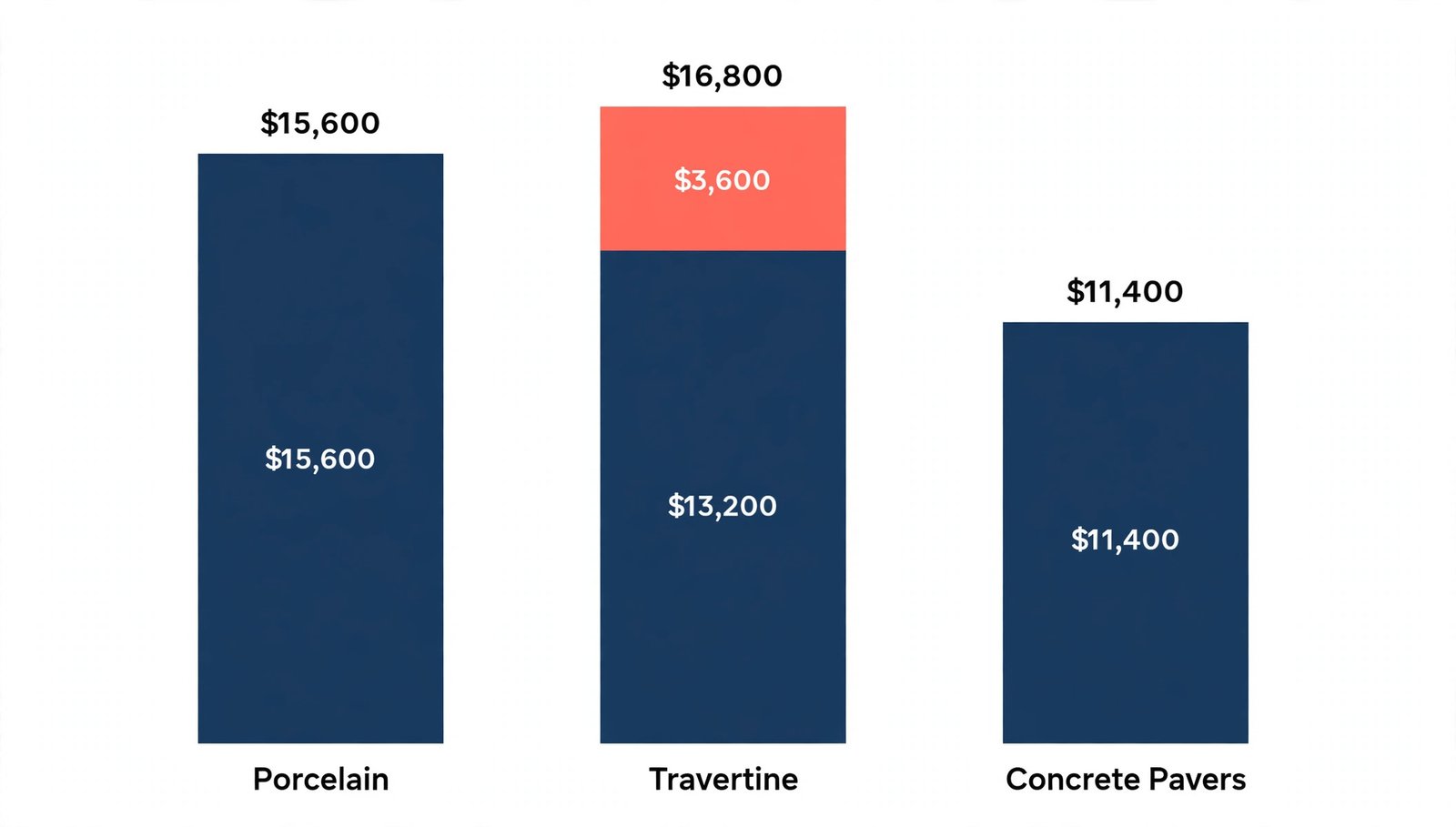
Over 10 years on a 600 sq ft deck, porcelain costs $15,600, travertine costs $16,800, and concrete pavers cost $10,800 at mid-range install prices, so porcelain ends up $1,200 cheaper than travertine and $4,800 dearer than concrete pavers. The flip happens because travertine needs sealing every 2 to 3 years at $1 to $3 per sq ft, which adds $3,600 over a decade, while porcelain needs no sealing at all. Concrete pavers win on 10-year cost and lose on stain resistance and color fade.
| Cost over 10 years, 600 sq ft deck | Porcelain | Travertine | Concrete pavers |
|---|---|---|---|
| Install, mid-range | $15,600 ($26/sq ft) | $13,200 ($22/sq ft) | $10,800 ($18/sq ft) |
| Sealing, 10 years | $0 | $3,600 (3 cycles at $2/sq ft) | $0 (optional sealer not counted) |
| Joint re-sand, 10 years | $0 | $0 | $600 (say 2 re-sands at $300) |
| 10-year total | $15,600 | $16,800 | $11,400 |
| Cost per sq ft per year | $2.60 | $2.80 | $1.90 |
Read the table as a range, not a promise. At the low end of install prices, porcelain totals $12,000 and travertine $7,800 plus $3,600 sealing, or $11,400, so the 2 materials tie. At the high end, porcelain totals $24,000 and travertine $18,000 plus $3,600, or $21,600, so porcelain costs $2,400 more. The sealing math is what most comparisons skip: 3 sealing cycles at $2 per sq ft on 600 sq ft is $1,200 per cycle, and that $3,600 is money you pay a contractor in years 3, 6, and 9, when the deck no longer feels new. Porcelain also holds its color for 50 to 70 years with no fading, while concrete pavers fade and need a color refresh sooner.
The value question is not which material is cheapest. It is what you are buying with the extra $4,200 over concrete pavers: zero sealing, zero staining from sunscreen and leaf tannins, zero freeze-thaw cracking, and a uniform modern look that never fades. If you will live in the house for 10 years or more, porcelain earns its premium against travertine and is a fair trade against concrete pavers. If you plan to sell within 5 years, concrete pavers bank the savings and the buyer never sees the difference. If you are still weighing a wood-look deck against pavers, read composite decking vs pavers before you decide.
3 Installation Methods: Sand-Set, Mortar-Set and Pedestal in 1 Decision Tree

The right install method depends on 3 answers: what sits under the deck, how cold your winters get, and whether you need to reach anything underneath. Sand-set is the default for a ground-level deck on soil. Mortar-set suits a deck over an existing sound concrete slab. Pedestal-set suits roof decks, raised decks, and any deck where pipes or drains must stay reachable. Pick the wrong method and the pavers fail no matter how good they are.
Follow the tree. First, is the deck on the ground with soil underneath? If yes, go sand-set: 4 to 6 in. of compacted aggregate, 1 in. of bedding sand, pavers laid with 1/8 in. joints, polymeric sand swept in. Budget $20 to $32 per sq ft installed. Second, is there a sound concrete slab already in place? If yes, go mortar-set: thin-set the 20mm pavers directly to the slab with a 1/4 in. per foot slope to drains, and cut expansion joints every 8 to 12 ft. Budget $25 to $40 per sq ft. Third, is the deck raised, on a roof, or over pipes you may need to reach? If yes, go pedestal-set: adjustable pedestals every 2 ft. under the paver corners, no mortar, each paver liftable by hand. Budget $28 to $45 per sq ft.
Two details decide whether any method lasts. The slope must fall 1/4 in. per foot away from the pool and the house, because standing water under porcelain breeds algae in the joints and heaves in a freeze. And the edge restraint must be solid: a concrete haunch or aluminum edge restraint pinned every 12 in., because pavers without a locked edge creep outward within 2 seasons and open gaps at the coping line. Ask your installer to name the edge restraint in the quote. If the quote has no edge restraint line, it is not a finished quote.
5 Ways a Porcelain Deck Fails and What Each Repair Costs
Porcelain itself almost never fails. The build around it does, and each failure has a price. Here are the 5 that show up most, with the repair cost for a 600 sq ft deck.
- Settling from a thin or uncompacted base. Pavers sink in patches and trip feet at the joints. Repair means lifting the sunken area, re-compacting, and re-laying: $800 to $2,000 for a 100 sq ft patch.
- Lippage from an uneven setting bed. One paver edge sits 1/8 in. or more above its neighbor and catches bare toes. Repair means re-setting the high pavers with a leveling system: $500 to $1,500.
- Cracked pavers from point impact. A dropped furniture leg or a heavy planter cracks a 20mm paver because porcelain is brittle under a sharp hit. Repair means swapping 1 to 3 pavers at $40 to $120 each plus $200 to $400 labor, if you kept spares from the same dye lot. Without spares, the new pavers may not match.
- Stained or weedy joints from the wrong joint sand. Regular sand washes out and grows weeds; polymeric sand locks in and resists both. Repair means re-sweeping all joints: $300 to $600.
- Water pooling from a flat or reversed slope. Water sits against the coping and the house wall, and in a freeze it heaves the edge course. Repair means re-grading the base under the affected area: $1,500 to $4,000, and it is the only failure on this list that can reach the house foundation if the slope runs toward the house.
Keep 10 to 15 spare pavers from the same dye lot in the garage. That one habit turns failure 3 from a $500 mismatch problem into a 30-minute swap, and dye lots shift enough between batches that a paver bought 2 years later will show.
7 Questions About Porcelain Pavers for Pool Decks
Are porcelain pavers too hot around a pool?
Only in dark colors. Light porcelain runs about 95 to 120 degrees F in peak sun, while dark porcelain passes 140 degrees F. Pick a light or mid-tone paver and test samples barefoot at 2 p.m. before ordering.
Do porcelain pavers need sealing?
No. Porcelain absorbs under 0.5 percent water, so it never needs a sealer. Travertine needs sealing every 2 to 3 years, which is the main maintenance gap between the 2 materials.
Can you lay porcelain pavers on sand?
Yes, sand-set is the standard ground-level method: 4 to 6 in. of compacted aggregate, 1 in. of bedding sand, and polymeric sand in the joints. Mortar-set suits an existing slab, and pedestal-set suits raised decks.
How long do porcelain pool pavers last?
50 to 70 years with no sealing and no fading, based on manufacturer lifespan figures. The base and the joints wear out first, not the paver.
Are porcelain pavers slippery when wet?
Only if you buy the wrong finish. Demand a wet DCOF of 0.60, an R11 or R12 rating, and a DIN 51097 barefoot class of B or C. Smooth polished porcelain with no rating is slick when wet.
What size porcelain paver is best for a pool deck?
24×24 in. is the most common pool deck size and the easiest to repair, at 150 pavers for a 600 sq ft deck. 24×48 in. looks more modern but each paver weighs about 55 lbs and costs more to install.
Is porcelain or travertine better for a pool deck?
Porcelain wins on 10-year cost and maintenance, at $15,600 vs $16,800 for a 600 sq ft deck, and never needs sealing. Travertine wins on barefoot heat in dark tones and on a natural stone look. Pick porcelain for low upkeep and travertine for a classic stone finish.
Editorial Note: This guide was researched and written by our small editorial team under the pen name Dave Hendrick. We are homeowners and researchers, not licensed contractors. Prices are typical national ranges, not quotes — confirm locally before you buy.