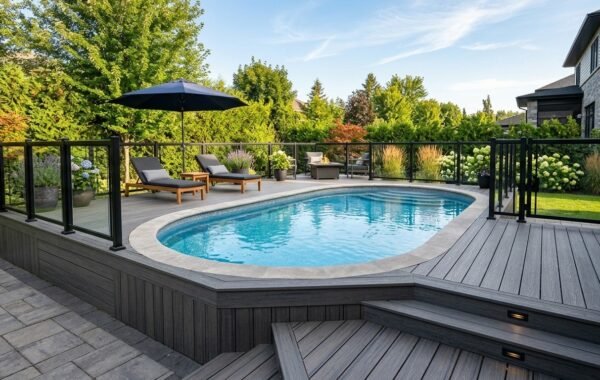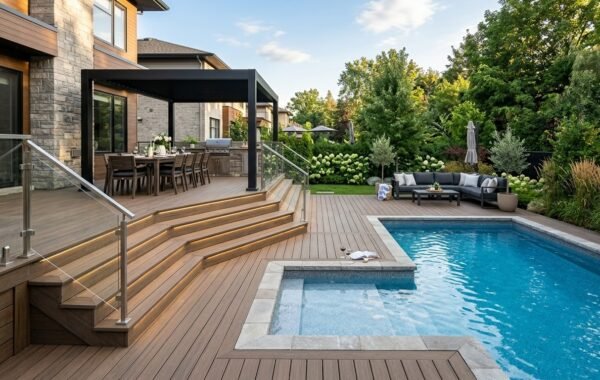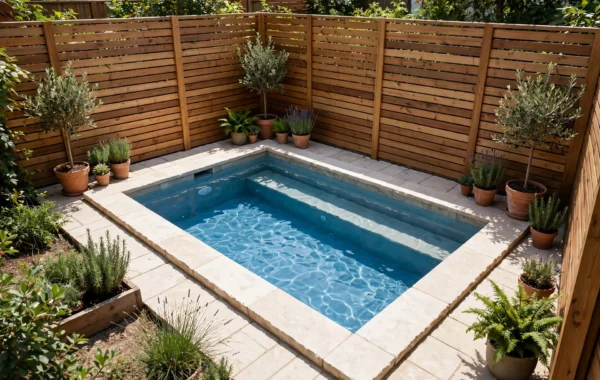

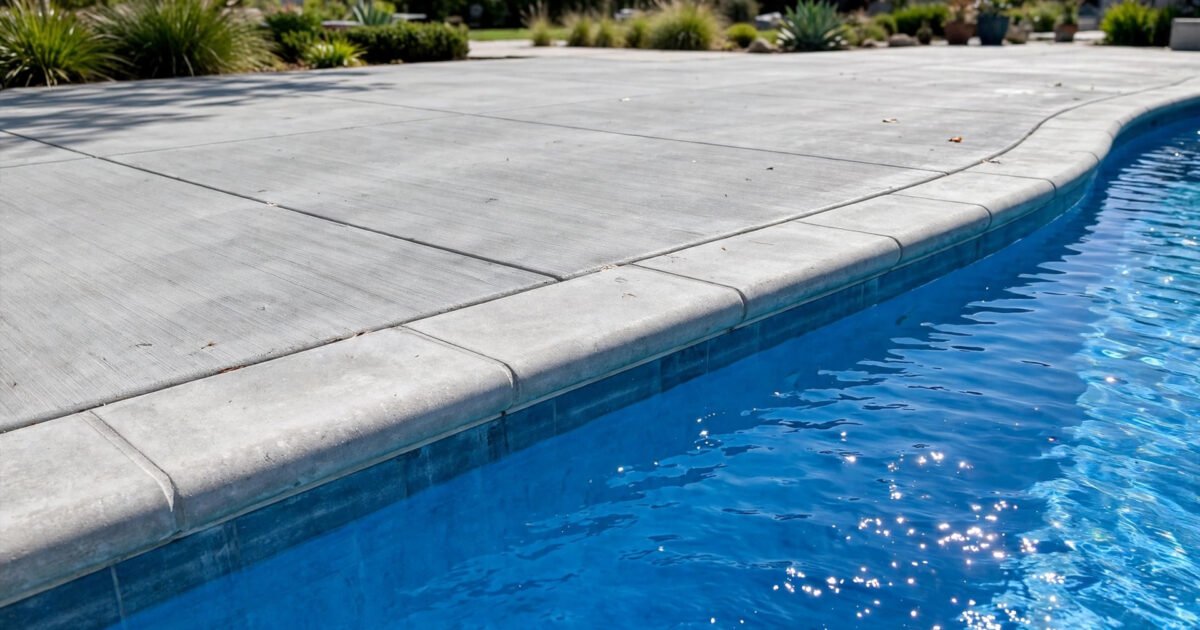
Poured cantilever concrete is the cheapest concrete pool coping over 10 years at $14 to $35 per linear foot. Concrete paver coping costs the most at $48 to $70. The gap is not the material. It is the install price plus one mastic reseal, which every concrete edge needs inside 10 years. This ranking uses installed prices verified in November 2026 and adds exactly one joint reseal at $8 to $20 per linear foot. For the broad styles overview first, read our general coping styles guide — this article covers concrete only, with the numbers.
The 5 Types at a Glance: 10-Year Cost per Linear Foot
| Rank | Type | Install, per lin ft | 10-year cost, per lin ft | 96 ft pool total, 10 years |
|---|---|---|---|---|
| 1 | Poured cantilever, broom finish | $6-$15 | $14-$35 | $1,344-$3,360 |
| 2 | Poured cantilever, stamped or exposed aggregate | $11-$25 | $19-$45 | $1,824-$4,320 |
| 3 | Precast bullnose | $30-$50 | $38-$70 | $3,648-$6,720 |
| 4 | Precast flat / square edge | $30-$50 | $38-$70 | $3,648-$6,720 |
| 5 | Concrete paver coping | $40-$50 | $48-$70 | $4,608-$6,720 |
Install prices: poured cantilever $6-$15 per linear foot ; precast $30-$50 ; concrete paver coping $40-$50. Reseal: 1 reseal in 10 years at $8-$20 per linear foot ; mastic lasts 5 to 10 years. Regional quotes run higher than the national guide figures: cast-in-place coping $25-$45 per linear foot in Austin and concrete coping $35-$55 per linear foot in Phoenix. Get coping as its own line item on every quote. The stamped finish premium in rank 2 is an estimate: $6-$15 base plus $5-$10 per linear foot for the finish step, because no maker publishes a separate stamped-coping price.
The 6 Numbers That Govern a Concrete Pool Edge
Six numbers decide whether a concrete pool edge is safe, legal, and watertight. Overhang: 1 to 2 in past the pool wall for public pools.
That 1 to 2 in figure is not a residential code rule. It comes from public-pool rules and maker install guides, and no residential code sets an overhang number. Your building department has the last word.
Thickness at the overhang: 2.5 in maximum for public pools. Handhold: the top of coping must sit within 12 in above the design waterline on residential pools deeper than 42 in, with handholds no more than 4 ft apart. Slip: coping must be slip resistant, and where tested wet the bar is a DCOF of 0.42 or a P4 pendulum rating. Joint: the isolation joint where coping meets the deck must be watertight, sealed 1/4 to 1/2 in deep with the joint width twice the depth. Slope: the deck pitches away from the pool at a 2% grade, about 1/4 in per foot. Your local code edition and amendments decide what applies to your pool. Our pool deck safety codes guide covers the full code picture.

1. Poured Cantilever Concrete, Broom Finish: $14-$35 per Linear Foot Over 10 Years
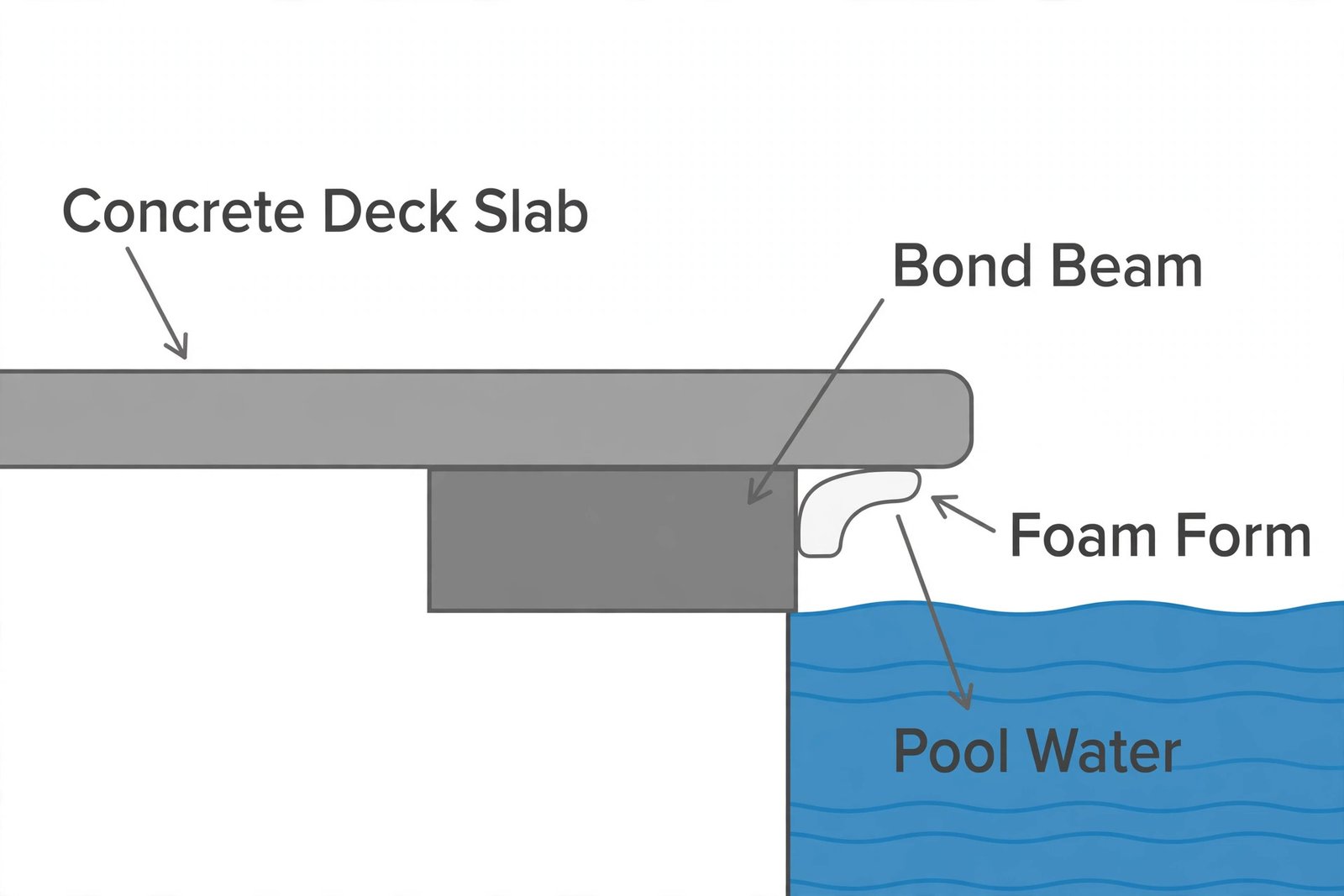
Poured cantilever coping is the deck itself, extended over the pool edge. Installers set disposable foam forms around the top of the pool shell, then pour the deck slab into the form. When the foam is stripped away, the slab ends in a rounded bullnose overhang with no separate units at all. That is why it costs $6-$15 per linear foot installed — one labor pass covers coping and deck together. Best for: rectangular pools on a tight budget, and any pool where you want coping and deck to read as one slab. Typical cost: $576-$1,440 for a 96 ft perimeter, plus one $768-$1,920 reseal inside 10 years. Downside: there is no single unit to replace. If the edge cracks or heaves, repair means saw-cutting the slab. The broom finish is the standard wet-grip texture and the cheapest finish to apply.
2. Poured Cantilever, Stamped or Exposed Aggregate: $19-$45 per Linear Foot Over 10 Years
This is the same poured edge as rank 1, with a decorative finish step. Stamping presses a stone or tile pattern into the fresh concrete. Exposed aggregate washes the surface paste away to show the stone underneath. Both finishes cost more than broom because they add a crew step while the concrete is still workable, and both need the same joint reseal as plain poured coping. Best for: homeowners who want the seamless poured edge but not the plain grey broom look. Typical cost: $11-$25 per linear foot installed ($6-$15 base plus a $5-$10 finish premium — no maker publishes a separate stamped-coping price), or $1,056-$2,400 for a 96 ft perimeter. Downside: a stamped pattern cannot be patched invisibly. A repair in one spot will show against the pattern for the life of the deck.
3. Precast Bullnose Concrete Coping: $38-$70 per Linear Foot Over 10 Years
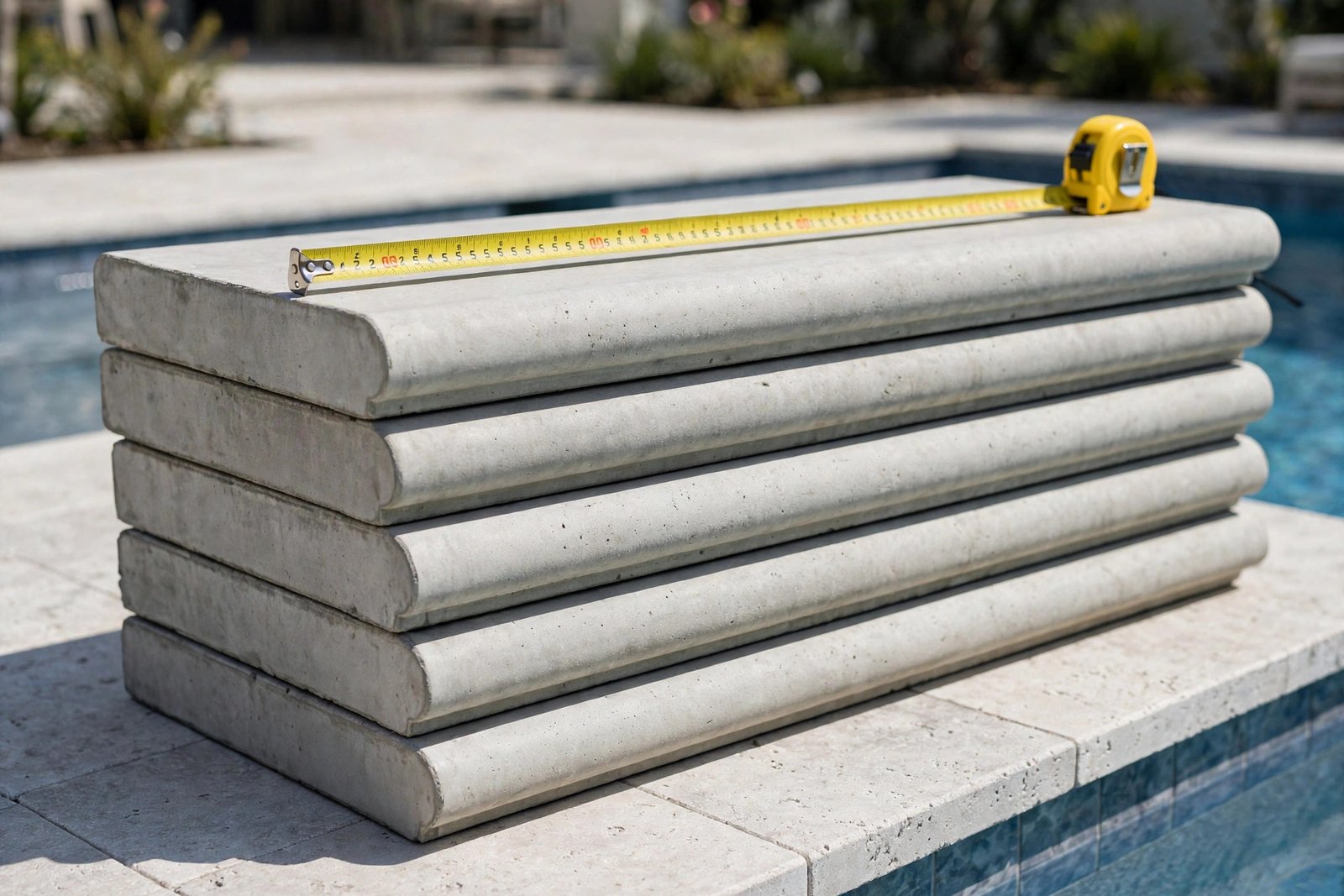
Precast bullnose units are cast in a plant, cured under controlled conditions, and set in a mortar bed on the bond beam. The bullnose is a fully rounded front edge that rolls down toward the water, which is why it is the classic pool edge: comfortable under hands and knees, with no sharp corner to chip. Real units you can buy: Rocky Mountain Concrete bullnose, 10 in wide x 24 in long x 2 in thick, about 40 lb per piece, 35 MPa 28-day design strength, 5-7% air entrainment for freeze-thaw, 39 integral colors. Stepstone Classic is 14 in x 24 in x 2.5 in with a 2 in bullnose, wet-cast from 4,000 psi concrete with absorption held to 6.0% average maximum. Best for: family pools, and any pool where swimmers climb out at the edge. Typical cost: $30-$50 per linear foot installed. Downside: visible joints every 24 in, and each unit needs periodic sealing against salt pitting.
4. Precast Flat Concrete Coping: $38-$70 per Linear Foot Over 10 Years
Flat precast coping is the same plant-cast concrete as rank 3 with a square edge instead of a rounded one. Rocky Mountain Concrete flat coping is 12 in wide x 24 in long x 2 in thick. The square edge reads as modern and crisp, and the same unit doubles as deck banding and bond-beam capping, so the whole pool area can be finished in one material. Best for: geometric pools, modern patios, and edges that double as seat walls. Typical cost: $30-$50 per linear foot installed, identical to bullnose. Downside: the square corner chips more easily than a rounded bullnose, and it gives a smaller grip surface for swimmers climbing out. Ranks 3 and 4 tie on 10-year cost. The choice between them is looks and grip, not money.

5. Concrete Paver Coping: $48-$70 per Linear Foot Over 10 Years
Concrete paver coping uses individual paver units as the edge cap, set like stone but cast from concrete. It costs $40-$50 per linear foot installed. Units run up to 72 in long on straight runs, but makers cap them at 18 in on curves so the edge does not look choppy. Paver coping must meet ASTM C936 at 8,000 psi and pass the C1645 freeze-thaw test, which caps weight loss at 225 g/m2 after 28 cycles. Best for: pools where the deck is already pavers and you want the edge to match the field exactly. Typical cost: $3,840-$4,800 for a 96 ft perimeter, plus the reseal. Downside: the highest install price of any concrete option, and long units need 1/2 in mortar joints or 1/4 in spacing with flexible grout at butt joints.
How These 5 Types Were Ranked: Install Price Plus 1 Reseal in 10 Years
The ranking criterion is 10-year cost per linear foot: install price plus one mastic reseal. Every type gets exactly one reseal because mastic lasts 5 to 10 years, so a 10-year window always includes one. The reseal price is $8-$20 per linear foot. Install prices come from the sources named in the table: River Pools for poured and paver coping, a 2026 US market guide for precast. The only assumed figure is the stamped finish premium in rank 2, labeled as an assumption. Freeze-thaw performance, grip, and repairability did not change the ranking order — they decide ties and exceptions, which the decision tree below covers.
How Much Coping Does Your Pool Need? Piece Counts for 5 Pool Sizes
A rectangular pool needs coping equal to its perimeter: 2 x (length + width). Precast units are 24 in long, so pieces equal perimeter in feet divided by 2. Add 10% for cuts and breakage. Sealant kits are 96 oz DECK-O-SEAL 125 kits covering 106 lin ft at a 1/2 in wide x 1/4 in deep joint.
| Pool size | Perimeter | Precast pieces | Pieces + 10% waste | Total weight at 40 lb each | Sealant kits, 1/2 x 1/4 in joint |
|---|---|---|---|---|---|
| 12 x 24 ft | 72 ft | 36 | 40 | 1,600 lb | 1 |
| 14 x 28 ft | 84 ft | 42 | 47 | 1,880 lb | 1 |
| 16 x 32 ft | 96 ft | 48 | 53 | 2,120 lb | 1 |
| 18 x 36 ft | 108 ft | 54 | 60 | 2,400 lb | 2 |
| 20 x 40 ft | 120 ft | 60 | 66 | 2,640 lb | 2 |
Worked example, start to finish: a 16 x 32 ft pool has a 96 ft perimeter. Precast bullnose at 24 in per unit means 48 units, plus 5 spares at 10% waste, for 53 units total. At about 40 lb per unit, that is 2,120 lb of coping to move and set. You need 1 sealant kit at the standard 1/2 in wide x 1/4 in deep joint, or 2 kits if the joint is 3/4 in wide x 3/8 in deep (51 lin ft per kit). Add a mortar bed for the units, a foam backer rod to set the sealant depth, and penetrating sealer for the precast faces. At $30-$50 per linear foot installed, the precast edge on this pool runs $2,880-$4,800, and the one reseal inside 10 years adds $768-$1,920.
Which Concrete Coping Should You Choose? 3 Questions Decide It
Question 1: is installed price under $15 per linear foot your hard limit? Yes — poured cantilever, broom finish, rank 1 at $6-$15 per linear foot. It is the only concrete coping that fits that budget. No — go to question 2.
Question 2: does your climate freeze? Yes — buy precast with a named freeze-thaw result and skip any unit without one. Rocky Mountain Concrete lists 5-7% air entrainment for freeze-thaw. Stepstone lists ASTM C666. Precast also wins on repair in a freeze climate because you swap one unit instead of saw-cutting a slab. No — go to question 3.
Question 3: is the pool freeform or curved? Yes — poured cantilever follows curves in one pour; precast needs radius cuts at $15-$25 per linear foot in added labor. No — pick on looks and grip: bullnose if kids climb out at the edge, flat if you want the modern square edge and matching deck banding. Both cost the same over 10 years.
The Joint Is Where Coping Fails: 3 Rules and 1 Question to Ask
Most coping does not fail at the stone. It fails at the joint between the coping and the deck. A concrete deck surface swings about 100 degrees between summer heat and winter cold, and a 100 ft run of concrete grows about 3/4 in across that swing. Shorter runs move less, in proportion. The force is high enough to shear coping or the bond beam off the pool if the joint is wrong.
Rule 1: the joint must be a flexible mastic joint that runs the full depth of the deck, not a skim of sealant on top. The gap runs 1/2 to 3/4 in wide. The sealant sits in the top 1/4 to 1/2 in over a foam backer rod, never mortar or grout. Mortar and grout are rigid, so the first deck movement cracks them and water gets behind the bond beam.
Rule 2: no steel runs from the bond beam into the deck. A deck tied to the bond beam drags the coping with it every time it moves. Fiberglass pools are the one exception: the shell maker may require rebar tying the deck to the shell beam, so follow the shell maker guide for that pool type.
Rule 3: a poured cantilever edge needs a bond breaker, a layer of felt or plastic on top of the leveled bond beam, so the deck can slide over the beam instead of gripping it.
Ask your builder one question before work starts: ‘What is between the coping and the deck, and how deep does it go?’ A full-depth flexible joint is the right answer. A quote that does not mention the joint is the one to question. A failed joint costs $8 to $20 per linear foot to reseal. A sheared edge costs $50 to $160 per linear foot to replace.
3 Ways Concrete Pool Coping Fails (and What Each Repair Costs)
Failure 1: the poured edge cracks or heaves. A cantilever edge is one slab with the deck, so a crack in the edge is a crack in the slab. Repair means saw-cutting the perimeter and re-pouring, priced as full replacement at $50-$160 per linear foot installed. A 96 ft pool runs $4,800-$15,360 before the joint reseal. Prevention is the joint: keep the coping-to-deck isolation joint sealed so deck movement does not load the edge. Our guide to fixing cracks in a concrete pool deck covers diagnosis before you cut anything.
Failure 2: precast units come loose or pop. The mortar bed lets go, usually after freeze-thaw cycles or a failed joint lets water behind the units. Resetting loose coping costs $30-$45 per linear foot in Maryland, or $500-$1,500 for a few pieces in Orange County. A few loose units is a repair job. Units loose all the way around means the mortar bed has failed, and that is a replacement job at $50-$160 per linear foot.
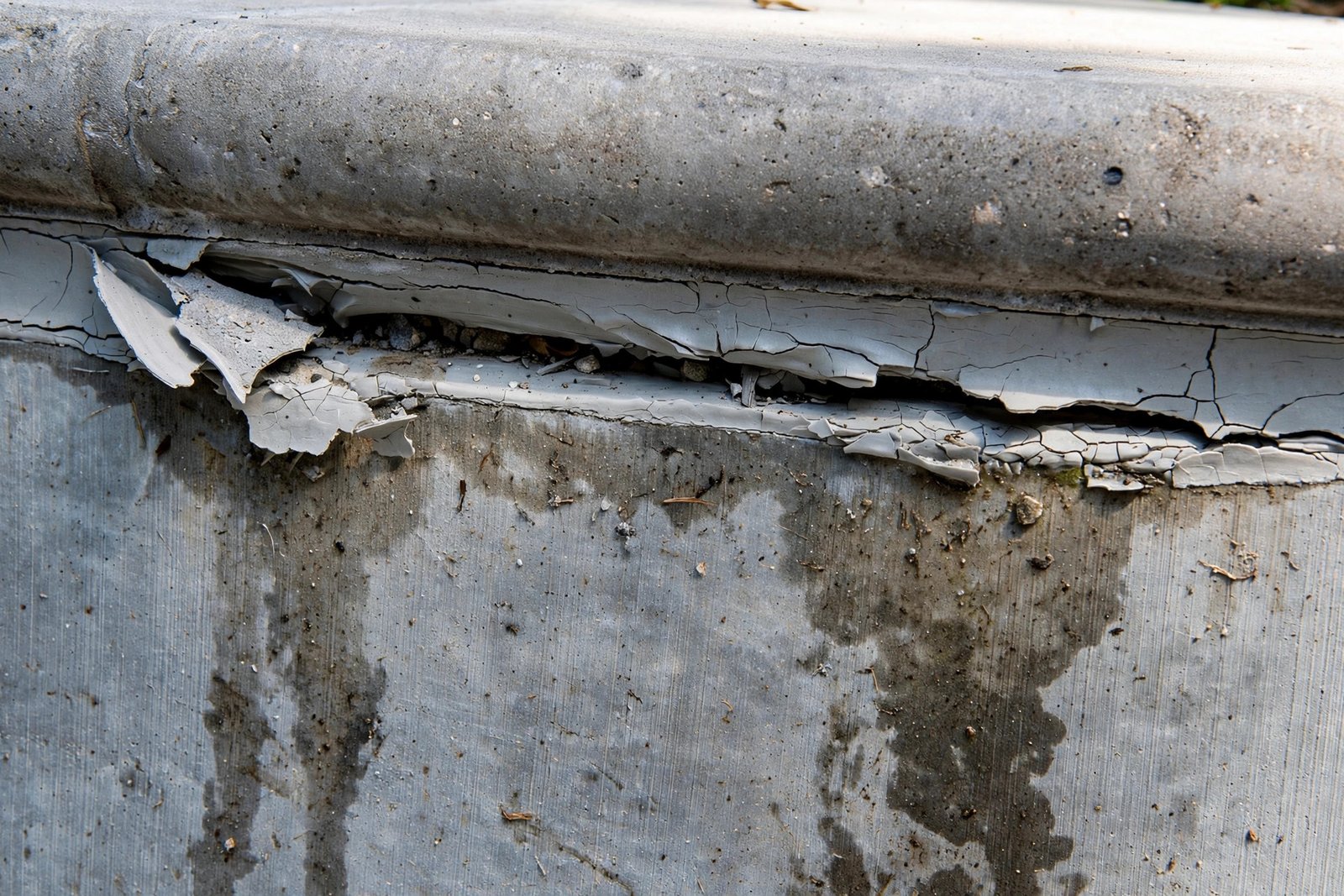
Failure 3: the mastic joint fails. The sealant cracks, gaps, or pulls away from the coping, and water gets behind the bond beam. This is the cheapest failure to fix and the most expensive to ignore. Digging out and replacing the joint costs $8-$20 per linear foot, $9-$11.50 per linear foot in Houston and Pennsylvania, or about $6 per linear foot from a Florida pool service. A 96 ft perimeter reseal runs $768-$1,920 at the Beltway range. Never fill the joint with mortar or grout — it must stay flexible over a foam backer rod. See our guide on how to seal a pool deck for the sealing schedule, and check our pool deck drainage and slope guide if water stands at the edge.
Salt Pools and Stone Coping: 7 Materials Ranked by Water Absorption
This article ranks concrete coping, but the same water test decides stone coping too, and it is the test that decides whether a salt pool eats the edge. Salt damage is mechanical, not chemical. Salty water soaks into the pores of the stone, the water evaporates, and the salt crystals left behind grow until they pop the surface off. The more water a stone can absorb, the faster that happens.
The table below uses the maximum absorption a stone may have and still meet its standard. A given quarry can test much lower, so ask the supplier for the test sheet on the exact stone you buy.
| Material | Max water absorption | What it means at the coping |
|---|---|---|
| Marble | 0.20% | Dense, but etches in acid water and with acid washing |
| Granite | 0.40% | The most water-resistant natural stone here; the safest stone pick for a salt pool |
| Travertine | 2.5% | The popular look; one of the two stones most at risk from salt |
| Limestone, high density | 3.0% | Absorbent; with travertine, the most salt-affected stone group |
| Limestone, medium density | 7.5% | Absorbent; with travertine, the most salt-affected stone group |
| Limestone, low density | 12.0% | Absorbent; with travertine, the most salt-affected stone group |
| Quartzitic sandstone, incl. most US bluestone | 3% | Middle of the pack; freeze-capable when dense |
| Sandstone | 8% | Absorbent; check the freeze rating before it goes near a pool |
| Porcelain, 20 mm | 0.5% or less | Needs no sealing; salt does not get into it. Check the wet slip rating on the exact product |
Four rules follow from the table. First, put the dense materials at the coping, where splash is constant: porcelain, granite, or a dense quartzitic stone. Second, if the stone must be travertine or limestone, pick a dense tested stone and seal it with a salt-rated sealer before it ever sees salt water. Sealers are generally not meant for surfaces already exposed to salt. Third, hold salt at the cell maker level. Running salt high buys no extra chlorine and pushes more salt into the stone. Fourth, read the salt system warranty before you buy the stone. The warranty for a common salt chlorine generator excludes damage to natural stone used in or next to the pool, so the cost of a wrong stone choice sits with the owner, not the cell maker. Ask a qualified stone specialist about type, installation, sealer, and upkeep before the generator goes in.
Where does concrete sit in this table? Precast and poured concrete are made to their own standards, not the stone standards above. The precast units named in this article carry their own absorption figure: one maker holds absorption to 6.0% average maximum. That is higher than granite and porcelain, which is why precast faces need a penetrating sealer and a reseal schedule, the same as stone. For the broad styles overview first, read our general coping styles guide.
Pre-Order Checklist: 9 Measurements to Take Before You Buy
- Pool length __ ft x width __ ft = perimeter __ lin ft
- Pool type: concrete / vinyl / fiberglass (vinyl needs a concrete collar or an aluminum track — see FAQ)
- Overhang target __ in (1-2 in for public pools; residential: confirm with local code)
- Coping thickness __ in (2 in is typical for precast units)
- Precast pieces needed: perimeter / 2 = __ + 10% waste = __
- Sealant kits: __ (1 kit covers 106 lin ft at a 1/2 in wide x 1/4 in deep joint)
- Freeze-thaw rating asked for: yes / no (air entrainment % or ASTM C666 on the data sheet)
- Sealer planned for precast faces: yes / no
- Quote check: coping as its own line item? yes / no — reseal included? yes / no
Frequently Asked Questions
Hover or tap any question below to reveal the answer.
Can you pour concrete coping on a vinyl liner pool?
A vinyl wall cannot carry coping. The Unilock guide calls for a reinforced concrete collar at least 6 x 6 in around the pool, recessed 1/2 in below the wall top and cured 3 days before coping is set. Vinyl pools often use an aluminum coping track instead, which holds the liner bead.
Do you need a permit to replace pool coping?
Replacing coping units alone is usually treated as pool repair, but work on the bond beam, the pool barrier, or the deck structure can trigger a permit and inspection. Ask your local building department before you start and confirm which code edition your city enforces.
Does concrete pool coping get too hot to walk on?
Light integral colors stay cooler under bare feet, and dark colors absorb more heat. Rocky Mountain Concrete casts 39 integral colors, so pick a light one and a textured finish if bare feet matter. A broom or exposed aggregate finish also grips better wet than a smooth troweled face.
Can you replace a single precast coping piece?
Cut out the failed unit and set a new one in mortar without touching the rest of the edge, as long as an expansion joint isolates the coping from the deck. Poured cantilever coping cannot be fixed this way — a cracked section means saw-cutting the slab.
What sealant goes in the joint between coping and deck?
Depth is 1/4 to 1/2 in with the joint width twice the depth. Let new concrete cure 28 days before sealing.
Is poured or precast concrete coping better in a freeze-thaw climate?
Rocky Mountain Concrete lists 5-7% air entrainment. Stepstone lists ASTM C666. Precast wins on repair in cold climates because you swap one unit instead of saw-cutting a slab.
How long does the mastic joint between coping and deck last?
A reseal costs to per linear foot. For a 96 ft perimeter that is 8 to
Can you pour concrete coping on a vinyl liner pool?
No, not directly. A vinyl wall cannot carry coping. The Unilock guide calls for a reinforced concrete collar at least 6 x 6 in around the pool, recessed 1/2 in below the wall top and cured 3 days before coping is set. Vinyl pools often use an aluminum coping track instead, which holds the liner bead.
Do you need a permit to replace pool coping?
It depends on your city and on what changes. Replacing coping units alone is usually treated as pool repair, but work on the bond beam, the pool barrier, or the deck structure can trigger a permit and inspection. Ask your local building department before you start and confirm which code edition your city enforces.
Does concrete pool coping get too hot to walk on?
Color decides it. Light integral colors stay cooler under bare feet, and dark colors absorb more heat. Rocky Mountain Concrete casts 39 integral colors, so pick a light one and a textured finish if bare feet matter. A broom or exposed aggregate finish also grips better wet than a smooth troweled face.
Can you replace a single precast coping piece?
Yes. Cut out the failed unit and set a new one in mortar without touching the rest of the edge, as long as an expansion joint isolates the coping from the deck. Poured cantilever coping cannot be fixed this way — a cracked section means saw-cutting the slab.
What sealant goes in the joint between coping and deck?
A flexible pool sealant such as DECK-O-SEAL 125 over a foam backer rod, never mortar or grout. Depth is 1/4 to 1/2 in with the joint width twice the depth. Let new concrete cure 28 days before sealing.
Is poured or precast concrete coping better in a freeze-thaw climate?
Buy the one with a named freeze-thaw result. Rocky Mountain Concrete lists 5-7% air entrainment. Stepstone lists ASTM C666. Precast wins on repair in cold climates because you swap one unit instead of saw-cutting a slab.
How long does the mastic joint between coping and deck last?
Five to 10 years. A reseal costs $8 to $20 per linear foot. For a 96 ft perimeter that is $768 to $1,920. Reseal when the joint cracks or gaps, even if the coping stones are still tight.