

Deck Lighting Ideas: 10 Ranked by 10-Year Cost
String lights win. They cost $410 over 10 years, the lowest of the 10 ideas below. Solar path lights lose: $1,280 over the same 10 years, because you replace the fixtures 3 times. Every idea below is ranked by its real 10-year cost, not its sticker price. If you want the fixture-by-fixture technical guide first, our swimming pool deck lights guide covers transformers and code in depth.
One number drives the whole ranking. Assume 5 hours a night, 180 nights a year, and 17 cents per kWh. A 3-watt LED fixture then burns 2.7 kWh a year and costs about 46 cents a year to run. Electricity is almost free. Fixture replacement is where the money goes. That is why a $320 set of solar lights ends up costing 3 times more than a $450 set of wired stair lights over 10 years.
10 Deck Lighting Ideas Ranked by 10-Year Cost
The cheapest idea over 10 years is string lights at $410. The most expensive is solar path lights at $1,280. The table below shows the full math for all 10 ideas: materials plus install, yearly electricity, replacements in 10 years, and the 10-year total. The totals leave out the shared transformer, which costs $200 to $500 once for the whole system and is covered in the worked example below.
| Rank | Idea | Typical setup | Materials + install | Electricity per year | Replacements in 10 yrs | 10-year total |
|---|---|---|---|---|---|---|
| 1 | String lights over seating | 2 strings, 50 ft | $120 | $5 | 2 ($240) | $410 |
| 2 | Recessed stair riser lights | 6 fixtures | $450 | $3 | 0 | $480 |
| 3 | Under-rail LED channels | 30 ft | $300 | $6 | 1 ($120) | $480 |
| 4 | Post cap lights | 8 fixtures | $520 | $4 | 0 | $560 |
| 5 | Well lights and uplights | 4 fixtures | $600 | $4 | 0 | $640 |
| 6 | Under-coping LED strips | 40 ft | $460 | $8 | 1 ($160) | $700 |
| 6 | Flush in-deck paver lights | 10 fixtures | $650 | $5 | 0 | $700 |
| 8 | Smart color-changing accents | 6 fixtures + hub | $690 | $6 | 0 | $750 |
| 9 | Bollard lights | 5 fixtures | $1,000 | $5 | 0 | $1,050 |
| 10 | Solar path lights | 8 fixtures | $320 | $0 | 3 ($960) | $1,280 |
1. String lights over seating — $410 over 10 years
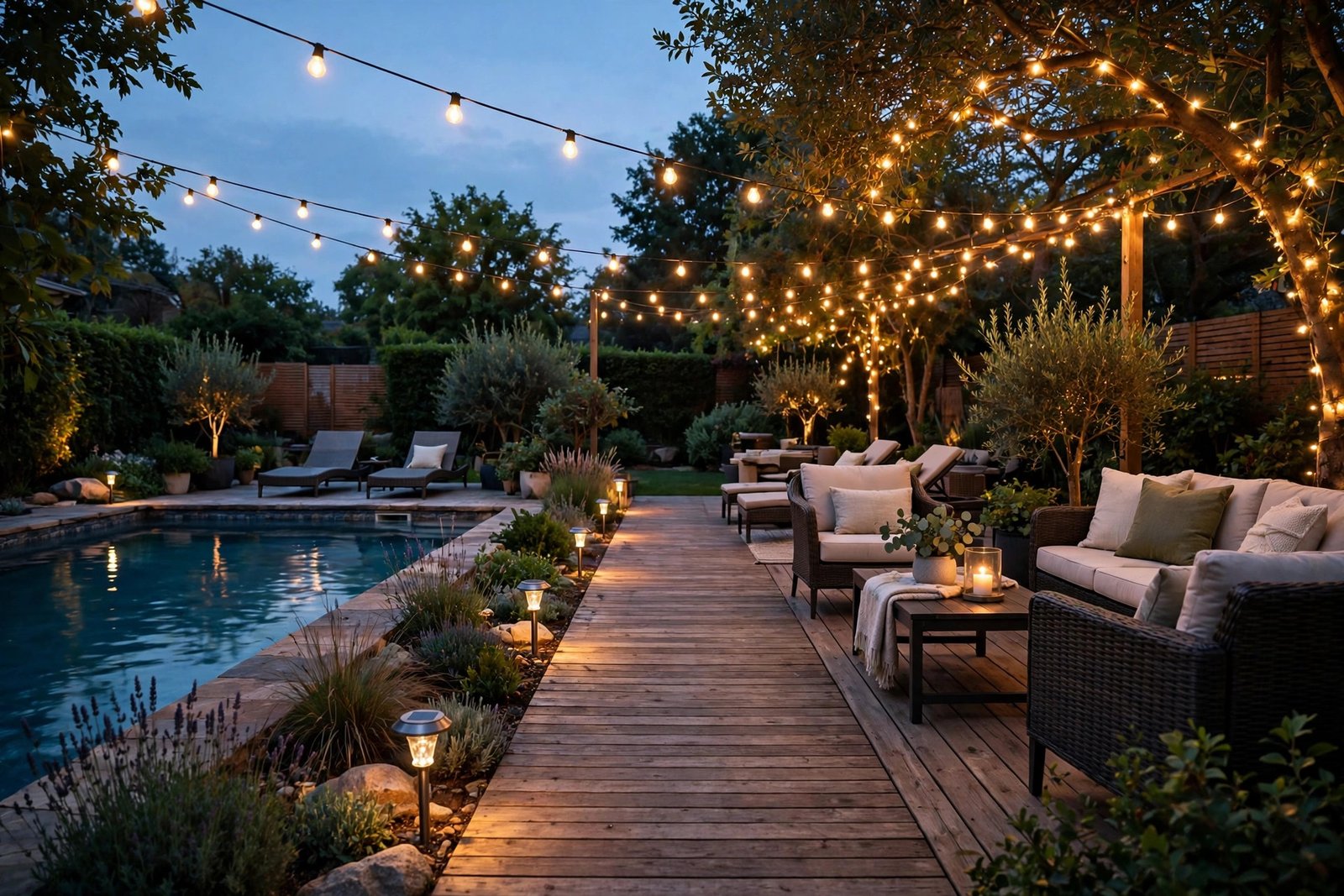
Two 50 ft commercial-grade strings over the seating area, hung 8 to 10 ft high on posts or a pergola beam. Best for: dining and lounge zones where you want warm light with zero wiring. Typical cost: $120 for both strings. Downside: one failed bulb section darkens a whole run, and the strings need replacing twice in 10 years. The stat that earns rank 1: $41 per year all-in, the lowest yearly cost of any idea here.
2. Recessed stair riser lights — $480 over 10 years
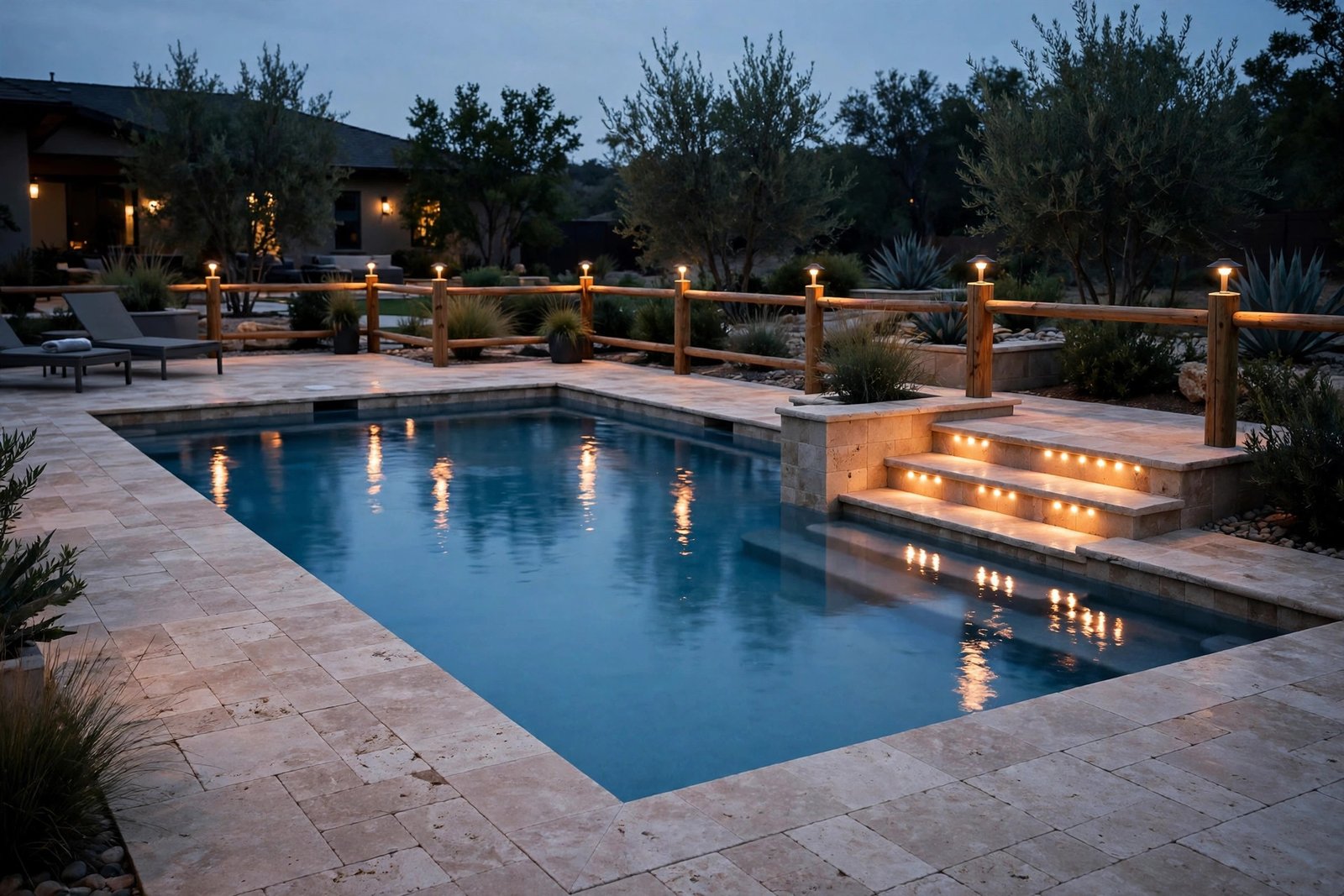
Small LED fixtures set flush into the vertical face of each step riser, casting light down across the tread. Best for: any deck with 3 or more steps, where wet feet and darkness meet. Typical cost: $450 installed for 6 fixtures. Downside: you cut into the risers, so this is a build-time or remodel job, not a Saturday add-on. The stat that earns rank 2: stairs are the highest fall-risk spot on a wet deck at night, and 6 fixtures cover a full 4-step run.
3. Under-rail LED channels — $480 over 10 years
Thin LED channels mounted under the top rail cap, washing light down over the balusters. Best for: defining the deck edge without visible fixtures or glare in swimmers’ eyes. Typical cost: $300 for a 30 ft run. Downside: the strips sit in the splash zone and need replacing once in 10 years. The stat that earns rank 3: $10 per linear foot all-in over 10 years, the cheapest per-foot wired option.
4. Post cap lights — $560 over 10 years
LED caps that replace the flat top of each railing post, throwing a soft pool of light downward. Best for: marking the deck perimeter and gate entries. Typical cost: $520 installed for 8 caps. Downside: caps only light a 3 to 4 ft circle each, so wide decks need 10 or more. The stat that earns rank 4: spaced 4 to 6 ft apart, 8 caps cover a 40 ft railing run with no dark gaps.
5. Well lights and uplights — $640 over 10 years
Flush in-ground fixtures that throw light up into trees, palms, and planting beds around the deck. Best for: making the yard feel bigger at night and lighting the approach path. Typical cost: $600 installed for 4 fixtures. Downside: uplights aimed wrong shine straight into seated guests’ eyes. The stat that earns rank 5: 4 fixtures at 150 to 300 lumens each light a 30 ft planting bed without a single visible fixture body.
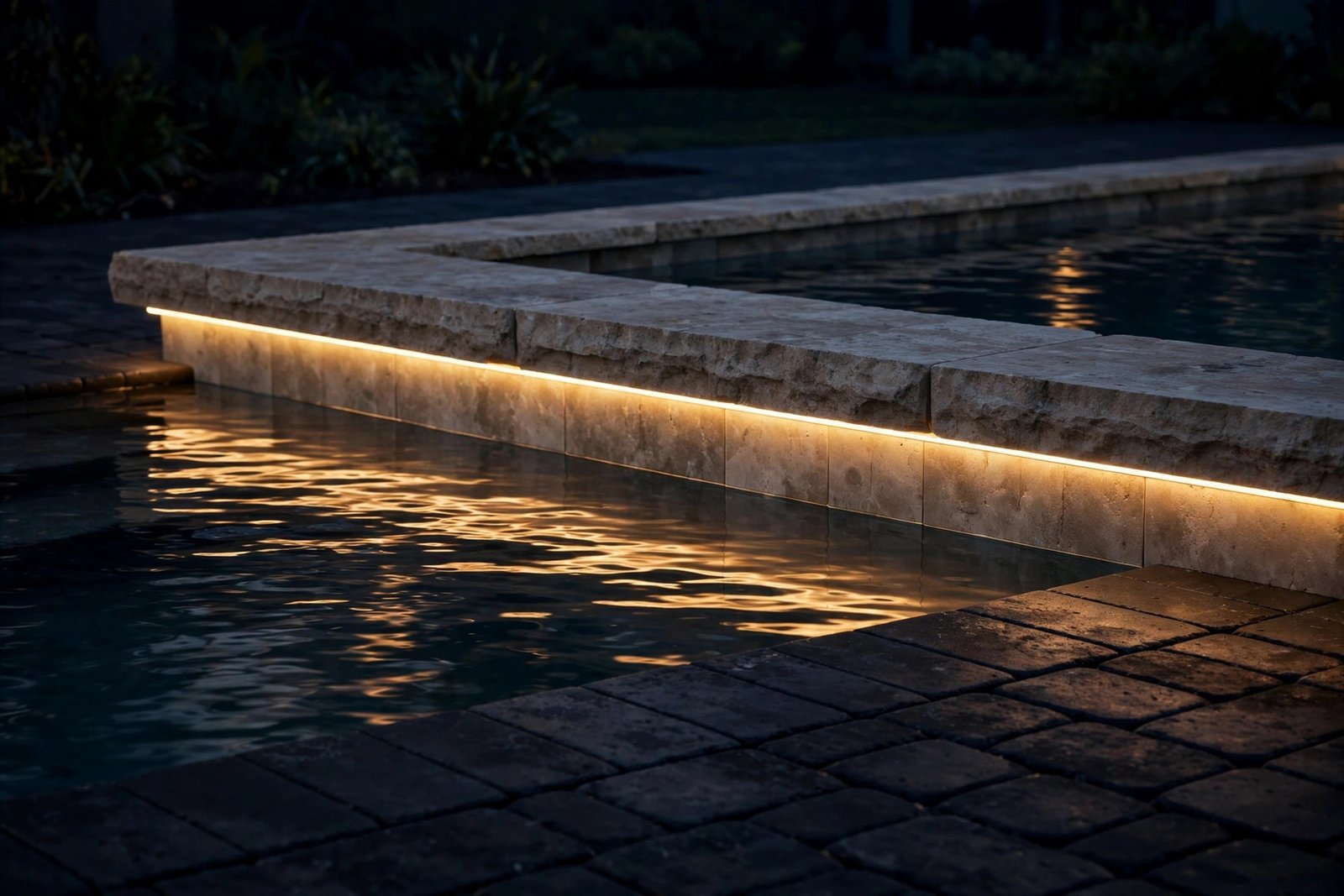
6. Under-coping LED strips — $700 over 10 years
A continuous waterproof strip tucked under the coping overhang, outlining the pool shape in light. Best for: the resort look, and for marking the water edge so nobody steps in by mistake. Typical cost: $460 for a 40 ft run. Downside: the strip lives in constant wave wash, so buy IP68 or plan on replacing it once. The stat that holds rank 6: 180 to 250 lumens per foot, the brightest glow per dollar of any idea here.
7. Flush in-deck paver lights — $700 over 10 years
Round LED markers set flush into decking boards or pavers, marking walkways and borders. Best for: traffic paths between the house, the pool, and the seating area. Typical cost: $650 installed for 10 fixtures. Downside: flush lenses collect dirt and need a wipe every few weeks to stay bright. The stat that holds rank 6: walk-over tempered glass lenses carry foot traffic, so the path stays usable and lit at the same time.
8. Smart color-changing accents — $750 over 10 years
Low-voltage fixtures with a hub and app control: color scenes, timers, and dimming from your phone. Best for: parties and families who use the pool 4 or more nights a week. Typical cost: $690 for 6 fixtures plus the hub. Downside: the hub is a $100 to $150 part that can fail, and app support for cheap brands ends fast. The stat that earns rank 8: one hub runs up to 20 fixtures, so the cost per fixture drops to $35 if you expand the system later.
9. Bollard lights — $1,050 over 10 years
Short posts 18 to 36 in. tall that cast light downward along the main approach path. Best for: a hotel-style entrance path from the house to the pool. Typical cost: $1,000 installed for 5 bollards. Downside: the highest installed cost per fixture of any idea here, and bollards are trip hazards if placed inside the deck traffic lane. The stat that earns rank 9: $200 per fixture installed, double the cost of a post cap light.
10. Solar path lights — $1,280 over 10 years
Stake lights with a small panel on top that charge by day and switch on at dusk. Best for: renters, or a deck where trenching cable is impossible. Typical cost: $320 for 8 fixtures. Downside: the batteries and panels fade in 2 to 3 years, so you buy the set 3 more times in a decade. The stat that puts solar last: $128 per year all-in, 3 times the yearly cost of wired stair lights.
How These 10 Ideas Were Ranked
By 10-year total cost, nothing else. Each total adds materials plus install, 10 years of electricity at 5 hours a night and 180 nights a year, and the replacements the fixture type actually needs in a decade. LED fixtures rated 25,000 to 50,000 hours need zero replacements at 900 hours a year. Solar fixtures rated 2 to 3 years need 3. That single difference flips the ranking: solar looks cheapest on day 1 and costs the most by year 10. If your only goal is the lowest day-1 price, buy solar. If your goal is the lowest cost per night of use over a decade, buy wired LED and pay the transformer cost once.
1 Worked Example: A 300 Sq Ft Deck With 4 Lighting Zones
A 15 by 20 ft deck needs 4 zones and 24 fixtures, and the whole system costs $2,030 installed. Zone 1 is the stairs: 6 riser lights at 3 watts each, 18 watts. Zone 2 is the perimeter: 8 post caps at 3 watts each, 24 watts. Zone 3 is the water edge: 40 ft of under-coping strip at 3 watts per foot, 120 watts. Zone 4 is the rail: 30 ft of under-rail channel at 3 watts per foot, 90 watts. Total draw is 252 watts. Size the transformer at 125 percent of the load, which is 315 watts, so buy a 300-watt transformer. It costs $200 to $500 installed. The fixtures cost $450 plus $520 plus $460 plus $300, which is $1,730. Add a $300 transformer and the system total is $2,030. Running cost is about $38 a year at 17 cents per kWh. If you want the same math for the deck itself first, our pool deck cost guide breaks down the build cost per square foot.
3 Lighting Mistakes That Cost the Most to Fix
The most expensive mistake is line-voltage fixtures near water without GFCI protection. It is a shock risk first and a rewire second: fixing it means pulling the circuit and adding protection, $800 to $2,000, plus the fixture cost again. Class A GFCI devices trip at 6 mA of leakage current, and pool circuits need that level of protection. Use 12-volt low-voltage fixtures near the pool and put the transformer on a GFCI-protected circuit.
The second mistake is buying the wrong waterproof rating for the zone. An IP65 strip under coping sits in wave wash every swim session and fails in one season. Replacing 40 ft of strip plus the labor costs $460, the same as doing it right the first time. Match the rating to the zone: IP68 under coping and in the splash line, IP67 for risers and flush deck lights, IP65 for post caps and rails.
The third mistake is an undersized transformer. A 150-watt transformer on a 200-watt load dims the far fixtures and burns out early. The fix is a new transformer at $200 to $500 plus $100 to $200 of labor. Size it once: add up the watts, multiply by 1.25, and buy the next size up. A 300-watt transformer on a 252-watt load is right. A 150-watt transformer on the same load is a $400 mistake waiting to happen.
Which Idea Should You Pick First? 4 Questions That Decide It
Four questions sort the 10 ideas into a buying order. Question 1: do you have steps that are dark at night? If yes, buy riser lights first. Nothing else prevents falls. Question 2: is your budget under $500? If yes, buy string lights and riser lights and stop. That pair covers seating and stairs for $570 installed. Question 3: do you want the resort look? If yes, add under-coping strips next. They are the single biggest visual change per dollar. Question 4: can you run low-voltage cable? If no, buy solar path lights, but budget $320 every 2 to 3 years for replacements. If yes, skip solar entirely and put the money into wired fixtures that last 25,000 hours. Our pool deck safety codes guide covers the barrier and slip rules that sit next to lighting in any inspection.
Pre-Buy Checklist: 8 Checks Before You Order
Run these 8 checks before you spend anything. They take 20 minutes and catch the 3 mistakes above.
- [ ] Stair count: number of risers that need a light, one fixture per riser or every 3 to 4 ft
- [ ] Railing length in feet: post caps every 4 to 6 ft, so divide the run by 5 to get the count
- [ ] Coping length in feet: measure the water edge you want outlined, then add 10 percent for corners
- [ ] Total watts: add every fixture at its rated watts, then multiply by 1.25 for the transformer size
- [ ] IP rating per zone: IP68 under coping, IP67 for risers and flush lights, IP65 for caps and rails
- [ ] GFCI: transformer plugs into a GFCI-protected outlet, and no line-voltage fixture sits within 10 ft of the water
- [ ] Color temperature: 2700K to 3000K warm white for every fixture, so the zones match
- [ ] Cable run: measure the longest run from transformer to farthest fixture; over 100 ft needs heavier 12-gauge cable
6 Questions About Pool Deck Lighting
How much does pool deck lighting cost?
Low-voltage fixtures run $100 to $150 each installed, and a 10-to-20-light system runs $800 to $6,000 installed. A DIY 12-fixture kit with a transformer costs $200 to $600 in parts. Running cost is $20 to $60 a year in electricity for a typical system.
Is solar or low-voltage lighting better for a pool deck?
Low-voltage wins on 10-year cost and brightness. Solar costs $20 to $60 per fixture with no wiring, but the fixtures last 2 to 3 years. Wired LED fixtures last 25,000 to 50,000 hours, which is 25 years or more at 900 hours a year.
What voltage is safe for lights near a pool?
12-volt low-voltage is the standard near water. The transformer steps household current down to 12 volts, and the transformer itself plugs into a GFCI-protected outlet. Line-voltage fixtures near the pool need GFCI protection and a licensed electrician.
How far apart should post cap lights be?
4 to 6 ft apart along the railing. At 5 ft spacing, 8 caps cover a 40 ft run. Wider spacing leaves dark gaps between the pools of light.
Do LED strips survive chlorine splash?
Only IP68-rated strips with silicone channels survive constant splash. IP65 strips fail in one season under coping. Check the rating on the box before you buy, not after the strip dies.
Do I need an electrician for deck lighting?
Not for a plug-in 12-volt system: the low-voltage side needs no permit in most areas. You need an electrician if the transformer needs a new outdoor outlet, or if any part of the job is line voltage. Confirm the rule with your city before you start.
Running LEDs instead of halogen also cuts the power bill. LEDs use at least 75% less energy and last up to 25 times longer than incandescent bulbs, which is why every wired idea above uses them. If you are still choosing the deck surface the lights will sit in, our composite vs pavers comparison covers heat, slip, and 10-year cost for both.
Editorial Note: This guide was researched and written by our small editorial team under the pen name Dave Hendrick. We are homeowners and researchers, not licensed contractors. Prices are typical national ranges, not quotes — confirm locally before you buy.