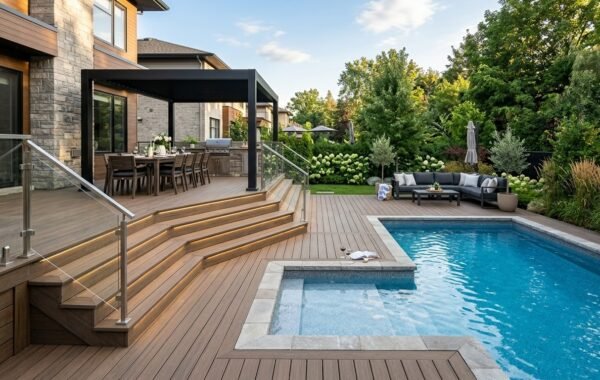

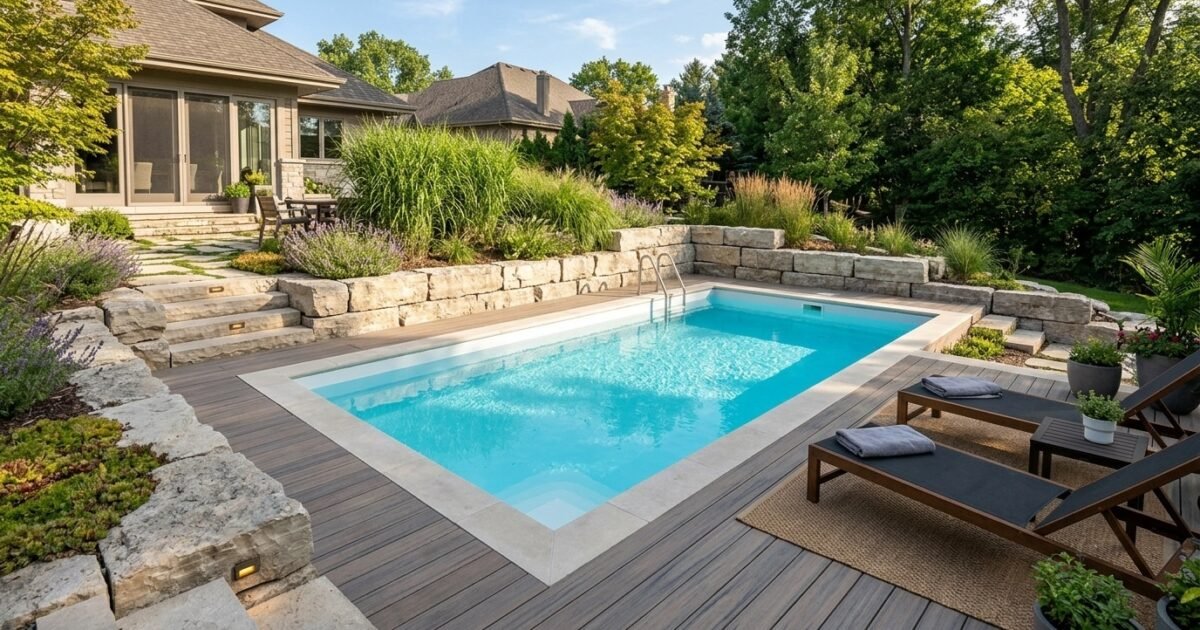
A buried above ground pool gives you a sleek inground look. In fact, it costs a fraction of standard gunite. In fact, sinking an above-ground pool into your yard blends water lines cleanly with nearby patios. Most families spend between $8,000 and $22,000 for a semi-buried setup. In contrast, standard poured concrete inground pools often exceed $65,000.
However, burying an above-ground pool requires specialized site design. Standard pool walls cannot handle inward dirt push without proper gravel backfill. Also, water buildup can rust buried steel walls or float vinyl liners. In addition, local building departments enforce strict drainage and barrier codes, most of them based on the International Swimming Pool and Spa Code. This contractor guide covers tested buried above ground pool designs, retaining wall solutions, gravel backfill rules, and price facts.
Cost Comparison: Buried Above Ground Pool vs Inground Pool
Complete Budget and Site Prep Specs
Planning a buried above ground pool requires understanding where your budget goes. Every buried above ground pool project balances earthwork with equipment costs. Homeowners save significant money on pool shell making compared to gunite. However, you must set aside sufficient funds for digging, drainage gravel, and retaining walls.
Therefore, review the detailed cost comparison in the table below. We compare four distinct swimming pool builds across equipment costs, digging expenses, nearby decks, and lifespan. This data helps you plan an accurate budget for your backyard.
| Pool System Type | Pool Kit & Shell Cost | Excavation & Base Prep | Retaining Wall & Drainage | Surrounding Decking | Total Project Cost | Expected Lifespan |
|---|---|---|---|---|---|---|
| Buried Above Ground Steel Pool | $4,500 to $8,500 | $2,500 to $4,500 | $3,000 to $6,500 | $4,500 to $9,000 | $14,500 to $28,500 | 15 to 22 years |
| Buried Resin Hybrid Pool | $6,200 to $11,000 | $2,500 to $4,500 | $3,500 to $7,000 | $5,000 to $11,000 | $17,200 to $33,500 | 20 to 28 years |
| Traditional Inground Vinyl Liner | $18,000 to $28,000 | $5,500 to $9,000 | $2,000 to $4,500 | $8,000 to $16,000 | $33,500 to $57,500 | 25 to 35 years |
| Poured Concrete Gunite Pool | $45,000 to $85,000 | $7,000 to $14,000 | $4,000 to $9,000 | $12,000 to $28,000 | $68,000 to $136,000 | 50+ years |
Consequently, a semi-buried setup offers a compelling balance of high-end aesthetics and lower upfront investment. Choosing resin hybrid components protects buried pool components from rust. For nearby patio layout inspiration, check out our guide on above ground pool deck ideas.
Related: Pool Coping Ideas: Modern Styles, Pavers & Costs
Engineering Challenges of Burying an Above Ground Pool
Lateral Earth Pressure and Wall Collapse Risks
Understanding side dirt force is critical before placing a buried above ground pool in the ground. Standard above-ground pool walls rely on outward water pressure to maintain their round shape. When full, water pushes outward against pool walls. In fact, thousands of gallons create steady outward pressure.
However, when you dig a deep pit and backfill with native dirt, soil weight pushes inward. Damp native soil weighs between 100 and 125 pounds per cubic foot. If you drain the pool for cleaning, inward dirt push crushes thin walls. In fact, damage happens instantly.
Therefore, you must never backfill right against thin pool metal with digd yard dirt. Instead, builders construct separate retaining walls or backfill with self-supporting clean angular crushed stone. This building rule relieves direct side push from the pool rim.
Soil Types and Hydrostatic Water Pressure
Subsurface soil conditions shape the stability of every buried above ground pool. Expansive clay soils present hazards for buried pools. Specifically, wet clay swells up fast. Wet clay swells significantly during rainy seasons, exerting massive water pressure against buried pool framing.
Furthermore, high water tables can lift empty vinyl pool liners or buckle thin floor tracks. Rainwater quickly saturates clay around your pool. Then, trapped water seeks an exit path. In fact, water pressure can float an entire pool shell right out of the digd trench.
To protect your buried above ground pool from water force, dig a drainage trench 12 inches below the bottom rail. Fill this trench with clean washed stone. In addition, lay perforated drain pipe. As a result, ground water diverts safely away before reaching your pool frame.
Galvanic Corrosion and Wall Rust Prevention
Burying metal walls buried exposes standard steel to rusting soil moisture and minerals. Standard above-ground pool panels feature thin zinc coatings. Makers design these panels for open-air exposure. Damp acidic soil destroys thin zinc coatings. In fact, breakdown happens in three to five years.
Consequently, smart builders take active steps to insulate metal walls against buried rust. First, coat outer steel panels with heavy sealer. A rubberized mastic stops ground moisture. This rubber barrier stops damp dirt moisture from touching bare steel.
Next, install 1.5-inch dense extruded polystyrene foam foam panels against the outer pool wall. Rigid foam panels protect metal coatings from stones. In addition, they insulate warm pool water. Foam panels also keep pool water warmer. As a result, you save money on spring heating.
Critical Drainage and Gravel Backfill Requirements
Clean Washed Crushed Stone Backfill
Proper backfill material makes or breaks a long-lasting buried above ground pool build. Never push original digd dirt back into the trench around your pool walls. Native soil settles unevenly in trenches. Also, it holds water and pushes against pool walls.
Instead, specify 3/4-inch clean washed crushed angular stone conforming to ASTM International standards (such as ASTM #57 stone). Angular crushed stone locks tightly in place. Therefore, you do not need heavy packing tools. Compactors can easily dent or warp thin pool wall panels.
Furthermore, clean crushed stone features an open-graded void ratio of roughly 40 percent. This open structure allows rainwater to fall straight through to bottom collection pipes without generating water pressure. Crushed gravel also eliminates frost heaving against buried pool walls.
Perimeter French Drains and Sump Crocks
A continuous edge drainage loop protects your buried above ground pool from rising ground moisture. Install a 4-inch perforated smooth-interior rigid PVC drain pipe along the outer base of the gravel backfill trench. Wrap the pipe in filter fabric. This fabric stops fine silt from clogging drainage pipes.
Slope the drainage pipe at a minimum gradient of 1/8 inch per linear foot toward a low drain spot. In sloping yards, run the pipe out to open lawn. Gravity lets water flow out freely. In flat yards, route the pipe into an outer sump pit. An automatic pump removes water fast.
Set the sump pump float switch 6 inches below the bottom pool track elevation. The sump pump ejects water to storm basins. Consequently, groundwater never touches the pool base. In addition, install a vertical inspection standpipe to check water levels easily.
Surface Water Swales and Deck Drainage Slopes
Managing yard surface runoff prevents muddy rainwater from flooding into your buried above ground pool. Never allow uphill lawn water to drain right across pool coping stones. Heavy downpours wash yard dirt into pools. In addition, fertilizer runoff feeds green algae.
Grade the nearby landscape into gentle grass swales pitched around the pool digging zone. In addition, pitch all adjoining pool deck surfaces at 1/4 inch per linear foot away from the water edge. For detailed deck framing calculations, review our complete guide on how to build a pool deck.
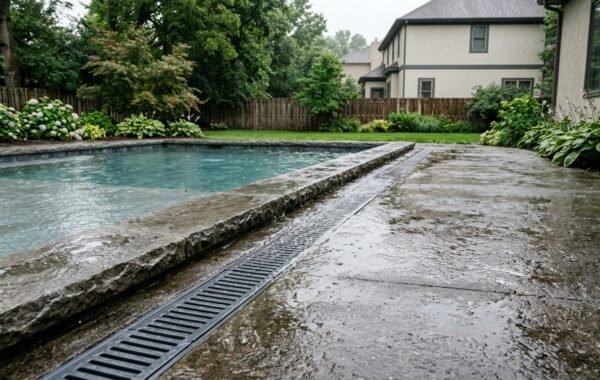
Install slim trench drains along retaining walls. These channel drains collect rain runoff fast. Route drain runoff into solid PVC pipes. Keep this line separate from your pool ground pipes. Keeping surface runoff isolated protects buried gravel beds from sediment clogging.
Retaining Wall Solutions for Semi-Buried and Fully Buried Pools
Segmental Concrete Retaining Blocks
Segmental concrete blocks offer the most dependable solid wall defense for a buried above ground pool. Interlocking concrete blocks (such as Allan Block or Belgard systems) hold back tons of side dirt pressure easily. These heavy masonry units feature built-in alignment lips for fast, accurate stacking.
When installing blocks along sloping yards, dig a level base trench 6 inches deep into solid subsoil. Fill the trench with packed crushed dense-grade aggregate base. Lay the first course of blocks level around your buried above ground pool. Any minor tilt magnifies across upper wall courses.
In addition, install biaxial geogrid support mesh between block layers exceeding 3 feet in height. Geogrid locks blocks into hillside soil. Consequently, it creates a reinforced earth structure. Leave a clean 18-inch gravel gap between the block wall back and the pool frame.
Poured Concrete and Masonry Foundation Walls
For custom high-end backyards, poured-in-place concrete walls provide permanent solid retaining strength around a buried above ground pool. Builders form an separate circular or oval concrete wall footprint 2 feet wider than the pool frame. Concrete mixes rated at 4,000 PSI resist frost heave and water penetration.
Reinforce poured walls with #4 steel rebar placed on 12-inch horizontal and vertical centers. Alternatively, lay concrete masonry unit (CMU) cinder blocks core-filled with solid pea gravel grout. Waterproof the outer wall face with a liquid-applied elastomeric rubber membrane.
This concrete vault approach fully isolates the pool shell from nearby earth pressure. If you ever need to replace the pool shell in 20 years, the concrete vault remains intact. You simply drop a new pool kit into the existing reinforced masonry chamber.
Pressure-Treated Timber Retaining Systems
Pressure-treated wood timbers offer an economical, rustic retaining solution for a semi-buried above ground pool. Use 6×6 timbers treated to AWPA UC4B standards for heavy solid ground contact. Never use cheap landscaping ties treated for light surface applications.
Secure timber courses together using 1/2-inch by 10-inch hot-dipped galvanized timber spikes or solid LedgerLOK screws. In addition, install crosswise tieback timbers (known as deadmen) extending 4 feet back into the hillside soil. Deadman timbers anchor wood walls against sliding soil forces.
Line the back of the timber wall with weed fabric around the buried above ground pool. Then backfill with clean stone. Provide 2-inch PVC weep holes through the bottom timber course every 6 feet. Weep holes relieve trapped ground moisture behind the wood face.
Decking Integration and Coping Transitions
Cantilevered Wood and Composite Deck Overhangs
Proper decking transitions transform a buried above ground pool into a seamless architectural feature. Builders overhang deck boards 1 to 1.5 inches over the top pool rail. This slight overhang hides the bulky steel pool rim, mimicking true inground pool coping.
However, you must never fasten deck joists right to the above-ground pool frame. Pool walls flex slightly as water surges from swimmers splashing. Fastening deck boards to the pool rim causes fasteners to pull out or buckles top pool plates.
Instead, build a fully freestanding deck frame supported by separate concrete piers. Place support posts within 12 inches of the pool wall rim. Cantilever your deck joists over the posts toward the water line. For step-by-step layout blueprints, check our above ground pool deck plans.
Stone and Paver Coping Interfaces
Pairing natural stone coping with a buried above ground pool produces a stunning high-end custom look. Homeowners love natural travertine or bullnose concrete pavers set flush with nearby patio walkways. Achieving this requires building a reinforced concrete bond collar around the pool rim.
Pour an 8-inch wide by 6-inch deep concrete collar right behind the top pool rim, supported by gravel backfill. Embed galvanized wire mesh or #3 rebar inside the concrete collar to prevent cracking. Adhere bullnose travertine pavers to the concrete collar using polymer-modified outdoor thinset mortar.
Keep a 3/8-inch flexible expansion joint along coping pavers. This joint isolates adjacent patio slabs. Fill this joint with closed-cell foam backer rod and seal with tough polyurethane sealant (such as Sikaflex 1a). Flexible joints prevent shifting patio pavers from exerting pressure on pool coping stones.
Equipment Access Panels and Winter Cover Track Integration
Maintaining access to plumbing connections is essential when designing a buried above ground pool deck. The pool skimmer, return jets, and bottom drains sit below nearby deck boards. If a pipe fitting leaks, you must have immediate access without tearing up expensive deck boards.
Build a hinged trap door above the skimmer on your buried above ground pool deck. This hatch gives fast access to equipment valves. Frame the access hatch with pressure-treated 2×4 lumber and matching surface boards. Ensure the hatch provides clear clearance to empty the skimmer basket and inspect vacuum hoses.
Furthermore, integrate a flush rim track for your winter pool safety cover. Recessed aluminum cover channels mount right into deck framing. This clean track system keeps winter covers tight across the water without requiring unsightly rim water bags.
Step-by-Step Installation Process for a Buried Above Ground Pool
Site Survey, Utility Markings, and Excavation
Building a buried above ground pool starts with thorough site planning and precise digging. First, mark your proposed pool boundary using spray paint and wooden offset stakes. Call 811 several days before digging to locate buried utility pipes and power cables.
Next, determine your pool burial depth based on yard slope and deck plans. Most families bury pools between 24 and 48 inches deep. Over-dig the pit rim by 24 to 36 inches beyond the pool footprint. This wide edge trench provides necessary working room for wall assembly and gravel drainage.
Use a laser level to establish a perfectly flat digging floor. Above-ground pool walls cannot tolerate elevation differences exceeding 1/2 inch across the entire diameter. An unlevel base creates uneven water pressure that can collapse the pool frame.
Pouring the Concrete Base Pad or Compacted Sand Bed
A stable base slab ensures that your buried above ground pool stays level for decades. For maximum durability, pour a 4-inch steel-reinforced concrete base slab across the digging footprint. A poured concrete slab provides a flat, puncture-proof floor that never shifts or develops foot indentations.
Alternatively, prepare a 3-inch bed of washed concrete sand packed with a plate vibrator. Level the sand bed carefully across the entire diameter using screed boards and optical levels. Underneath bottom track vertical uprights, embed 12×12 concrete patio patio pavers flush with the sand base.
These concrete patio blocks support upright support posts, stopping vertical settling into soft soil. Along the inside base, shape a 6-inch cove using sand. In addition, you can install preformed foam pool coves. Foam coves prevent the vinyl liner from slipping under the bottom bottom rail.
Assembling Walls, Bottom Track, and Vinyl Liner
Once your base pad cures, start assembling the solid pool framework. Lay out curved bottom track segments, clicking them into track connector plates over your sunken concrete support blocks. Measure diagonal check lines across oval or round track layouts to guarantee true square alignment.
Next, unroll the corrugated steel wall panel into the bottom track channel. Have several helpers support the wall as you guide the metal edge into the bottom track. Join the wall ends together using the factory-supplied high-strength bolt hardware, torquing every bolt to exact factory specs.
Cover bolt heads inside the pool with duct tape. This heavy tape protects the vinyl liner from cuts. Spread a tough geotextile liner pad across the sand floor, then drop in your virgin vinyl pool liner. Use a tough vacuum blower inserted behind the liner to pull wrinkles tight before adding water.
Installing Exterior Protective Wrap and Gravel Infill
Protecting the outer pool wall before backfilling ensures long-term solid success. Wrap the outer pool wall with 1.5-inch rigid polystyrene foam foam boards or heavy 20-mil polyethylene plastic sheeting. Tape all panel seams securely with weatherproof builder tape.
Next, begin filling the pool with fresh water from a water tanker or garden hoses. As water depth rises to 12 inches inside the pool, begin shoveling 3/4-inch washed crushed stone into the outer trench. Always keep the internal water level 12 inches higher than the outer gravel backfill level.
This balanced filling method equalizes internal and outer forces during the backfilling process. Continue adding water and gravel in balanced 12-inch lifts until you reach your final finished grade. For nearby hardscape options, explore our guide on inground pool with deck surfaces.
Maintenance, Winterizing, and Liner Replacement
Never Drain a Buried Above Ground Pool Completely
Draining water out of a buried above ground pool requires extreme caution. Standard inground pools feature thick reinforced concrete walls that withstand empty ground pressure. In contrast, thin buried above-ground pool walls rely on water weight to hold their shape.
If you drain all water out of a buried pool, nearby soil and gravel backfill exert inward pressure. Without counteracting internal water force, pool walls can buckle or collapse inward. In addition, empty vinyl liners shrink under direct summer sunlight, tearing along seams when refilled.
If you must replace a damaged liner, drain the pool only on a clear, dry day. Remove the old liner, install the new liner, and begin refilling with fresh water immediately. Never leave an empty buried pool sitting overnight in rainy weather.
Winter Closing and Ice Expansion Air Pillows
Winterizing a buried above ground pool in cold climates protects plumbing pipes and vinyl liners from freezing ice damage. Lower water in your buried above ground pool 4 to 6 inches below the skimmer mouth. Then blow out all buried lines. Blow out all buried water return lines using an industrial air compressor, then plug fittings with rubber freeze plugs.
Add specialized winter pool closing chemicals, including non-chlorine winter algaecides and mineral sequestering agents. Float heavy vinyl air pillows in the middle of the pool. Do this before securing your winter safety cover. Air pillows absorb ice expansion pressure as surface water freezes solid.
Without air pillows, expanding ice sheets push outward against buried pool walls, popping wall seams and damaging coping brackets. Secure your winter safety cover using heavy-duty straps anchored right into nearby deck framing.
Liner Replacement Protocols with Surrounding Decks
Replacing a vinyl liner on a buried above ground pool surrounded by decking requires smart planning. On standard above-ground pools, workers unclamp top rails to hang overlap liners. However, when overhanging deck boards cover top rails, accessing the rim becomes difficult.
To avoid removing deck boards during liner swaps, install a beaded liner conversion track during initial pool building. Beaded track channels attach permanently to the upper pool wall face just below the top rail. Beaded liners feature a thick vinyl lip that snaps right into the front-facing track slot.
When the liner wears out, peel the bead from the track. You do this easily from inside the pool basin. Snap the new liner into place on your buried above ground pool. You finish the job without touching deck boards or coping stones. This simple upgrade saves hundreds of dollars in carpentry labor down the road.
Frequently Asked Questions
Hover or tap any question below to reveal the answer.
Common Questions and Contractor Answers
Here are straightforward answers right from our swimming pool building crew.