
META DESCRIPTION: Cable deck railing costs $150 to $285 per linear foot installed. 316 stainless only, 3 in. cable spacing, and a 36 in. guard is not a 48 in. pool barrier.
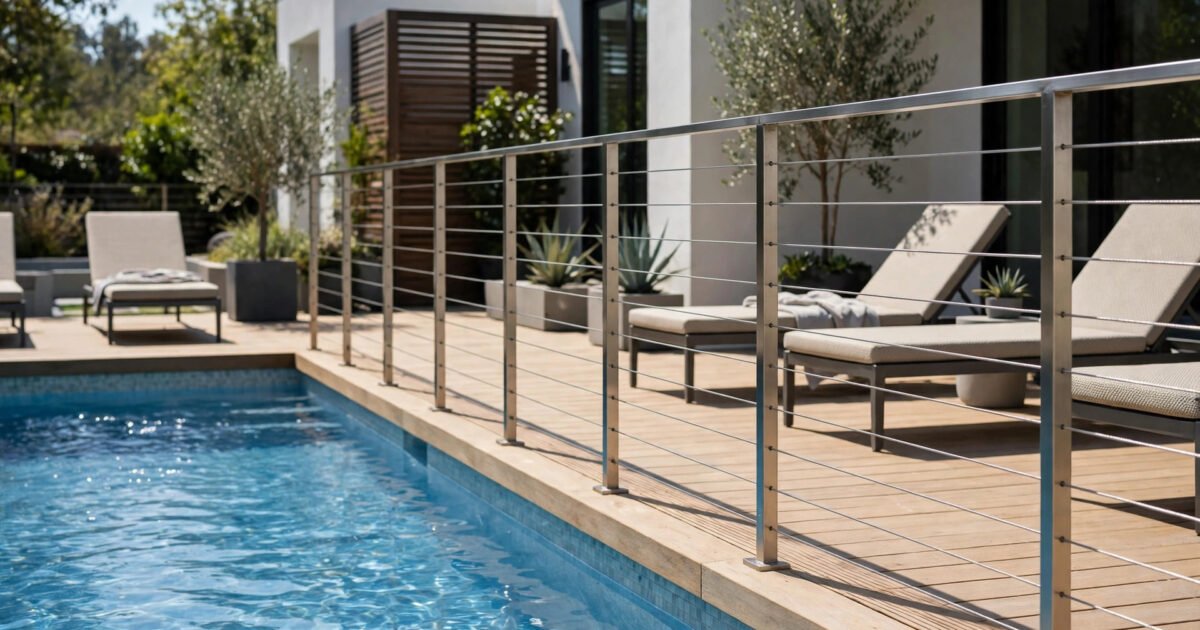
Cable railing wins on the view and loses on climbability, and at a pool the only grade to buy is 316 stainless. A 60 linear ft pool deck perimeter runs $9,000 to $17,100 installed. Here is the side-by-side against glass and aluminum pickets, the code numbers your inspector will check, and what 10 years of chlorine does to each choice. If you want the full field of railing options first, our pool deck railing ideas guide compares all five systems.
Cable vs Glass vs Aluminum: 5 Pool Deck Railings Compared
A pool deck railing has three jobs: keep people from falling off the deck, keep children out of the pool, and survive chlorinated splash water every day. No one system wins all three, so the table below scores the five systems our railing guide covers.
| System | Installed cost per linear foot | View | Climbable? | Chlorine resistance |
|---|---|---|---|---|
| Cable, 316 stainless | $150 to $285 | Excellent, open sightlines | Yes, horizontal runs | Maximum, resists pitting |
| Frameless glass panels | $140 to $240 | Flawless, fully transparent | No, solid barrier | High, needs squeegee care |
| Aluminum pickets | $60 to $95 | Moderate, vertical bars | No, vertical bars | High, powder-coat finish |
| Composite + aluminum pickets | $75 to $120 | Moderate, wide top rail | No, vertical pickets | High, impervious to rot |
| Wrought iron / steel | $90 to $160 | Good, slender bars | No, vertical bars | Moderate, rusts if paint scratches |
The cost column mixes two sources on purpose. The $150 to $285 range is the 2026 national pro-installed range for a stainless cable system, posts, top rail, cable and tensioning labor included. Our own railing guide lists a 316 marine cable system at $85 to $145 per linear foot, which is the basic-kit end: aluminum posts and a simpler top rail. Where you land depends on the posts, the top rail and who does the tensioning.
Cable is the only system with a climbability problem. Horizontal cables give a child footholds, and some inspectors and towns treat that as a failed pool barrier even when the guard itself passes the sphere test. Glass is the safest barrier against climbing toddlers because it has no footholds at all, which is why our glass pool fence guide recommends it where child safety leads. Aluminum pickets and wrought iron are vertical, so they read as non-climbable everywhere. Pool handrails follow the same vertical-bar logic at the steps.
What Cable Railing Costs on a Pool Deck: $150 to $285 per Linear Foot
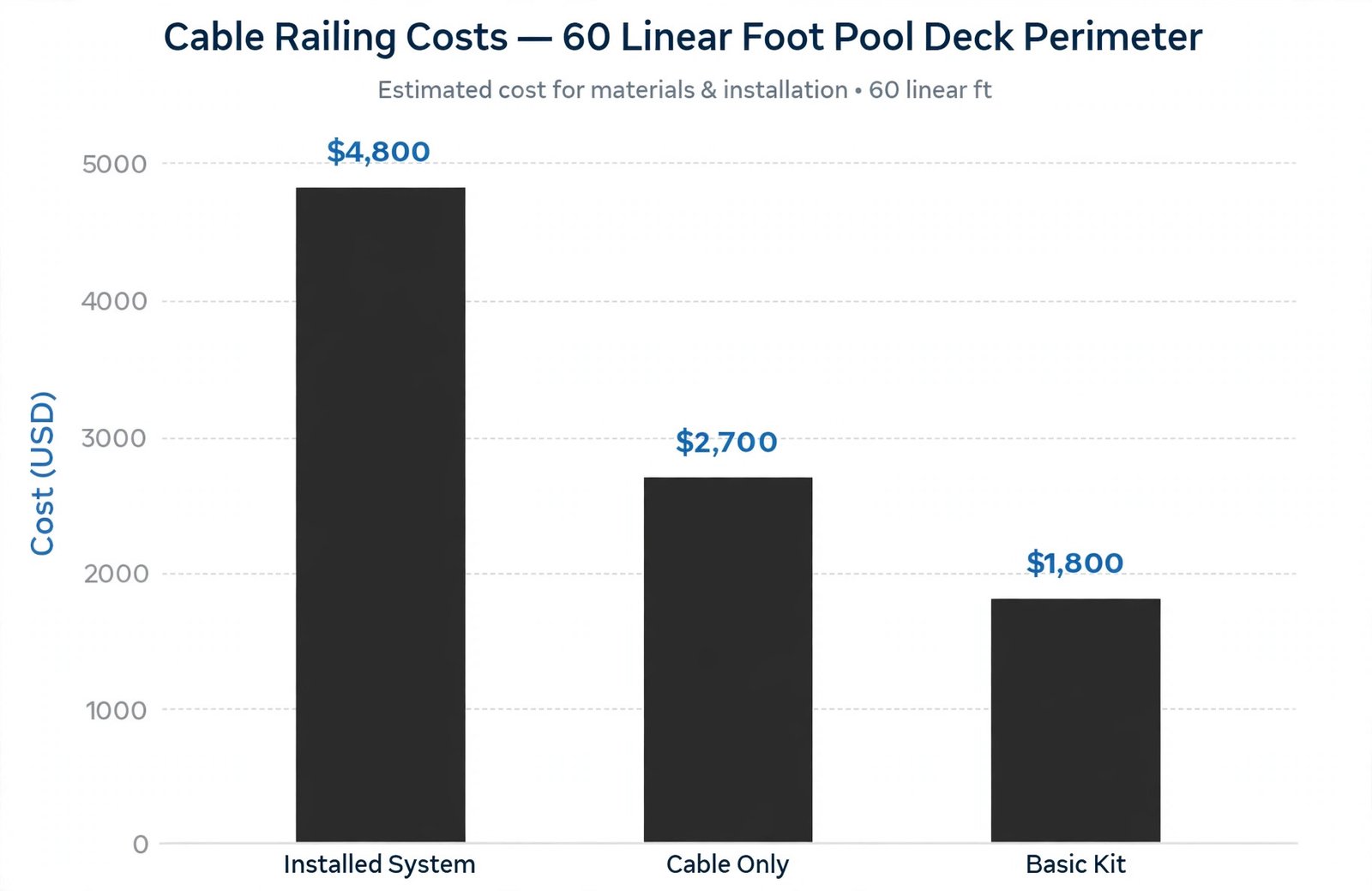
A stainless cable system costs $150 to $285 per linear foot installed in 2026, covering posts, top rail, cable, hardware and labor. The cable itself is the cheap part: $0.50 to $1.70 per foot. Posts, tensioners and labor make up most of the price, and the tensioning labor is the part people forget to budget.
For a 60 linear ft pool deck perimeter, the worked example below, the installed total is $9,000 to $17,100. A national average from Angi puts a 50 linear ft run at $9,000, with most homeowners paying $3,750 to $13,000. That average sits at the low end of the $150 to $285 range because it mixes kit installs with full pro installs.
| Cost item, 60 linear ft perimeter | Low | High |
|---|---|---|
| Installed system, $150 to $285 per linear foot | $9,000 | $17,100 |
| Cable only: 11 cables x 60 ft = 660 ft at $0.50 to $1.70 per ft | $330 | $1,122 |
| 316 premium on cable and hardware, +10 to 25 percent | +$33 to +$281 on cable alone | |
| Basic kit end (aluminum posts, our railing guide $85 to $145 per linear foot) | $5,100 | $8,700 |
Three things move the number. First, posts: stainless or powder-coated steel posts cost more than aluminum and carry more load. Second, the top rail: a stainless top rail runs about $20 per linear foot, while aluminum or wood rails run $30 to $60 per foot. Third, stairs and angles: every stair run and corner adds fittings and tensioning time, so a straight run costs less per foot than a run with deck stair railing turns. Get the quote broken down by posts, cable, top rail and labor before you compare two installers, or you will compare two different systems.
304 vs 316 Stainless: The Chlorine Test
The grade decides whether your cables still look new in ten years or show rust stains in two. Grade 304 is the standard for most homes: it handles rain, snow and normal humidity without rusting, and it costs less than the marine grade. Grade 316 adds 2 to 3 percent molybdenum, and that one element resists pitting corrosion from salt and chlorides.
A pool deck is a chloride environment even if it is nowhere near the sea. Chlorinated splash water mists the cables every day, and a saltwater chlorine generator adds salt to the same mist. Our railing guide is blunt about it: standard 304 stainless develops tea staining when exposed to chlorine mist and salt systems. At a pool, 316 is not an upgrade; it is the correct grade.
The premium is 10 to 25 percent on the cable and hardware, which on a 60 linear ft perimeter adds roughly $36 to $306 to the cable alone and a few hundred dollars to the full system. Both grades meet the same structural load ratings, so 316 buys corrosion resistance, not strength. Pick 316 if the deck surrounds a chlorinated or saltwater pool, if you live within a few miles of salt water, or if road salt sprays onto the deck in winter. Pick 304 only for a normal inland deck with no pool, and spend the savings on better posts. Never use galvanized carbon steel cable outside: it costs $0.35 to $0.45 per foot but rusts, stains the deck, and needs replacing far sooner than stainless.
Cable size is the second choice. Choose 1/8 in. or 3/16 in. cable; the 3/16 in. size is the most popular because it holds tension better, while 1/8 in. looks lighter but needs more tensioning. Either size works in 316.
Cable Spacing and Code: 3 Inches, 36 Inches and 48 Inches
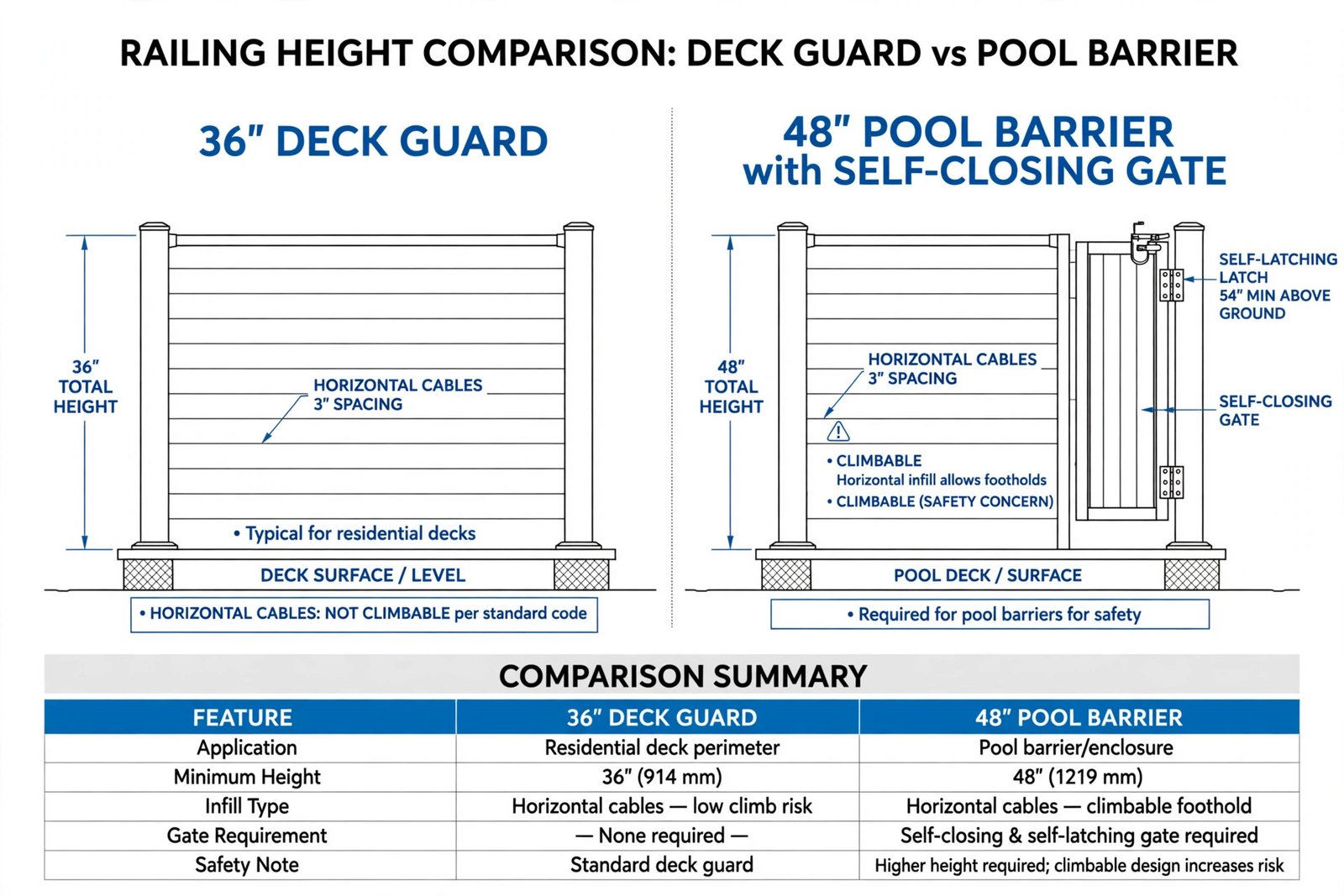
Three numbers decide whether cable railing passes inspection on a pool deck, and they come from two different codes. Do not mix them up.
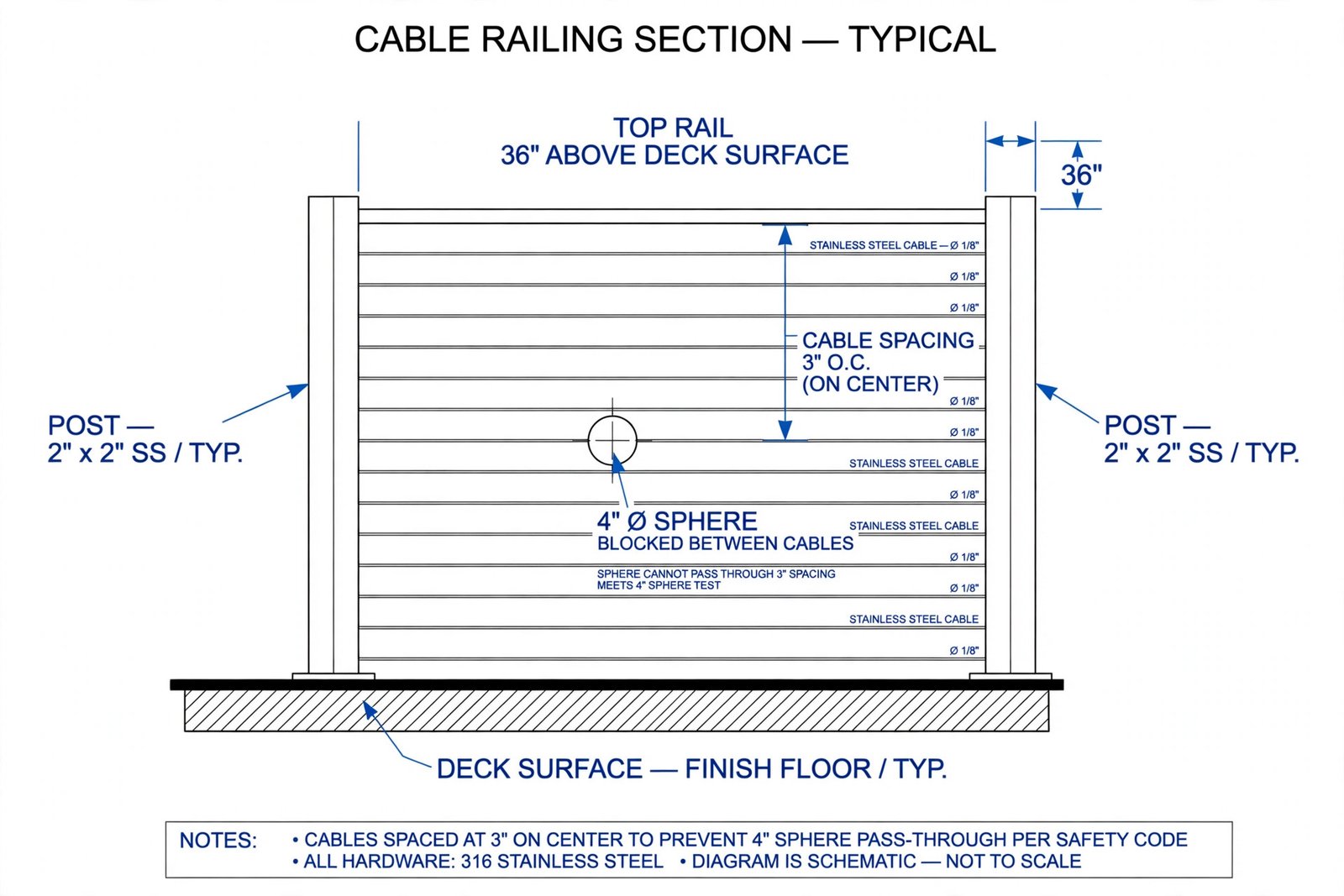
First, 3 in.: cables are spaced 3 in. apart, center to center, at most. The model IRC calls for openings that block a 4 in. sphere, but cables stretch and bend, so a cable spaced 4 in. apart opens to 5 or 6 in. when someone leans on it. At 3 in. spacing, even a pushed cable cannot open past the 4 in. limit. Stairs use a 4-3/8 in. sphere limit instead.
Second, 36 in.: a residential deck guard must be at least 36 in. tall, measured from the deck surface to the top of the rail. The top rail must resist a 200 lb concentrated load, and the cable infill must resist a 50 lb load applied to any 1 sq ft area. A guard is required where the drop exceeds 30 in.
Third, 48 in.: a pool barrier must be at least 48 in. tall under ISPSC. A 36 in. deck guard is not a pool barrier. If your railing is the barrier that keeps children out of the pool, it must reach 48 in., and the horizontal cables may still fail because an inspector can judge them climbable. Some towns do not allow horizontal railings at all. Check with your building department before you order: confirm the barrier height, confirm horizontal members are allowed, and confirm whether the railing or a separate fence is the barrier. For the full barrier rules, see our pool deck safety codes and standards guide.
The 10-Year Cost: Cable vs Glass vs Aluminum Pickets
Installed price is only year one. Over 10 years, cable railing costs almost nothing to maintain: rinse the cables with fresh water once a year, check the tension, and replace any fitting that shows corrosion early. Glass needs regular squeegee care and a panel replacement if one cracks. Aluminum pickets need almost nothing beyond washing.
| System, 60 linear ft | Installed | 10-year maintenance | 10-year total |
|---|---|---|---|
| Cable, 316 stainless | $9,000 to $17,100 | Rinse yearly, one pro re-tension visit; say $150 to $300 | $9,150 to $17,400 |
| Frameless glass | $8,400 to $14,400 | Squeegee care, one panel replacement risk; say $200 to $600 | $8,600 to $15,000 |
| Aluminum pickets | $3,600 to $5,700 | Wash only; say $0 to $100 | $3,600 to $5,800 |
The maintenance figures are stated assumptions in plain words, not quotes: say a pro re-tension visit runs $150 to $300 once in 10 years, and say a single glass panel replacement with labor runs $200 to $600. The installed figures are the verified ranges from the cost table above and from our railing guide.
Cable is the most expensive system to install and the cheapest to keep. Aluminum pickets are the cheapest on both counts and the right choice when the budget binds. Glass sits between them on price and wins outright on the view and on climbability. If the railing must be the pool barrier, glass wins the decision before price is considered, because it has no footholds at all.
Which Railing Should You Choose? 4 Questions Decide It
Answer these four questions in order and the choice makes itself.
Is the railing the pool barrier? If yes, pick glass or aluminum pickets. Horizontal cables can be judged climbable, and a 36 in. guard does not meet the 48 in. barrier height. If a separate fence is the barrier and the railing is only a deck guard, cable stays in the running.
Is the pool chlorinated or saltwater? If yes, buy 316 stainless cable or pick a non-cable system. Grade 304 tea-stains under chlorine mist within a few seasons.
Is the view the point? If the deck exists to watch the water, cable or glass preserve it. Aluminum pickets and wrought iron break the sightline with vertical bars.
Is the budget under $100 per linear foot? If yes, aluminum pickets at $60 to $95 per linear foot are the only system that fits. Cable at $150 to $285 and glass at $140 to $240 do not.
If cable survives all four questions, it is the right system: an open view, a 316 grade that resists chlorine, a separate fence as the pool barrier, and a budget that covers $150 to $285 per linear foot.
3 Cable Railing Failures and What Each Costs to Fix
Failure 1: tea staining and pitting on 304 cable. Chlorine mist pits 304 stainless within a few seasons, starting as brown tea stains at the fittings and spreading along the cable. Fix it by replacing the cable with 316: 660 ft of cable at $0.50 to $1.70 per ft plus the 10 to 25 percent 316 premium, plus a tensioning visit. Say the re-cable runs $500 to $1,500 in materials plus a day of labor; the cheaper fix is buying 316 the first time.
Failure 2: sag from lost tension. Cable sags because posts flex, tension is lost, or temperature swings move the run. The 3 in. spacing opens up and the guard fails the sphere test. Fix it by re-tensioning, and if the posts flex, add intermediate posts or stiffer posts. Say a re-tension visit runs $150 to $300; adding posts to a 60 ft run costs a few hundred dollars in materials plus labor.
Failure 3: failed inspection as a pool barrier. The inspector measures 36 in. where the barrier must be 48 in., or rejects the horizontal cables as climbable. Fix it by raising the railing to 48 in. with vertical balusters added between the cables, or by replacing the run with glass panels. Say the fix runs $2,000 to $5,000 for a 60 ft run depending on the system, which is why the barrier question comes first, before you order.
6 Questions About Cable Railing on a Pool Deck
Can cable railing be used as a pool barrier?
Only if it meets the barrier rules, and usually it cannot. A pool barrier must be at least 48 in. tall, and horizontal cables can be judged climbable. Some towns ban horizontal railings outright. Confirm with your building department, and plan on glass or vertical pickets if the railing is the barrier.
Does chlorine damage stainless steel cable?
Chlorine mist pits grade 304 stainless, showing as brown tea stains within a few seasons. Grade 316 resists it because of its molybdenum content. At a chlorinated or saltwater pool, buy 316 cable and 316 hardware, and rinse the cables with fresh water once a year.
How often do you re-tension cable railing?
Check the tension every year and re-tension when a cable deflects more than it should under a firm push. Most runs need a re-tension visit once in the first two years as the cable settles, then rarely after that if the posts are stiff enough.
Is cable railing safe for small children?
As a deck guard, yes, when it is spaced 3 in. apart and tensioned correctly so the 4 in. sphere cannot pass. As a pool barrier, it is the weakest option because children can climb horizontal cables. Glass or vertical pickets are safer where keeping children out of the pool is the job.
Can I install cable railing myself?
A handy homeowner can install a kit, but tensioning is the skill that decides whether it passes inspection. Uneven tension leaves some cables slack, and slack cables fail the sphere test. If you DIY, buy a tension gauge and test every cable before you call the inspector.
Does cable railing rust near a saltwater pool?
Grade 304 will pit and stain near salt water within a few seasons. Grade 316 resists saltwater pitting and is the only grade rated for that environment, at a 10 to 25 percent premium. Even 316 benefits from a fresh-water rinse once a year.
Editorial Note: This guide was researched and written by our small editorial team under the pen name Dave Hendrick. We are homeowners and researchers, not licensed contractors. Prices are typical national ranges, not quotes — confirm locally before you buy.