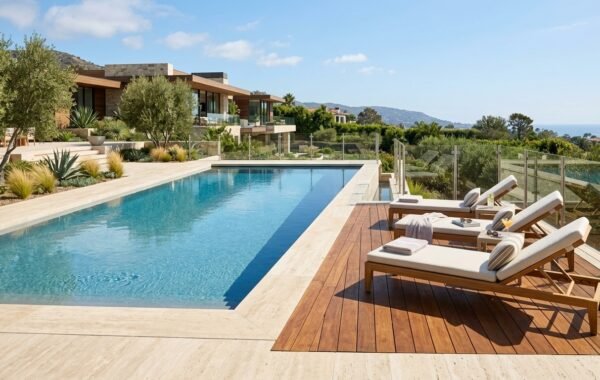


The cheapest inground pool deck that still works costs $6 to $12 per sq ft over 10 years. The most expensive costs $22 to $38. Between those two numbers sit 8 ideas, ranked below by 10-year cost per sq ft, with the material, the layout, and the cost for a 600 sq ft deck beside a 16×32 ft pool. The ranking is measured, not guessed: every idea carries its installed price and its mid-life spend.
8 Inground Pool Deck Ideas Ranked by 10-Year Cost per Sq Ft
The 8 ideas below are ranked by 10-year cost per sq ft, cheapest first. The number in each heading is the 10-year cost, install plus one mid-life spend where it applies. An inground pool deck is a ground-level slab or paver field, not a raised platform, so every idea here sits on grade and drains away from the pool.
1. Broom-Finish Concrete — $6 to $12 per sq ft over 10 years
Broom-finish concrete is a poured slab with a broom dragged across the surface while it sets, which leaves fine lines that grip wet feet. It is the value baseline every other inground deck is measured against. Best for: large decks on a tight budget, and any yard where the deck area tops 500 sq ft. Typical cost: $6 to $12 per sq ft installed, or $3,600 to $7,200 for a 600 sq ft deck. Downside: it cracks, and every crack shows on a light slab, so control joints every 8 to 10 ft are part of the build, not an extra. Measured stat: 10-year cost equals install cost at $6 to $12 per sq ft, because a sound slab needs no resurfacing in its first decade.
2. Acrylic Spray Overlay — $8 to $20 per sq ft over 10 years
An acrylic spray overlay, often sold as a cool-deck coating, is a textured acrylic layer sprayed over a sound concrete slab. It is the only idea on this list that resurfaces a deck you already have instead of building a new one. Best for: an existing concrete deck that is sound but hot, slick, or stained. Typical cost: $4 to $12 per sq ft installed, or $2,400 to $7,200 for a 600 sq ft deck. Downside: it needs a recoat at year 7 to 10, priced at $4 to $8 per sq ft, which is why the 10-year cost runs $8 to $20. Measured stat: light-colored cool-deck coatings run noticeably cooler than bare concrete, commonly cited as up to about 20 degrees F cooler in light colors, though the maker publishes no temperature figure.
3. Stamped Concrete — $12 to $20 per sq ft over 10 years
Stamped concrete is a poured slab pressed with mats that mimic stone, brick, or wood, then colored and sealed. It gives a stone look at a concrete price, and it pours in one piece, so there are no joints for weeds. Best for: a formal look on a mid-range budget, especially with a border color that matches the coping. Typical cost: $12 to $20 per sq ft installed, or $7,200 to $12,000 for a 600 sq ft deck. Downside: stamped concrete can be slick when wet, so ask for a non-slip additive in the sealer, and reseal every 2 to 3 years or the color fades in patches. Measured stat: 10-year cost runs $12 to $20 per sq ft before resealing, which adds $1 to $2 per sq ft per cycle.
4. Concrete Pavers — $15 to $25 per sq ft over 10 years
Concrete pavers are individual molded blocks set on a compacted base with sand joints. They are the most repaired deck on this list, because a cracked or stained paver lifts out and a new one drops in. Best for: yards where the ground moves, and owners who want to fix damage one paver at a time. Typical cost: $12 to $20 per sq ft installed, or $7,200 to $12,000 for a 600 sq ft deck. Downside: the sand joints need a re-sand and re-seal at about year 5, which adds $3 to $5 per sq ft. Measured stat: concrete pavers test 0.55 to 0.70 wet DCOF, the highest published wet grip on this list, well above the 0.42 code floor.
5. Porcelain Pavers — $18 to $28 per sq ft over 10 years
Porcelain pavers are 24×24 in. or 24×48 in. engineered tiles, 3/4 in. thick, set on a pedestal system or a mortar bed. They are dead uniform in color, absorb almost no water, and hold the cleanest modern look of any inground deck. Best for: a modern pool with straight lines, and owners who want zero sealing and zero fading. Typical cost: $18 to $28 per sq ft installed, or $10,800 to $16,800 for a 600 sq ft deck. Downside: a chipped porcelain paver cannot be patched, only replaced, and matching the dye lot 5 years later is a gamble. Measured stat: 10-year cost equals install cost at $18 to $28 per sq ft, with no sealing and no resurfacing in the first decade.
6. Travertine Pavers — $18 to $30 per sq ft over 10 years
Travertine pavers are cut natural stone with a porous, light-colored surface that stays cool and grips wet feet. They are the classic high-end inground pool deck, and the stone most often photographed around luxury pools. Best for: hot climates where bare feet spend all day on the deck, and pools where the coping is also stone. Typical cost: $18 to $30 per sq ft installed, or $10,800 to $18,000 for a 600 sq ft deck. Downside: travertine has no published wet DCOF figure, so judge it by its tumbled texture and ask the supplier for a test report before you commit. Measured stat: light travertine typically runs about 20 to 30 degrees F cooler than concrete pavers in full sun.
7. Mixed-Material Deck — $20 to $32 per sq ft over 10 years
A mixed-material deck blends 2 or 3 surfaces: travertine squares with turf or gravel joints, poured concrete bands that frame paver panels, or a stone border around a concrete field. It is the most designed look on this list and the hardest to price, because the cost tracks the most expensive material plus the extra cutting labor. Best for: a pool that is the center of the yard, where the deck is meant to be looked at, not just walked on. Typical cost: $20 to $32 per sq ft installed, or $12,000 to $19,200 for a 600 sq ft deck. Downside: every joint between materials is a place water and weeds collect, so the edging and the drainage need more care than a single-material deck. Measured stat: 10-year cost runs $20 to $32 per sq ft, with a re-sand of the paver sections at about year 5.
8. Capped Composite Platform — $22 to $38 per sq ft over 10 years
A capped composite platform is a raised wood-frame deck with composite boards, built beside an inground pool where the yard slopes or the pool sits above grade. It is the only raised idea on this list, and the only one that needs footings, joists, and a railing. Best for: sloped yards, and pools where the deck must bridge a grade change to reach the water. Typical cost: $22 to $38 per sq ft installed, or $13,200 to $22,800 for a 600 sq ft deck. Downside: capped composite tests 0.32 to 0.45 wet DCOF, which means many boards fall below the 0.42 code floor when wet, so check the maker’s wet test sheet for the exact board you buy. Measured stat: 10-year cost equals install cost at $22 to $38 per sq ft, because capped composite needs no staining, sealing, or resurfacing.
How the 8 Ideas Were Ranked: 3 Measurements
The ranking uses 3 measurements, not opinions. First, installed cost per sq ft from national 2026 ranges. Second, one mid-life spend where it applies: a recoat for overlays at year 7 to 10, a re-sand and re-seal for pavers at year 5, and resealing for stamped concrete every 2 to 3 years. Third, wet grip, measured as published wet DCOF where a maker publishes one.
Two ideas carry no published wet DCOF at all: acrylic overlays and natural travertine. That does not make them slippery. It means no maker has published a test number, so the ranking judges them by texture and by field reports, and the article says so instead of printing a number that does not exist. A ranking that invents a slip rating for those two would be neater and wrong.
Coping and Drainage: 2 Details That Decide Whether the Deck Works
Coping and drainage decide whether an inground deck works, and both are priced separately from the deck surface, which is why they surprise first-time builders.
Coping: $40 to $80 per linear ft. Coping is the cap on the pool edge, the piece your hands and elbows touch every time you get in and out. A 16×32 ft pool has 96 linear ft of edge, so coping runs $3,840 to $7,680. A bullnose edge is the classic choice because it is rounded and soft on skin. A contrasting coping, such as warm travertine against a cooler grey deck, makes an ordinary deck look designed for about the same money. Coping must be slip resistant and cleanable, and the joint between the coping and the deck needs to flex, because the deck and the pool wall move at different rates.
Drainage: 1/8 to 1/4 in. of fall per ft. Pool decks must slope away from the pool or toward deck drains, and the code sets the minimum slope by surface. Textured concrete and residential pavers need at least 1/8 in. per ft. Exposed aggregate needs 1/4 in. per ft. No deck surface may slope more than 1/2 in. per ft. On a 10 ft lounge deck, 1/4 in. per ft means the far edge sits 2-1/2 in. lower than the pool edge. A deck that slopes toward the pool sends splash water, dirt, and chemicals back into the water, and a flat deck holds puddles that breed algae and stain the surface.
Where the site forces it, deck drains may sit at the back side of the pool structure or coping. Site drainage must also carry roof and yard water away from the pool area, not just deck water.
What a 600 Sq Ft Inground Deck Costs in 5 Materials
A 600 sq ft deck beside a 16×32 ft pool is the most common inground build: a 4 ft apron on 3 sides and a 10 ft lounge deck on the long side. Here is what that deck costs in 5 materials, surface only, before coping and drainage.
| Material | Installed $/sq ft | 600 sq ft total | With coping ($3,840 to $7,680) |
|---|---|---|---|
| Broom concrete | $6 to $12 | $3,600 to $7,200 | $7,440 to $14,880 |
| Acrylic overlay | $4 to $12 | $2,400 to $7,200 | $6,240 to $14,880 |
| Concrete pavers | $12 to $20 | $7,200 to $12,000 | $11,040 to $19,680 |
| Travertine pavers | $18 to $30 | $10,800 to $18,000 | $14,640 to $25,680 |
| Capped composite | $22 to $38 | $13,200 to $22,800 | $17,040 to $30,480 |
Coping adds $3,840 to $7,680 to every row, which is why the cheapest deck in the table still costs $6,240 once the pool edge is finished. Two more costs hide outside this table: demolition of an old deck runs $2 to $6 per sq ft, and a deck drain or a regrade for drainage runs $500 to $2,000 depending on the yard. Ask whether demolition, coping, and drainage are in the quote before you compare two builders, because a quote that excludes coping can look $4,000 cheaper and cost the same in the end.
Which Idea Fits Your Yard? A 4-Question Decision Tree
Answer 4 questions in order. The first yes decides the material.
1. Is the deck over 500 sq ft and the budget under $15,000? Yes: broom concrete at $6 to $12 per sq ft. It is the only idea that finishes a 600 sq ft deck with coping for under $15,000. No: go to question 2.
2. Does the yard freeze in winter? Yes: concrete pavers or porcelain pavers. Pavers reset one at a time after frost heave, and frost-rated porcelain holds up where a poured slab cracks. Seal porous stone before the first freeze. The composite vs pavers comparison covers how each material handles freeze and thaw in more detail. No: go to question 3.
3. Do bare feet spend all day on the deck in full sun? Yes: travertine at $18 to $30 per sq ft, or a light-colored acrylic overlay at $4 to $12. Light travertine runs about 20 to 30 degrees F cooler than concrete pavers. No: go to question 4.
4. Does the yard slope more than 2 ft from the pool to the fence? Yes: a capped composite platform at $22 to $38 per sq ft, framed to bridge the grade. No: concrete pavers at $12 to $20, the best all-around inground deck for a flat yard.
If you answered no to all 4, you have a flat yard, a mild climate, and a mid-range budget. Concrete pavers are the default pick: 0.55 to 0.70 wet DCOF, piece-by-piece repair, and $12 to $20 per sq ft installed. Once the material is picked, the pool deck safety codes and standards guide covers the slip, slope, and barrier rules to check before you build, and the pool deck lighting guide covers how to light the finished deck for night swimming.
Editorial Note: This guide was researched and written by our small editorial team under the pen name Dave Hendrick. We are homeowners and researchers, not licensed contractors. Prices are typical national ranges, not quotes — confirm locally before you buy.
6 Questions About Inground Pool Decks
What is the best pool deck material for an inground pool?
Concrete pavers are the best all-around pick: 0.55 to 0.70 wet DCOF, piece-by-piece repair, and $12 to $20 per sq ft installed. Travertine wins on cool feet in hot sun at $18 to $30. Broom concrete wins on budget at $6 to $12.
How much does an inground pool deck cost?
$3,600 to $22,800 for a 600 sq ft deck surface, depending on material, plus $3,840 to $7,680 for coping on a 16×32 ft pool. The cheapest finished deck with coping costs about $6,240. Demolition of an old deck adds $2 to $6 per sq ft.
How wide should a pool deck be around an inground pool?
Give yourself at least 3 to 4 ft of walking room all the way around, and 8 to 12 ft on the side you will furnish with loungers or a dining set. A 4 ft apron with a 10 ft lounge side is the most common layout for a 16×32 ft pool.
What pool deck stays coolest underfoot?
Light travertine, which typically runs about 20 to 30 degrees F cooler than concrete pavers in full sun. Light-colored acrylic cool-deck coatings also run noticeably cooler than bare concrete. Color matters more than material: a dark deck of any material runs hot.
Do inground pool decks need to slope away from the pool?
Yes. Decks must slope away from the pool or toward deck drains, at least 1/8 in. per ft for textured concrete and residential pavers and 1/4 in. per ft for exposed aggregate, with a 1/2 in. per ft maximum. A deck that slopes toward the pool sends splash water and dirt back into the water.
Can I put composite decking around an inground pool?
Yes, as a raised platform where the yard slopes or the pool sits above grade, at $22 to $38 per sq ft installed. Check the maker’s wet DCOF sheet first: capped composite tests 0.32 to 0.45 wet, and many boards fall below the 0.42 code floor when wet.