

META DESCRIPTION: Close your pool and deck before the first freeze with this full 2026 checklist: DIY vs pro costs, winter cover prices, and the 5 steps you can safely skip.
Close your pool when the water stays at or below 65 degrees F, and close the deck in the same weekend, because the first hard freeze does not wait for a second trip to the backyard. A full pro closing costs $200 to $500 with most homeowners paying about $350, while a DIY closing runs $70 to $200 in supplies if you already own a cover and a blower. This guide walks the pool and the deck together: water chemistry, lines, equipment, cover, furniture, pavers, and the 5 steps you can skip without risking a $500 to $2,500 burst-pipe repair in spring.
What You Will Need: 12 Tools and Supplies for a $70 to $200 DIY Closing
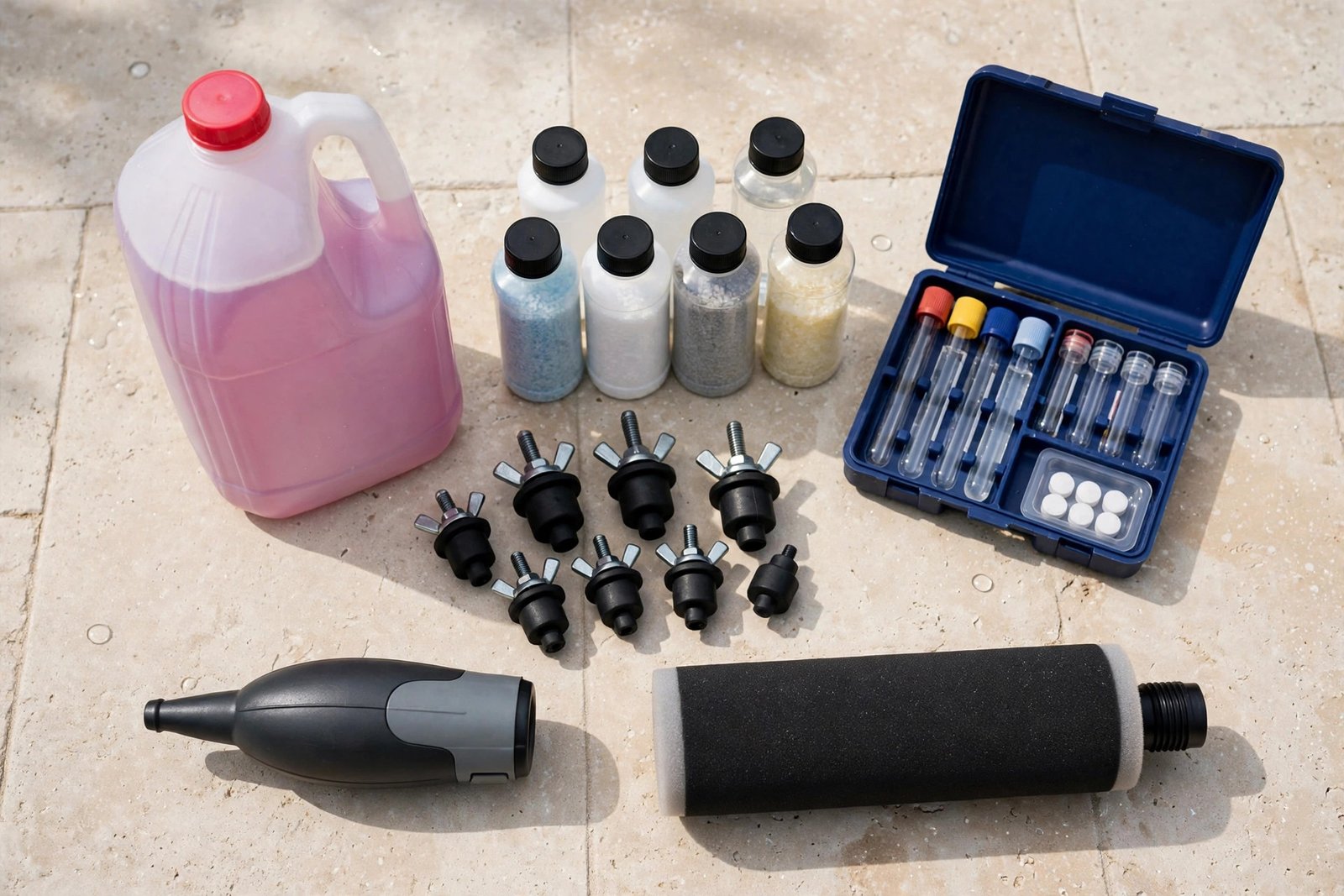
A DIY closing needs 12 items and costs $70 to $200 in supplies if you already own a winter cover and a blower, or $170 to $450 in year 1 if you must buy both. The single most important tool is a high-volume blower, not a shop vacuum: a shop vacuum lacks the air volume to clear long underground runs, and an uncleared line is the failure that costs $500 to $2,500 in spring. If you do not own a blower, hire out the blowout alone and DIY the rest.
| Item | Cost | Notes |
|---|---|---|
| Winter chemical kit (shock, algaecide, stain preventer) | $30 to $70 | Sized by gallons; a 20,000-gallon kit runs $35 to $60 |
| Pool antifreeze, propylene glycol, 1 gallon | $10 to $30 | Never automotive antifreeze; it is toxic to pool equipment |
| Winterizing plugs and skimmer Gizzmo | $20 to $60 | Gizzmo absorbs ice expansion in the skimmer |
| High-volume blower or cyclone blower | $100 to $250 to buy | Rent for $40 to $75 per day if you close once |
| Submersible pump for lowering water | $0 to $80 | Borrow one; you need it for 30 minutes |
| Winter cover (tarp style) | $50 to $200 | Mesh and solid safety covers cost far more; see the cover table below |
| Cover pump | $100 to $300 | Only needed for a solid cover |
| Leaf net or cover clips and water bags | $20 to $50 | Water bags hold a tarp cover down in wind |
| Test kit or test strips | $10 to $25 | pH 7.4 to 7.6, alkalinity 80 to 120 ppm before closing |
| Deck furniture covers or storage bins | $30 to $80 | Or move furniture into a garage or shed for $0 |
| Paver and deck cleaner | $15 to $30 | Clear leaves now; tannin stains set over winter |
| Hose, brush, vacuum head | Already owned | Clean the pool before you balance the water |
Budget 4 to 8 hours for a first DIY closing and 2 to 4 hours once you have done it twice. A pro crew finishes in 1 to 3 hours. If your pool has an attached spa, a heater, water features, or complex plumbing, add $50 to $150 to a pro quote for those extras and think twice about DIY: the heater core and the spa lines are the 2 places a missed drain plug turns into a cracked housing.
Step 1: Clean the Pool and Balance the Water to pH 7.4 in 60 Minutes
Clean first, balance second, and give the water 60 minutes to settle before you test it. Skim the surface, brush the walls and coves, and vacuum the floor so no leaves or organic matter sit in the pool all winter; debris left in the water feeds algae and stains the liner by spring. Then test and adjust in this order: total alkalinity to 80 to 120 ppm first, because it steadies pH, then pH to 7.4 to 7.6, then chlorine below 5 ppm. Shock the pool and add a non-staining winter algaecide plus a stain and scale inhibitor, then run the pump for 24 hours so the chemicals mix fully.
Do not close a green or cloudy pool. Algae doubles in a covered pool over winter if the water is warm enough, and a green spring opening costs $100 to $300 in extra chemicals and a week of filtering. If the water is green now, fix it before you close, even if that pushes closing back a week. Closing is timed by water temperature, not by the calendar: wait until the water stays at or below 65 degrees F, which in most northern states means late September to mid-October. Close too early while the water is warm and algae grows under the cover all winter.
Step 2: Lower the Water 4 to 6 Inches Below the Skimmer in 30 Minutes
Lower the water to 4 to 6 in. below the bottom of the skimmer mouth and below all return fittings, which takes about 30 minutes with a submersible pump on a 20,000-gallon pool. The exact depth depends on your cover: a mesh safety cover wants the water 12 to 18 in. below the skimmer so rain and snowmelt have room to drain through, while a solid cover wants only 3 to 6 in. below the skimmer so there is less water to pump off in spring. Check your cover type before you pump, because pumping twice wastes an hour.
Never drain an inground pool fully. An empty pool can be pushed up by groundwater pressure, and a vinyl liner shrinks and wrinkles without water holding it in place. Lowering 4 to 6 in. removes about 1,000 to 1,500 gallons from a 20,000-gallon pool, which is enough to protect the skimmer and the returns. If your pool has a main drain, leave it alone for now; it gets blown out in the next step, not drained.
Step 3: Blow Out the Lines and Add Antifreeze in 90 Minutes
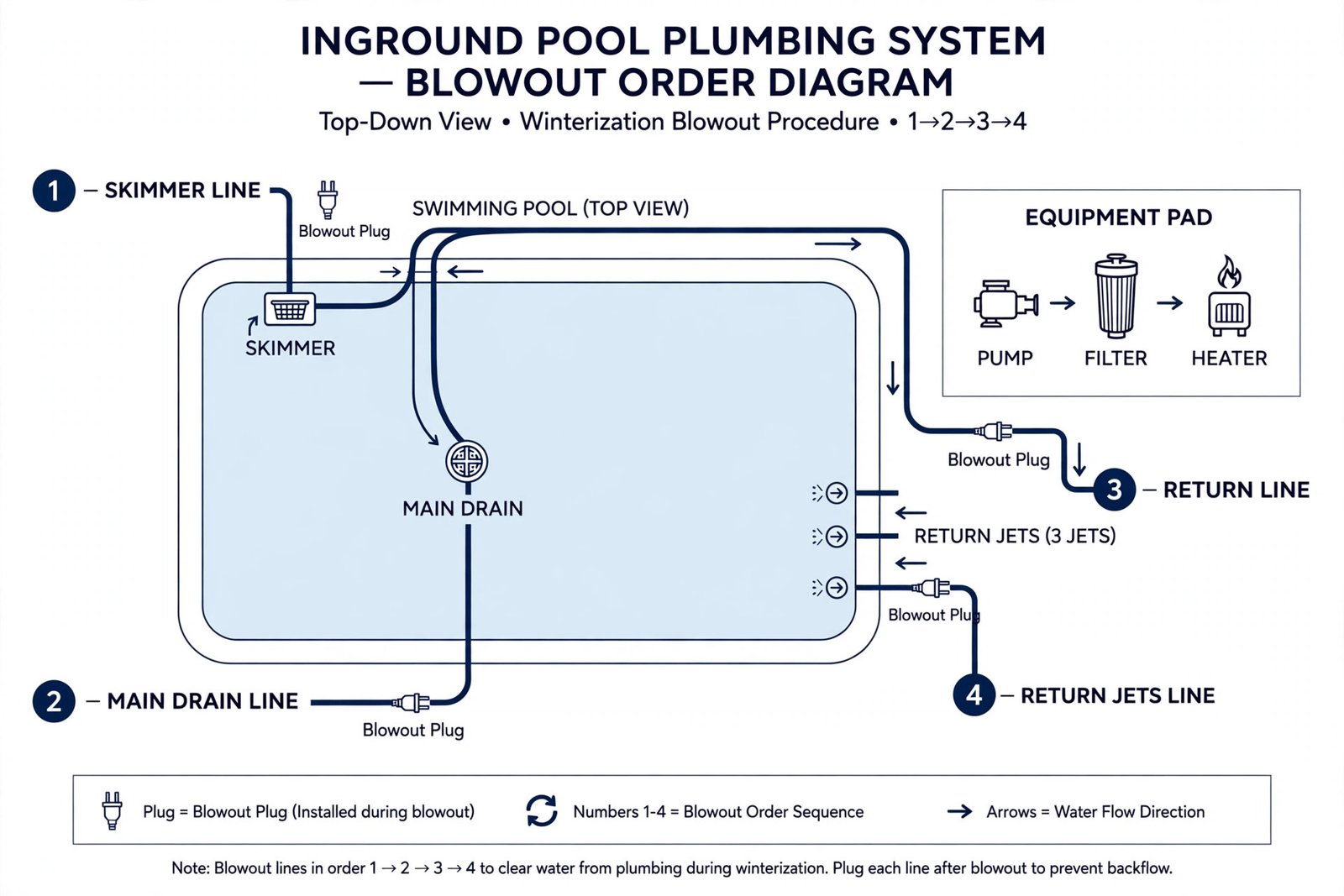
Blow out every line until only air comes out, then plug each line while the air is still bubbling. This is the step that prevents burst pipes, and it takes about 90 minutes on a standard inground pool. Water expands about 9 percent when it turns to ice, and that expansion cracks underground pipes, skimmer housings, and filter tanks. A missed line costs $500 to $2,500 to repair in spring, often with deck excavation to reach it.
Work line by line from the pump:
- Turn off the pump, heater, and chlorinator at the breaker, then remove the drain plugs from the pump housing, the filter tank, and the heater. Store the plugs in the pump basket so you find them in spring.
- Connect the blower at the pump drain plug or a dedicated winterizing port. Blow the skimmer line first until air bubbles hard at the skimmer, then plug it and fit the Gizzmo in the skimmer to absorb ice expansion.
- Blow each return line until bubbles appear at the return jet, then plug it while air is still flowing. The air lock stops water flowing back into the pipe.
- Blow the main drain line last. It is the deepest line and the hardest to clear, which is why some owners add antifreeze here even after blowing.
- Pour 1 gallon of propylene glycol pool antifreeze into the skimmer and return lines as insurance against any water left behind. Antifreeze is a backup, not a substitute for blowing the lines, and never use automotive antifreeze: it is toxic and damages pool equipment.
- Remove ladders, handrails, diving boards, and the solar blanket, and store them indoors. A handrail left in its socket over winter can seize in place and crack the socket when you pull it in spring.
If you own a shop vacuum instead of a blower, hire out this step. Shop vacuums move too little air to clear a long underground run, and a half-cleared line freezes exactly like an uncleared one. A pro blowout alone costs $100 to $200 inside a $200 to $500 full closing, and it is the best $100 to $200 in this whole guide.
Step 4: Cover the Pool and Pick the Right Cover in 1 Hour
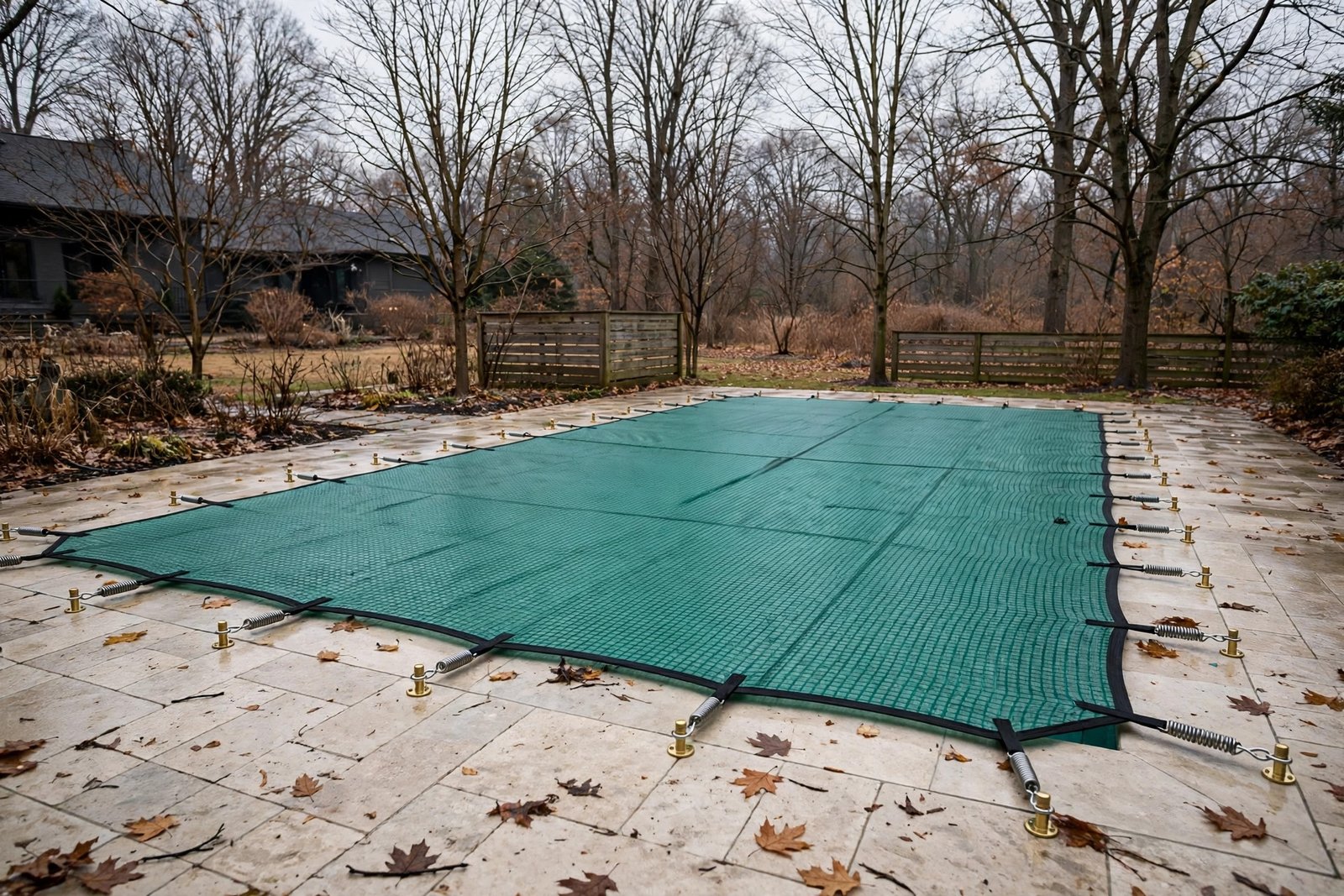
Install the cover after the lines are blown and plugged, and budget 1 hour with a helper for a tarp cover or 2 hours for a safety cover with anchors. A cover keeps out leaves, blocks the sunlight that feeds algae, and, if it is a safety cover, holds weight. It is not a fence: a cover never replaces a compliant pool enclosure with self-closing gates.
| Cover type | Cost | Lifespan | Pump needed | Best for |
|---|---|---|---|---|
| Solid tarp cover | $50 to $200 | 3 to 5 years | Yes, $100 to $300 pump | Tight budgets, short winters |
| Mesh safety cover | $1,000 to $3,000 | 10 to 15 years | No, water drains through | Most inground pools |
| Solid safety cover | $2,000 to $5,000 | 8 to 12 years | Yes, unless it has a drain panel | Cleanest spring opening |
| Automatic cover | $5,000 to $15,000 | 10 years plus, fabric replaced every few years | Yes | Year-round use, daily safety |
A mesh safety cover is the best value for most pools: it costs about $250 per season over a 12-year life, needs no cover pump, and is rated to hold at least 485 lbs under ASTM F1346. The trade is spring water: fine silt and some sunlight pass through, so the opening needs more chemicals. A solid safety cover opens cleaner but collects every rainfall on top, so you pump it off all winter or fit a drain panel. A tarp cover is the cheapest start but the dearest habit: it lasts 3 to 5 years, needs water bags and a pump, and tears in wind. For above-ground pools, a heavy-duty cover with a cable and winch runs about $200, and an air pillow under it absorbs ice expansion.
Check the cover monthly through winter. Pump standing water off a solid cover before it freezes into a sheet, clear heavy snow so the weight does not stretch the straps, and re-tighten any anchor that works loose. A cover that sags into the water all winter is a cover that fails in spring.
Step 5: Winterize the Deck in 2 Hours: Furniture, Pavers and Drains
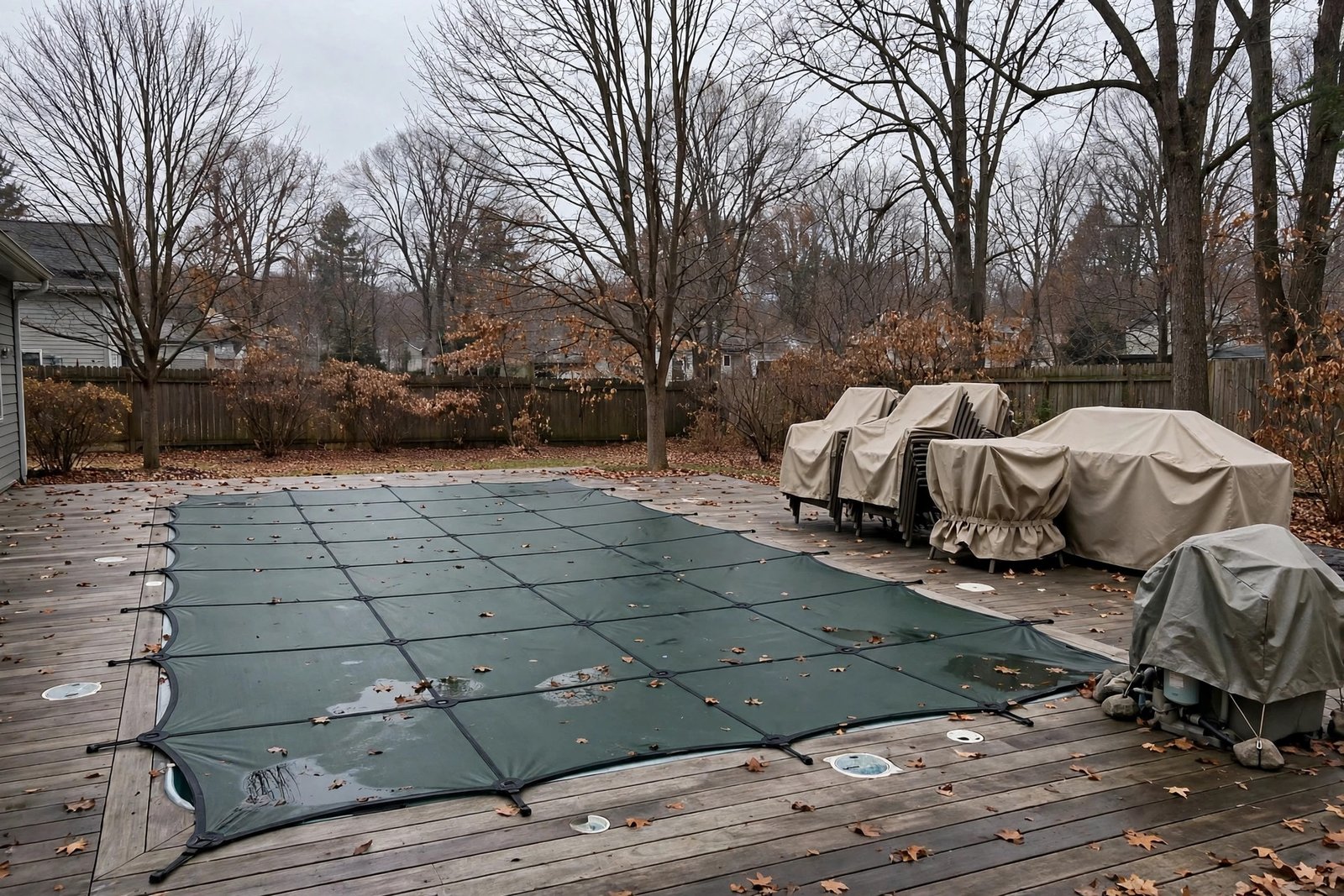
The deck half of closing takes about 2 hours and saves the most money per minute, because furniture and pavers left out all winter cost more to replace than the pool lines cost to blow out. Work the deck in this order: clean it, clear the drains, store what moves, and protect what stays.
Clean the deck first. Sweep off every leaf and hose down the surface, because leaf tannins stain pavers and concrete over a wet winter, and a stain set in November is still there in April. Check the deck drains and the channel drains at the coping line: clear leaves and grit so meltwater runs away from the pool and the house, not across the deck and under the cover. A blocked drain turns a January thaw into a sheet of ice across the walking path.
Store what moves. Stack chairs and loungers in a garage or shed, or cover them with fitted furniture covers if storage is full. Bring cushions indoors and dry: a cushion left out grows mold in 6 weeks and costs $40 to $120 to replace. See poolside furniture ideas for storage-friendly pieces that stack and cover well. Roll up the outdoor rug, deflate and store pool floats, and coil the hose after draining it. Drain the outdoor shower and hose bibs too; a hose bib that freezes cracks the pipe inside the wall, and that repair starts at $300.
Protect what stays. Sweep polymeric sand into any paver joints that have washed out, because open joints let water in and heave in a freeze. Check the coping joints and the caulk line where the deck meets the pool: a cracked joint lets water under the deck all winter, so seal it now with a $15 tube of pool caulk instead of paying $500 to $1,500 for a lifted coping repair in spring. See how to seal a pool deck and how to fix cracks in a concrete pool deck if the damage is already there. Cover the pump, filter, and heater with equipment covers or tarps that still let air move, and cover the grill and outdoor kitchen. Do not stack firewood or heavy planters on the pavers for winter: a 200-lb load on one spot all winter leaves a dip you will feel barefoot in May.
DIY vs Pro Closing: What 3 Years Actually Costs
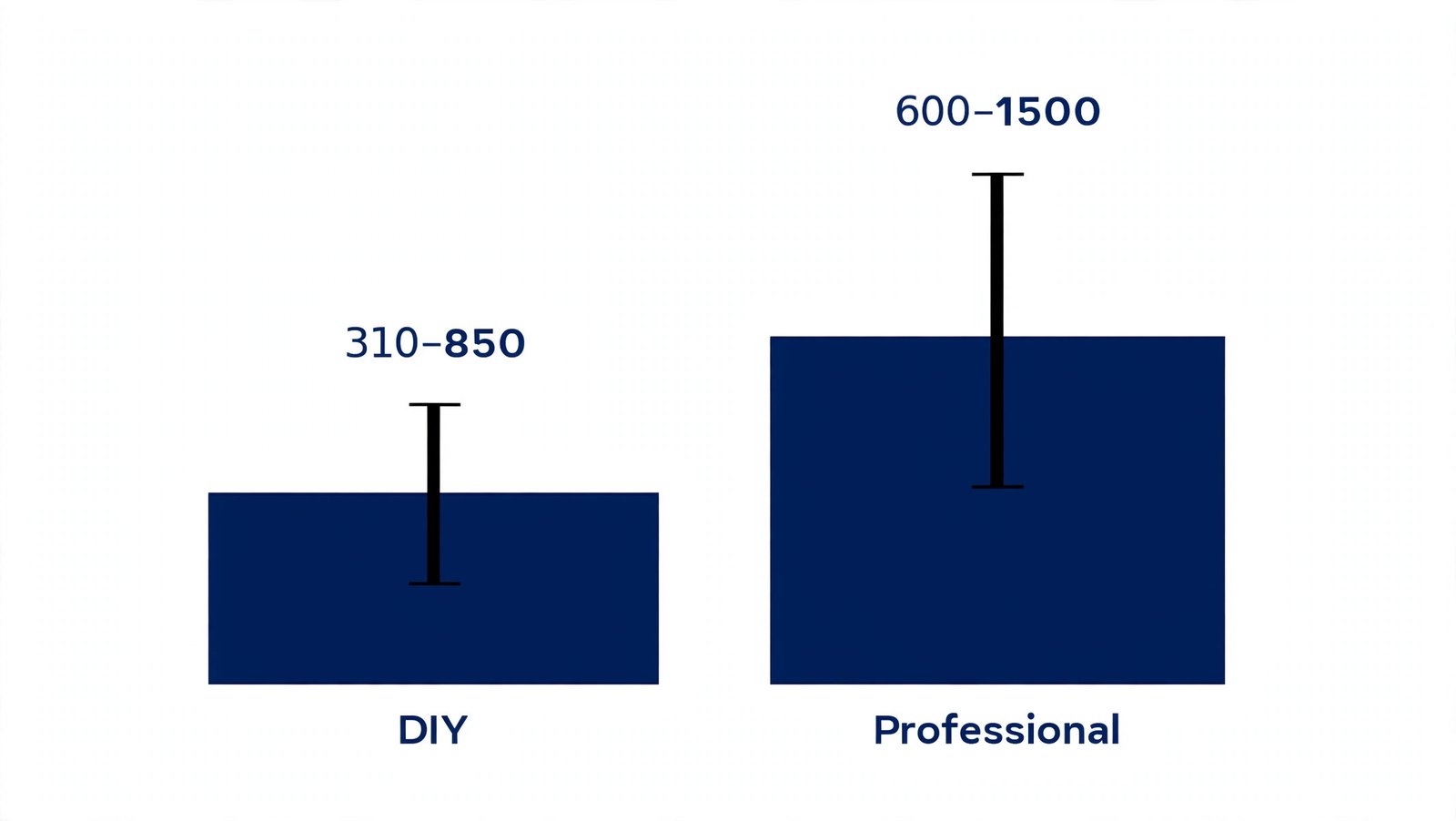
A pro closing costs $200 to $500 a year, every year. A DIY closing costs $170 to $450 in year 1 and $70 to $200 a year after that, once you own the blower and the plugs. Over 3 years the pro totals $600 to $1,500 and the DIY totals $310 to $850, so DIY saves $290 to $650 across 3 closings. The saving is real, but only if you do the blowout right: one burst pipe at $500 to $2,500 wipes out 3 to 5 years of DIY savings in a single spring.
| Closing cost over 3 years | DIY | Pro |
|---|---|---|
| Year 1 supplies and tools | $170 to $450 (kit $30-70, antifreeze $10-30, plugs $20-60, blower $100-250, cover $50-200 if needed) | $200 to $500 |
| Year 2 supplies | $70 to $200 | $200 to $500 |
| Year 3 supplies | $70 to $200 | $200 to $500 |
| 3-year total | $310 to $850 | $600 to $1,500 |
| Your time | 4 to 8 hours year 1, 2 to 4 hours after | 0 hours; crew takes 1 to 3 hours |
The smart split is the one most owners land on: DIY the cleaning, chemistry, water level, cover, and deck, and hire a pro for the blowout only, at $100 to $200. You keep the $290 to $650 saving and you buy the one step where a mistake costs 10 times the saving. Hire the full pro closing when the pool has an attached spa, a gas heater, water features, or a history of freeze damage, or when you are closing for the first time and the forecast shows a freeze within 7 days.
Closing Checklist: 20 Points to Tick Off in 1 Weekend
Print this list and tick each point off as you finish it. The pool half is points 1 to 12, the deck half is points 13 to 20, and the whole list fits into 1 weekend: Saturday for the pool, Sunday for the deck.
- Skim, brush, and vacuum the pool
- Test alkalinity and set it to 80 to 120 ppm
- Test pH and set it to 7.4 to 7.6
- Shock the pool and add winter algaecide and stain inhibitor
- Run the pump 24 hours to mix the chemicals
- Lower the water 4 to 6 in. below the skimmer
- Turn off the pump, heater, and chlorinator at the breaker
- Remove drain plugs from the pump, filter, and heater
- Blow out the skimmer line, plug it, and fit the Gizzmo
- Blow out each return line and plug it while air is bubbling
- Blow out the main drain and add 1 gallon of propylene glycol antifreeze
- Fit the winter cover and check the straps and anchors
- Sweep leaves off the deck and hose it down
- Clear the deck drains and the coping channel drains
- Store cushions indoors and cover or store furniture
- Drain the hose, outdoor shower, and hose bibs
- Sweep polymeric sand into washed-out paver joints
- Seal cracked coping joints with pool caulk
- Cover the pump, filter, heater, grill, and outdoor kitchen
- Store the drain plugs in the pump basket and note the closing date
5 Steps You Can Skip Without Risking a Burst Pipe
Not every step in a 20-point closing list earns its place. Skip these 5 and nothing breaks.
- Draining the pool below the returns. Lowering 4 to 6 in. below the skimmer is enough. Draining further wastes water and risks the liner.
- A second shock dose after the first. One shock plus algaecide, mixed for 24 hours, is the treatment. A second dose adds $15 to $25 of chemicals and no protection.
- Antifreeze in every line. Antifreeze belongs in lines you cannot fully drain, like the main drain. A fully blown and plugged return line needs none.
- Removing the pool light. Leave the fixture in place and drain the niche only if your pool manual calls for it. Pulling a light to “protect” it creates a leak risk where none existed.
- Winterizing the deck furniture with a pressure wash. A sweep and a hose-down is enough. Pressure washing pavers in November drives water into the joints right before the freeze.
Do not skip the blowout, the plugs, the Gizzmo, the drain plugs on the equipment, or the cover. Those 5 are the freeze protection. Everything else is convenience.
6 Questions About Winterizing a Pool and Deck
When should I close my pool for winter?
Close when the water stays at or below 65 degrees F, which in most northern states is late September to mid-October. Closing while the water is warmer lets algae grow under the cover all winter.
Can I leave my pool open all winter?
Yes, in mild climates, if you run the pump whenever temperatures drop below 32 degrees F, because moving water does not freeze. Many owners fit a freeze sensor that starts the pump automatically. A power cut during a hard freeze is the risk, so have a winterizing plan ready.
How much antifreeze does a pool need?
About 1 gallon of propylene glycol pool antifreeze for a standard inground pool, poured into the skimmer and the lines you cannot fully drain. It is insurance after blowing the lines, not a substitute for blowing them.
Do I need to cover my pool deck furniture?
Yes, or move it indoors. Cushions left out grow mold in about 6 weeks and cost $40 to $120 each to replace, while a fitted cover costs $30 to $80 for the set and lasts 3 to 5 winters.
What happens if I skip winterizing?
Water left in the lines freezes, expands about 9 percent, and cracks pipes, skimmers, and filter housings. Repairs run $500 to $2,500 and often need deck excavation to reach the broken pipe.
Should I hire a pro to close my pool?
Hire a pro for the full closing if the pool has a spa, a heater, or complex plumbing, or if this is your first closing. Otherwise DIY the cleaning and the deck and hire out the line blowout alone for $100 to $200.
Editorial Note: This guide was researched and written by our small editorial team under the pen name Dave Hendrick. We are homeowners and researchers, not licensed contractors. Prices are typical national ranges, not quotes — confirm locally before you buy.