
Proper illumination turns a dark swimming pool patio into a luxurious evening entertaining venue. Swimming pool deck lights enhance backyard aesthetics, eliminate tripping hazards on wet steps, and protect night swimmers. A complete low-voltage LED deck lighting system typically costs between $1,200 and $4,500 installed. Planning fixture placement early ensures clean, concealed wiring beneath your decking boards.
However, electrical installations near wet pool perimeters must satisfy strict National Electrical Code mandates. Using incorrect line-voltage fixtures near water poses severe electrocution risks. Therefore, professional contractors always install 12-volt low-voltage transformers equipped with ground fault circuit interrupters. This technical guide explores the best pool deck light fixtures, transformer sizing calculations, NEC code regulations, and glare-free design strategies.
Swimming Pool Deck Lights Fixture Comparison Table
Selecting pool lighting requires balancing warmth against waterproof durability. In addition, you must account for total energy draw. The comparison table below highlights critical technical specifications for pool deck lighting fixtures.
| Fixture Style | Typical Wattage (LED) | Lumen Output | Waterproof Rating | Best Placement |
|---|---|---|---|---|
| Recessed Stair Riser Lights | 1.5 to 3.0 Watts | 60 to 120 Lumens | IP67 (Heavy splash proof) | Stair vertical risers, level transitions |
| Under-Coping Linear LED Strips | 2.0 to 4.5 Watts/ft | 180 to 250 Lumens/ft | IP68 (Submersible rated) | Pool rim overhangs, perimeter coping |
| Post Cap Accent Lights | 2.0 to 4.0 Watts | 90 to 150 Lumens | IP65 (Weather resistant) | Perimeter railing posts, gate entries |
| Flush In-Ground Well Lights | 3.0 to 6.0 Watts | 150 to 300 Lumens | IP67 (Drive-over waterproof) | Paver walking paths, landscape borders |
| Under-Rail Downward Channels | 1.5 to 3.0 Watts/ft | 100 to 180 Lumens/ft | IP66 (Water jet resistant) | Concealed railing underside, perimeter glow |
Evaluating surface textures for your lighting plan? Compare surface finishes in our composite decking vs pavers guide.
Related: Pool Coping Ideas: Modern Styles, Pavers & Costs
5 Popular Swimming Pool Deck Light Fixtures
Layering multiple fixture types produces balanced illumination without harsh glare blinding night swimmers.
1. Recessed Stair Riser Lights
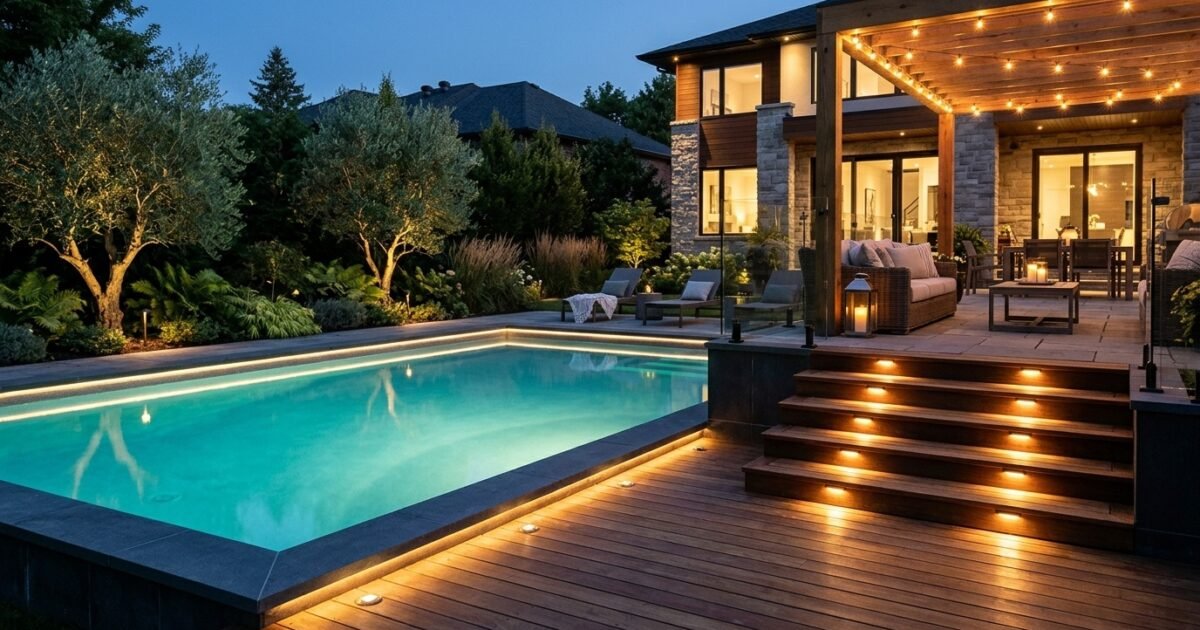
Stairs represent the highest fall risk on wet pool decks at night. Compact recessed LED fixtures mount flush into the vertical riser face of each step. They cast soft downward light across the tread surface without shining upward into pedestrians’ eyes. Solid cast brass or marine aluminum faceplates resist chlorine splash-out and accidental shoe kicks.
2. Under-Coping Perimeter Linear Glow
Under-coping lighting conceals flexible LED strips beneath the coping overhang. This projects a seamless glow along the pool water edge. Always select IP68-rated submersible strips with chlorine-resistant silicone channels to survive constant wave wash.
3. Flush In-Deck Dot and Paver Lights
Flush-mounted round LED marker lights embed directly into decking boards or patio pavers. They define traffic walkways and perimeter borders around lounging areas. Quality fixtures feature walk-over tempered glass lenses and drive-over ratings. In addition, their diffused frosted lenses prevent uncomfortable pinpoints of bright light under bare feet.
4. Under-Rail Downward Channel Lights
Under-rail lighting mounts miniature LED channels beneath the top railing cap. The light washes downward over the balusters, illuminating the deck perimeter without exposing the light source. This technique provides ambient mood lighting for poolside dining tables. For railing compatibility, explore our pool deck railing ideas and designs.
5. Low-Profile Post Cap Lights
Post cap fixtures mount directly atop perimeter railing posts. They cast soft downward perimeter light around the boundary of your outdoor living room. Choose solar caps for remote platforms. Alternatively, wire low-voltage caps to a central timer for reliable year-round operation.
National Electrical Code (NEC Article 680) Rules
Electrical safety near water is strictly regulated. The National Electrical Code (NEC Article 680) dictates all wet installations. Stray voltage around wet swimming pools can cause severe electric shock.
Contractors adhere to these mandatory electrical safety regulations:
- Low-Voltage Requirement: Fixtures within 5 feet of the water edge must operate at 15 volts AC or less. An isolated transformer must power them.
- Transformer Placement: Mount transformers at least 10 feet horizontally from the pool wall. In addition, elevate them 12 inches above grade.
- GFCI Protection: The primary circuit feeding your transformer requires GFCI protection. This prevents hazardous ground faults near the water.
- Underground Conduit Depth: Low-voltage direct-burial cable must be buried at least 6 inches deep in landscape beds. Under pool deck walkways, route conductors inside rigid nonmetallic PVC conduit.
How to Size a Low-Voltage Lighting Transformer
Correct transformer sizing prevents voltage drop. Undersized power supplies cause distant lights to appear dim or flicker.
Calculate your total system wattage by adding the wattage of every LED fixture. For example, twelve 2-watt stair lights and six 3-watt post caps total 42 watts. Next, apply a standard 20 percent safety buffer to allow for wire resistance. Multiply 42 watts by 1.20 to reach 50.4 watts. A standard 75-watt multi-tap transformer will run this system efficiently with room for future fixture expansion.
For framing installation details, review our joist guidelines in the above ground pool deck ideas guide.
Color Temperature and Glare Prevention Tips
Color temperature significantly impacts the mood of your outdoor evening retreat.
Specify warm white LED bulbs between 2700K and 3000K. Warm light complements natural wood tones, stone pavers, and warm sandstone coatings. Conversely, avoid harsh cool white bulbs (4000K to 5000K), which create an uninviting commercial appearance. In addition, position all fixtures with downward-directed baffles to avoid surface glare reflecting off still pool water. The DarkSky outdoor lighting principles point the same way: warm color temperatures of 3000K or lower and shielded fixtures aimed down.
Beyond the Deck: Landscape Lighting, Retaining Walls, and Spot Lights
Deck lights cover the deck itself, but the yard around the pool needs light too. Retaining walls, paths, and trees around the pool all take different fixtures.
Landscape Lighting Ideas
Landscape lighting ideas for a pool yard include path lights along the walk to the pool, up-lights on trees behind the fence, and wash lights on the house wall. Keep the light warm (2700K to 3000K) and aimed down, so it matches the deck lights and does not glare off the water. Landscape lighting runs on the same 12-volt transformer as deck lights, so plan both on one system.
Retaining Wall Lighting and Outdoor Ground Lamps
Retaining wall lighting uses small recessed lights set into the wall face, which wash light down the wall and mark the edge of a raised pool deck. Outdoor ground lamps are low lights set into the ground or on short stakes, which mark paths and planting beds without blocking the view. Both need IP65 or higher ratings, because they sit where splash water and rain collect.
Outdoor Spot Lights and Luminaire Lighting
Outdoor spot lights are narrow-beam fixtures that highlight one feature, like a tree, a waterfall, or a sculpture near the pool. Aim them away from the pool so the beam does not reflect off the water into swimmers’ eyes. Luminaire lighting is the general term for a complete light fixture: the housing, the lamp, and the lens together. Pool deck luminaires must be rated for wet locations, and the housing must resist chlorine splash.
Frequently Asked Questions
Hover or tap any question below to reveal the answer.
Are low-voltage deck lights safe around swimming pools?
They operate on isolated power lines protected by GFCI circuit breakers.
Can deck lighting stay on all night?
A 50-watt LED system running eight hours nightly is very efficient. It costs under two dollars per month in electricity.
What waterproof rating do pool deck lights need?
Linear strips installed directly under pool coping require an IP68 submersible rating.
How do you hide lighting wires on an existing pool deck?
On concrete paver decks, route wires inside expansion joint channels or beneath perimeter bedding sand.
Can I use landscape lighting around a pool deck?
Keep the light warm (2700K to 3000K), aim it down, and run it on the same 12-volt transformer as the deck lights.
What is the difference between a luminaire and a light fixture?
Pool deck luminaires must be rated for wet locations, and the housing must resist chlorine splash.