
|—|—|—|—|—|—|
| Umbrella | $200 | 9 ft dia | 64 sq ft | $3.13 | 4 | $800 |
| Shade sail | $800 | 12 x 12 ft | 144 sq ft | $5.56 | 2 | $1,600 |
| Marquee | $1,900 | 10 x 10 ft | 100 sq ft | $19.00 | 2 | $3,800 |
| Solar shade | $2,600 | 10 x 12 ft | 120 sq ft | $21.67 | 2 | $5,200 |
| Retractable awning | $4,000 | 12 x 14 ft | 168 sq ft | $23.81 | 2 | $8,000 |
| Pergola | $5,250 | 12 x 16 ft | 192 sq ft | $27.34 | 1 | $5,250 |
| Cantilever structure | $11,500 | 20 x 20 ft | 400 sq ft | $28.75 | 1 | $11,500 |
Read the table with 2 cautions. First, the umbrella and the sail win on cost per sq ft because they are fabric and air, not structure: they shade people, not the pool, and they come down in a storm. Second, the pergola looks pricey per sq ft but 1 pergola nearly covers the whole 200 sq ft zone for $5,250, while 2 awnings cost $8,000 to do the same job. Cost per sq ft ranks the fabric, but cost to shade the zone ranks the buy. And the table order is not the ranking: the sail is number 1 overall because it wins on value, covering 144 sq ft per unit and staying up in wind the umbrella cannot handle, while the umbrella is the cheapest shade that works today. If your budget is under $1,000, the answer is umbrellas or 1 sail. If your budget is $5,000, the answer is a pergola or 2 sails with money left over. If you want shade over the water itself, only the cantilever structure and layered sails do it, and the cantilever is the only one that does it in wind.
1. Shade Sail: $300 to $2,000 per Sail, Up to 98 Percent UV
A shade sail is the best value shade on a pool deck: $300 to $2,000 per sail, up to 98 percent UV block from high-density fabric, and 144 sq ft of shade from a single 12 x 12 ft sail. Layer 2 sails at different heights and you cover a 200 sq ft lounge zone for about $1,600, with a look no umbrella can match. Sails are the only budget option that can shade part of the water as well as the deck, because the fabric spans between posts, a wall, and a tree with no pole in the middle of the space.
The catch is the anchors. A sail is a tensioned fabric panel, and wind loads go straight into the posts. Each post needs a real footing, not a spike in the lawn, and the posts must sit clear of the pool fence setback line, which is where most sail plans fail: a post placed 2 ft inside the setback can force a re-do of the whole layout. Sails also need a pitch for rain drainage, or water ponds in the middle and stretches the fabric. Take sails down in winter or before a storm warning, because snow load and gale-force wind will destroy a sail left up year-round in a cold climate. Budget $300 to $2,000 per sail plus hardware and footings, and get the anchor points engineered if the sail spans more than 12 ft or sits over the pool itself. For a full comparison of open shade against a full enclosure, see pool screen enclosures.
2. Umbrella: $50 to $2,500, the Cheapest Shade That Works Today
An umbrella is the cheapest pool deck shade that works the day you buy it: $50 to $2,500, with a basic 7 to 9 ft model at $50 to $150 covering a small table and a 9 to 11 ft model covering a lounger pair. No permit, no footing, no installer. Move it as the sun moves, close it when the wind picks up, and store it in winter. A 9 ft umbrella shades about 64 sq ft, so 4 umbrellas cover a 200 sq ft lounge zone for about $800 at typical $200 prices.
Wind is the umbrella’s weak point, and the fix is a vented canopy plus a heavy base. A double-top vent lets a gust pass through instead of catching the canopy, and the best-evidenced cantilever umbrellas in the $250 to $450 tier carry a maker wind rating of 35 mph. A cantilever or offset umbrella puts the pole to one side and the canopy over the loungers, with a 9 to 13 ft span, but the base must hold 110 to 220 lbs of counterweight, usually sand or water in a resin base or concrete pavers on a cross stand. A light base turns an umbrella into a projectile in a gust, and a projectile next to a pool is a safety problem, not a nuisance. Buy the base with the umbrella, check the wind vent before the fabric color, and close any umbrella before a storm rather than testing its rating. Fabric matters too: solution-dyed acrylic holds color and blocks up to 98 percent of UV, while cheap polyester fades in 1 to 2 seasons of chlorine splash and sun.
3. Pergola: $1,500 to $9,000 for a Permanent Outdoor Room
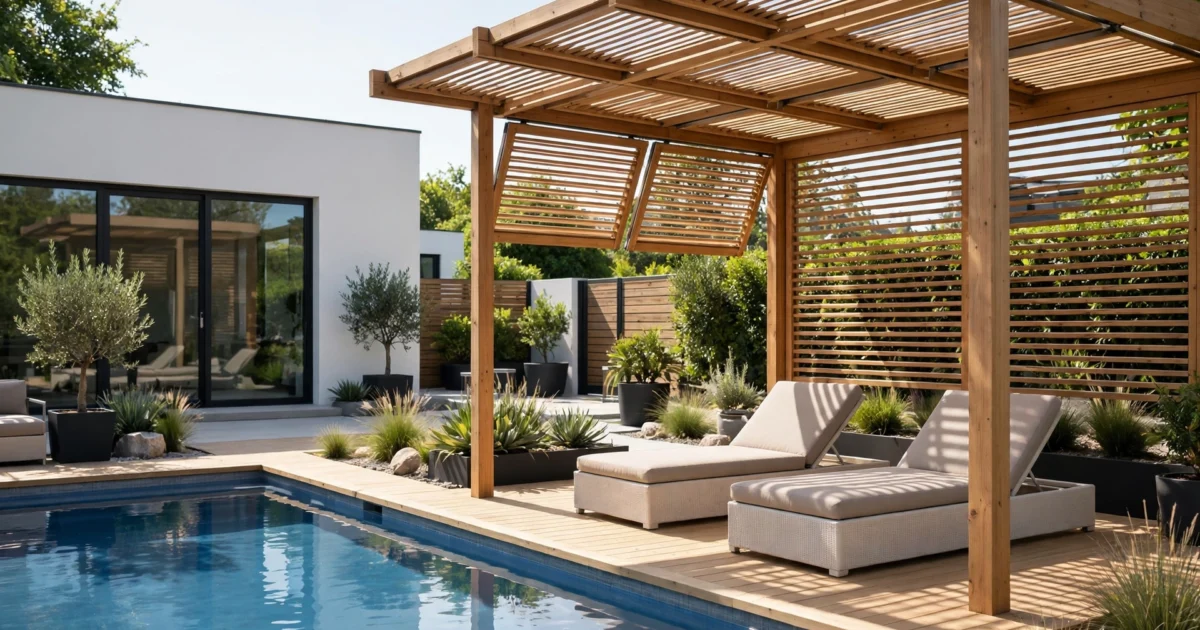
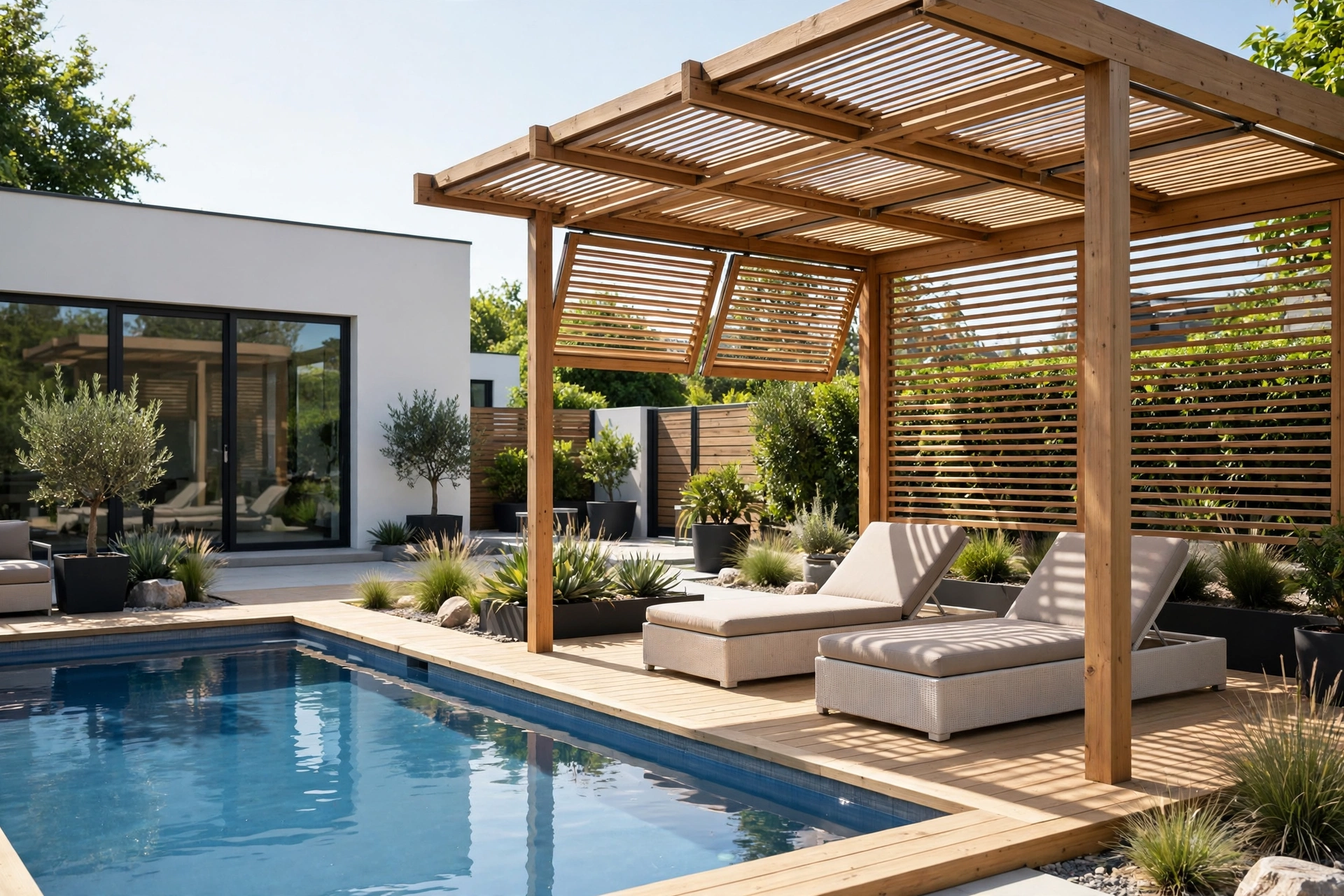
A pergola is the permanent answer: $1,500 to $9,000 or more, partial to full shade depending on the roof, and a real outdoor room that adds value to the house. A 12 x 16 ft pergola shades about 192 sq ft, so 1 structure covers a full lounge zone, and a louvered roof lets you open the slats for sun or close them for shade and light rain. Add a retractable canopy under the beams and you get adjustable shade without a second structure. Pergolas also carry lights, fans, and climbing plants, which is why they pair well with deck lighting ideas for evening use.
The price range is wide because the material and the roof decide it. A basic metal pergola kit runs $300 to $600 for the frame alone, while a built cedar or aluminum pergola with a louvered roof runs $5,000 to $9,000 or more installed. Wood needs annual oiling or sealing to hold its color near a pool, where chlorine splash and sun bleach it fast; powder-coated aluminum needs almost no upkeep and will not rust in salt air. Footings are the hidden line: a pergola needs concrete footings, and a footing drilled too close to the pool shell can crack the shell or void a warranty, so mark the pool edge before the crew digs. A pergola almost always needs a permit and an inspection because it is a permanent structure with foundations, so check with your local building department before you order. Hurricane-rated pergola options exist for storm-prone areas, and a well-anchored pergola is one of the strongest wind options on this list.
4. Solar Shade: $1,200 to $4,000, the Best Shade for Windy Decks
A solar shade, also sold as a zip shade, is a mesh screen that zips tight to its supports and blocks 90 percent or more of UV while still letting you see through it. Cost runs $1,200 to $4,000 depending on size and motorization. A 10 x 12 ft shade covers about 120 sq ft, so 2 shades cover a 200 sq ft zone for about $5,200. The mesh keeps bugs out, cuts glare on the water, and gives privacy from a neighbor’s second floor, which no sail or umbrella does.
Wind is where solar shades earn their price. The fabric zips into side tracks, so it cannot billow, and the motor retracts it on a sensor when sun or a storm arrives. That makes it the strongest pick for windy or coastal decks, alongside a well-anchored pergola. The trade is light: a 90 percent block still lets 10 percent of UV through, so it is not the pick for a baby’s play zone or for anyone who burns fast. Tracks also jam if chlorine and grit build up in them, so rinse the tracks monthly in pool season. Check the mesh rating before you buy: a shade that blocks 90 percent of UV is a different product from a privacy screen that blocks 50 percent, and the price does not always tell you which one you are holding.
5. Retractable Awning: $1,500 to $6,500, Shade Only When You Want It
A retractable awning costs $1,500 to $6,500, with motorized models at the top end, and it is the only permanent shade on this list that disappears on demand. Extend it on a hot afternoon, retract it on a mild evening, and the pool gets full sun when you want it. A 12 x 14 ft awning covers about 168 sq ft, so 2 awnings cover a 200 sq ft zone for about $8,000, which makes it the priciest way to shade a lounge zone that is not over the water.
The awning only fits a pool next to a house or a solid structure, because it mounts to a wall. A freestanding pool in the middle of a yard cannot take one. Wind sensors are not a luxury here: a motorized awning with wind and rain sensors retracts itself in a gust, and a manual awning left out in a storm tears its fabric or bends its arms. Replacement fabric runs $300 to $800, and a bent arm often means a full mechanism replacement, so the sensor pays for itself the first time you forget the awning is out. UV-resistant fabric is standard on good models, and an awning can cut deck temperature by 15 to 20 degrees F under it. Get a wall-mount inspection first if the house wall is older than the awning, because the mount loads go into the wall framing, not the siding.
6. Cantilever Structure: $3,000 to $20,000, Shade Over the Water Itself
A cantilever structure is the only shade on this list built to float over the pool itself: $3,000 to $20,000, with permanent supports on one side and the canopy reaching over the water with no posts in the way. A 20 x 20 ft structure shades about 400 sq ft of pool and deck in one span, which is why it costs $11,500 at mid-range and still looks cheap next to a second pool. It is also the shade that adds the most value to the house, because buyers read it as a permanent improvement, not an accessory.
Everything about a cantilever is engineered, and the price shows it. The footing on the support side carries the whole load, so it needs an engineered foundation, a permit, and an inspection, and the footing must sit clear of the pool shell and the fence setback. A footing poured too close to the shell can crack it, and a footing inside the setback can fail inspection and force a move. Budget the permit and the engineering on top of the $3,000 to $20,000 structure price, and expect a 4 to 8 week lead time for a custom build. If the budget does not stretch to a full cantilever, layered sails give you partial water shade for about $1,600, and a cantilever umbrella gives you shade over the loungers for $250 to $450 plus a heavy base.
7. Marquee: $800 to $3,000 for Parties and Seasonal Shade
A marquee costs $800 to $3,000 or more and gives full overhead coverage for a 10 x 10 ft area, about 100 sq ft per unit, so 2 marquees cover a 200 sq ft lounge zone for about $3,800. It goes up in an afternoon, comes in endless shapes and colors, and turns a pool deck into a party space with a roof. For a summer of weekend entertaining, it is the fastest full shade you can buy.
A marquee is seasonal, not permanent. It needs storage in winter, and a damp marquee folded into a bag grows mildew that costs $200 to $400 to clean or a full replacement canopy to fix. It is also the weakest option in wind: a marquee left up in a gust lifts, and the stakes that hold it are no match for a sail’s footings. Use it for parties and take it down between events, or leave it up only in a sheltered yard with a calm forecast. Do not buy a marquee as your everyday pool shade; buy it as your party shade, and buy umbrellas or a sail for the everyday job. For shade that also screens the neighbors, pair it with privacy ideas for a deck.

Which Shade Should You Buy: 4 Questions That Decide It
Four answers pick the shade, and the first one is budget. If your budget is under $1,000, buy umbrellas or 1 shade sail: 4 umbrellas shade 200 sq ft for about $800, and 1 sail shades 144 sq ft for $300 to $2,000. If your budget is $1,000 to $5,000, buy 2 sails or a pergola kit with a canopy: 2 sails cover 288 sq ft for about $1,600, and a pergola covers 192 sq ft for $5,250 at mid-range. If your budget is $5,000 to $10,000, buy a full pergola with a louvered roof or 2 solar shades. If your budget is over $10,000 and you want shade over the water, buy the cantilever structure.
Second, is the deck windy or coastal? If yes, buy a solar shade or a well-anchored pergola, and close any umbrella or awning before a gust. Awnings with wind sensors retract themselves, which is worth the motorized premium on an exposed deck. Third, do you want shade over the water or only over the loungers? Only layered sails and the cantilever structure shade the water, and only the cantilever does it in wind. Fourth, do you want it permanent or portable? Permanent means a pergola, a cantilever, or a mounted awning, plus a permit and footings. Portable means umbrellas, a marquee, or a sail you take down in winter. Answer those 4 and the list of 7 shrinks to 1 or 2.
7 Ways Pool Deck Shade Fails and What Each Fix Costs
Shade fails at the anchors, the fabric, and the footing, not in the middle of the canopy. Here are the 7 failures that show up most, with the fix priced from the same cost ladder used in the table above.
- Sail anchor pull-out. A post with a shallow footing leans or pulls out in the first big gust. Fix means a new engineered footing and re-tensioning: say $400 to $1,200 for 1 post, plus a new sail at $300 to $2,000 if the fabric tore.
- Umbrella projectile. A light base lets a gust lift the umbrella and throw it across the deck or into the pool. Fix means a proper base at 110 to 220 lbs plus a replacement canopy at $50 to $250 for a basic model.
- Awning fabric tear. A manual awning left out in a storm tears along the seam. Fix means new fabric at $300 to $800, and a bent arm can mean a full mechanism replacement at $1,500 or more.
- Pergola wood rot. Untreated or unsealed wood near the pool rots at the post bases from chlorine splash. Fix means post replacement and sealing: say $500 to $2,000, or choose powder-coated aluminum next time and skip the upkeep.
- Cantilever footing failure. An undersized footing settles and the canopy sags toward the pool. Fix means an engineered re-pour: say $2,000 to $5,000, which is why the footing is engineered before the build, not after.
- Solar shade track jam. Chlorine and grit build up in the side tracks and the shade sticks halfway. Fix means a track clean and re-lube at $100 to $300, or a motor replacement at $400 to $900 if the motor burned out fighting the jam.
- Marquee mildew. A damp marquee stored folded grows mildew over winter. Fix means a professional clean at $200 to $400, or a new canopy at $800 to $3,000 if the fabric is stained through.
The cheapest insurance on this list is free: close umbrellas and retract awnings before a storm, take sails down before winter, and rinse solar shade tracks monthly in pool season.
Before You Buy: 6 Measurements and Checks
Work through this list before you order anything, and write your own numbers in the blanks.
- Lounge zone size: measure the area you want shaded in feet. Length ___ ft x width ___ ft = ___ sq ft. Compare it with the 200 sq ft zone in the table above.
- Sun path: note where the sun sits at 2 p.m. and 4 p.m. in July. Shade that sits east of the loungers at 4 p.m. shades nothing.
- Wind exposure: rate the deck calm, breezy, or coastal. Coastal or breezy means a solar shade, a pergola, or a wind-sensor awning.
- Fence setback: measure from the pool fence line to each planned post or footing. Distance ___ ft. Check the setback rule with your local building department before you dig.
- Pool shell clearance: mark the pool edge and keep footings at least 3 ft clear unless an engineer signs off on a closer footing.
- Permit check: portable umbrellas and marquees typically need no permit. Pergolas, cantilevers, and sail posts may need one. Call the building department and ask before you pay a deposit.
6 Questions About Pool Deck Shade Ideas
What is the cheapest way to shade a pool deck?
Umbrellas are the cheapest way, starting at about $50 for a basic model with no install. For broader coverage on a budget, shade sails start at about $300 per sail and can be layered for full coverage with a DIY install.
Do pool shade structures need a permit?
It depends on the structure and local rules. Freestanding pergolas and cantilevers are more likely to need permits and inspections because they have permanent foundations. Portable umbrellas and marquees typically do not. Shade sail posts may also need to meet pool fence setback rules, so check with your local building department first.
What pool shade is best for windy areas?
Solar shades and well-anchored pergolas are the strongest options for windy or coastal decks. Solar shade fabric zips tight to its supports so it cannot billow, and retractable awnings with wind sensors retract themselves in high gusts. Umbrellas with a double-top vent carry a maker rating of 35 mph in the best-evidenced models.
How much shade do I need for a pool deck?
Shade the lounge zone, not the whole yard. A 200 sq ft lounge zone needs 4 umbrellas, 2 sails, 1 pergola, or 1 cantilever structure. Shade the loungers first, then the dining set, and only shade the water if you buy layered sails or a cantilever.
Can a shade sail cover the pool itself?
Yes, layered sails can span part of the water, and a cantilever structure is built to cover the pool and the deck. A sail over the water needs engineered anchors and a pitch for rain drainage, and it must come down before a storm.
Does pool shade really cut chlorine loss?
Yes. Quality shade blocks 95 to 98 percent of UV, and that cuts chlorine loss by 20 to 30 percent, because UV breaks chlorine down. It also cuts deck temperature by 15 to 20 degrees F and slows water evaporation, so you refill less often.
Editorial Note: This guide was researched and written by our small editorial team under the pen name Dave Hendrick. We are homeowners and researchers, not licensed contractors. Prices are typical national ranges, not quotes — confirm locally before you buy.