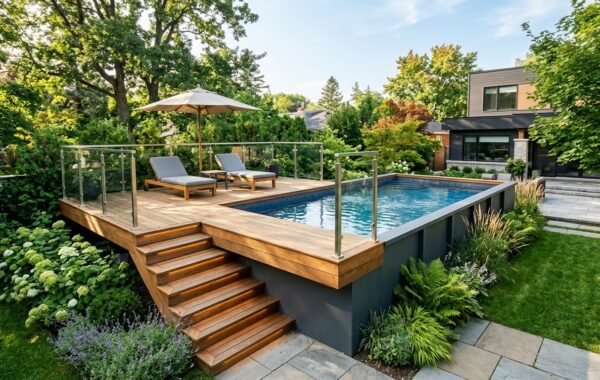


Above Ground Pool Deck Ideas on a Budget: 10 Ranked
Rubber tile over the deck you already have wins. It costs $400 over 10 years, the lowest total of the 10 ideas below. A half-wrap deck loses at $9,000. Every idea is ranked by its real 10-year cost: build price plus maintenance plus rebuilds. Sticker price lies. A $200 pallet deck that gets rebuilt 3 times costs more than a $400 tile job that lasts a decade. If you want full framing plans first, our above-ground pool deck plans guide covers 4 layouts with spans and footing counts.
One rule drives the ranking. Assume pressure-treated wood needs sealing or staining every 2 years at $150 a job, and solar-free materials last as long as their rated life. A deck that costs $2,500 to build and $750 to maintain over 10 years really costs $3,250. Compare that number, not the build price, and the ranking changes completely.
10 Above-Ground Pool Deck Ideas on a Budget, Ranked by 10-Year Cost
The cheapest idea over 10 years is rubber tile at $400. The most expensive is a half-surround deck with seating at $9,000. The table below shows the full math for all 10 ideas: build cost, maintenance and rebuilds in 10 years, and the 10-year total. Every total assumes a round or oval pool 18 to 24 ft across and a deck the size stated in the row.
| Rank | Idea | Size | Build cost | Maintenance + rebuilds in 10 yrs | 10-year total |
|---|---|---|---|---|---|
| 1 | Rubber tile over existing deck | 100 sq ft | $400 | $0 | $400 |
| 2 | Pallet platform | 8×8 ft | $200 | $600 (3 rebuilds) | $800 |
| 3 | Gravel and paver combo | 200 sq ft | $800 | $500 | $1,300 |
| 4 | Pea gravel surround | 200 sq ft | $600 | $800 | $1,400 |
| 5 | Integrate into existing deck | Stairs + gate + small platform | $1,500 | $300 | $1,800 |
| 6 | Narrow walkway | 2-3 ft wide, full perimeter | $2,000 | $750 | $2,750 |
| 7 | Single-side platform, PT wood | 8×12 ft | $2,500 | $750 | $3,250 |
| 8 | Floating deck | 12×12 ft | $3,300 | $750 | $4,050 |
| 9 | Quarter-wrap deck | 24 ft round pool | $5,000 | $750 | $5,750 |
| 10 | Half-surround with seating | 24 ft round pool | $8,000 | $1,000 | $9,000 |
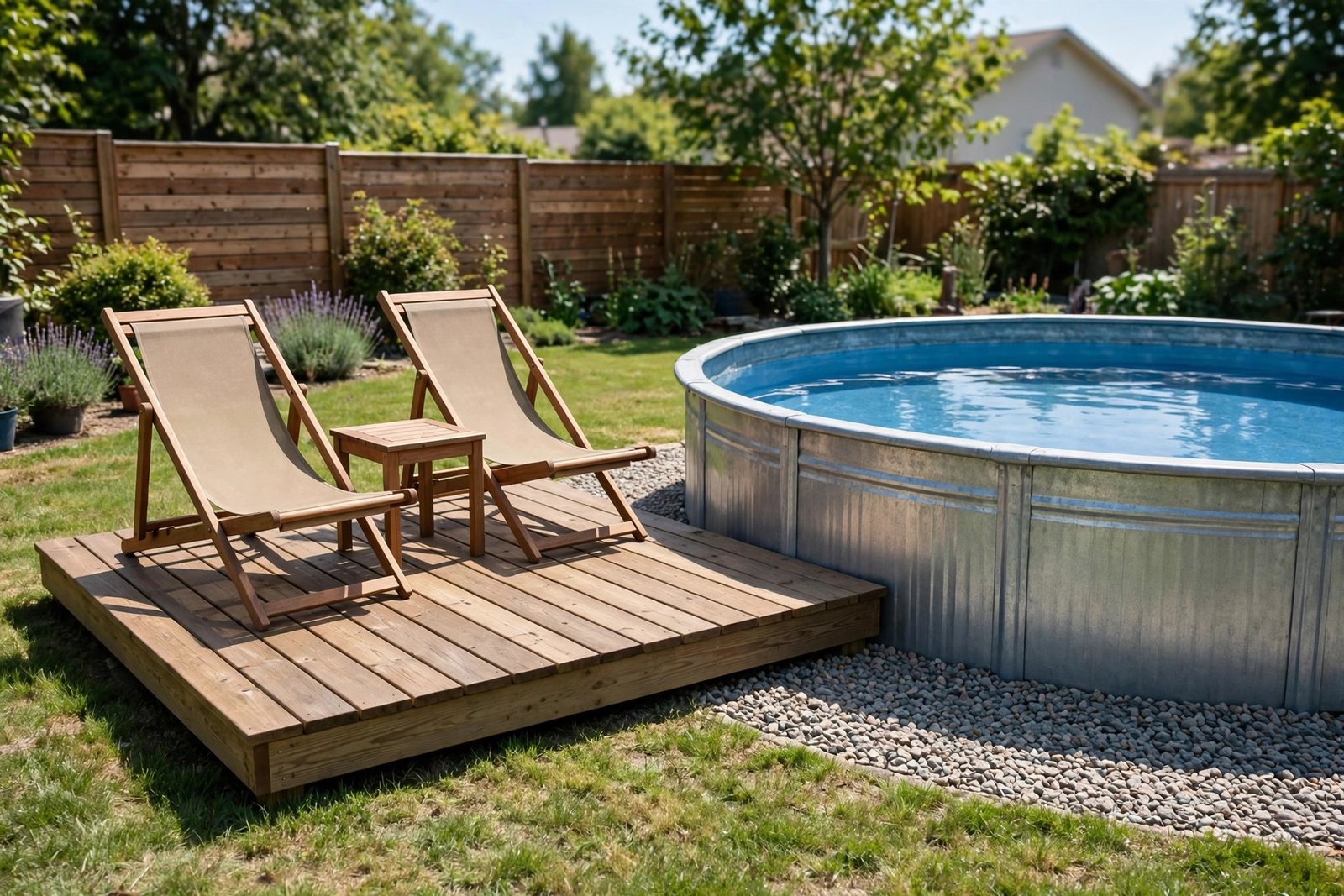
1. Rubber tile over existing deck — $400 over 10 years
Interlocking rubber tiles laid over the deck boards you already have. Best for: a dated deck that is solid underneath but looks tired. Typical cost: rubber tile starts at around $4 per square foot, so 100 sq ft costs $400. Downside: it only works if the deck underneath is level and sound. Rotten boards underneath stay rotten. The stat that earns rank 1: $40 per year all-in, and zero maintenance in 10 years.
2. Pallet platform — $800 over 10 years
A low platform built from reclaimed shipping pallets, sanded and screwed to a simple frame. Best for: renters and temporary pools, where the deck comes apart at the end of the season. Typical cost: $200 if the pallets are free. Downside: pallet wood rots fast at ground level, splinters under bare feet, and carries no rails, so it is an entry platform, not a real deck. The stat that earns rank 2: $800 over 10 years, but only because you rebuild it 3 times.
3. Gravel and paver combo — $1,300 over 10 years
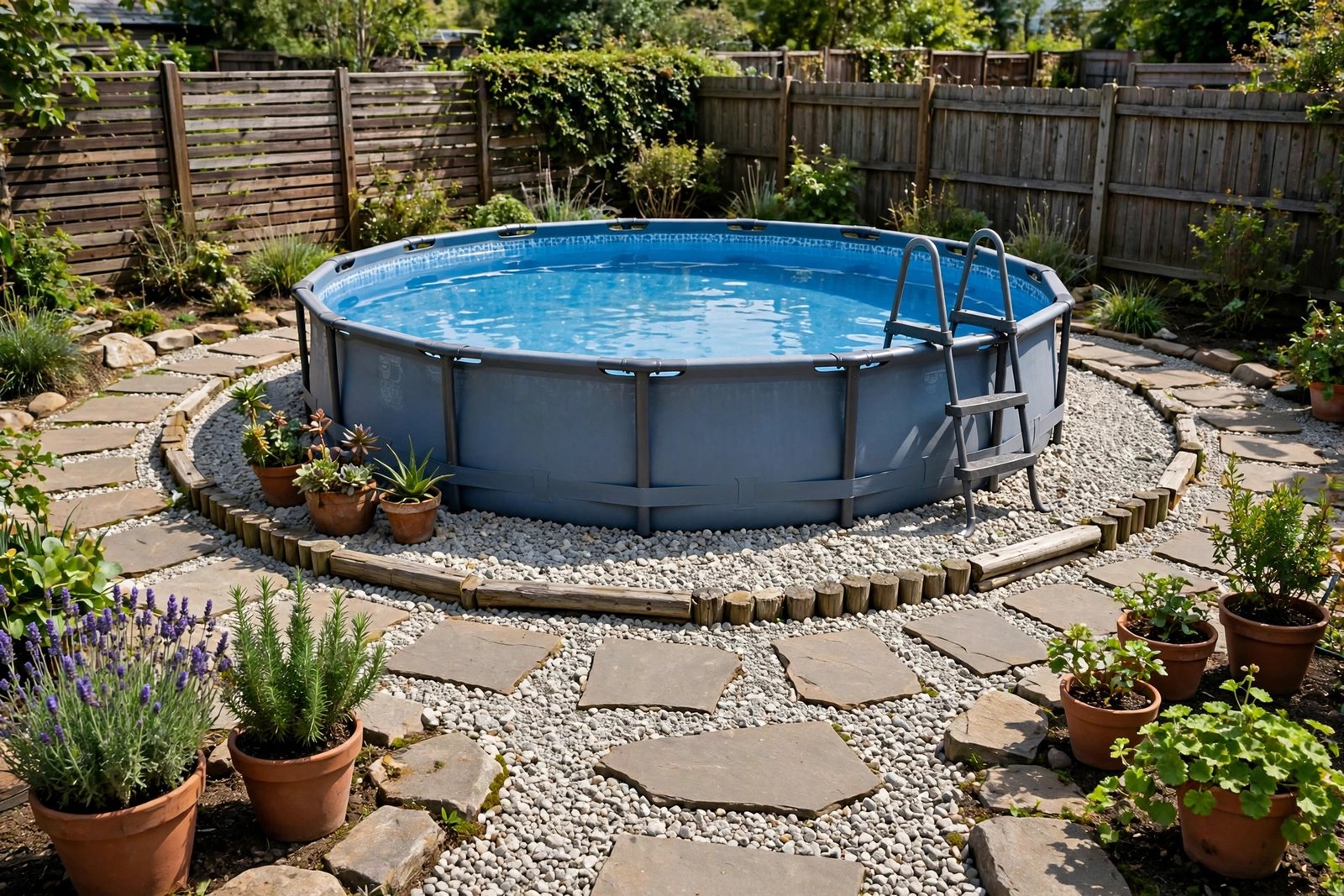
A compacted gravel border with flat stepping pavers set into it around the pool. Best for: stock tank and Intex pools where a framed deck makes no sense. Typical cost: $800 for 200 sq ft at $3 to $5 per square foot. Downside: gravel migrates onto the lawn and into the pool, so it needs topping up every year or two. The stat that earns rank 3: no framing, no rails, and no permit in most areas, which is where the savings come from.
4. Pea gravel surround — $1,400 over 10 years
Pea gravel alone, 3 to 4 in. deep over landscape fabric, edged with treated wood or metal. Best for: the cheapest full surround for any above-ground pool. Typical cost: $600 for 200 sq ft. Downside: bare feet on gravel get old fast, and chairs sink into it. The stat that holds rank 4: $80 a year in top-up gravel, the only running cost.
5. Integrate into existing deck — $1,800 over 10 years
Put the pool next to the deck you already have and build only stairs, a gate, and a small landing. Best for: homeowners with a sound back deck who want pool access without a second structure. Typical cost: $1,500 for stairs, gate, and landing. Downside: the pool has to sit in exactly the right spot, and moving it later costs the whole job again. The stat that earns rank 5: you reuse $3,000 or more of existing deck instead of building it twice.
6. Narrow walkway — $2,750 over 10 years
A walkway 2 to 3 ft wide around the full pool perimeter, just wide enough for skimming, vacuuming, and covering the pool. Best for: pool care access on a tight budget. Typical cost: $2,000 in lumber and boards. Downside: too narrow for chairs, so it is a work path, not a lounge deck. The stat that earns rank 6: half the lumber of a full wrap, because the deck is 3 ft wide instead of 6 ft.
7. Single-side platform, PT wood — $3,250 over 10 years
An 8 by 12 ft platform on one side of the pool with wide entry steps. Best for: the cheapest real deck with room for 2 chairs and a towel shelf. Typical cost: $2,500 to build, plus $750 of sealing over 10 years. Downside: it covers 15 to 25 percent of the pool, so the far side stays bare wall. The stat that earns rank 7: pressure-treated wood costs about $1 to $2 per linear foot, the lowest material price of any deck board. If you want the full build sequence, our how to build a pool deck guide covers footings, beams, and rails step by step.
8. Floating deck — $4,050 over 10 years
A low deck on concrete blocks or piers, built next to the pool instead of attached to the house. Best for: the most common budget build, because it skips deep footings and house attachment. Typical cost: $3,300 for a 12 by 12 ft deck. Downside: low decks trap moisture underneath, so the framing needs ground-contact treatment and airflow gaps. The stat that earns rank 8: floating decks are the most common and recommended option for above-ground pools, because they never touch the pool wall.
9. Quarter-wrap deck — $5,750 over 10 years
A deck wrapping about a quarter of a round pool, with room for chairs and a small table. Best for: round pools where a half-wrap is too much deck and a platform is too little. Typical cost: $5,000 to build. Downside: curved framing means angled cuts and more waste, about 20 percent more lumber than a straight run. The stat that earns rank 9: it covers the side facing the house, so the pool reads as built-in from the patio doors.
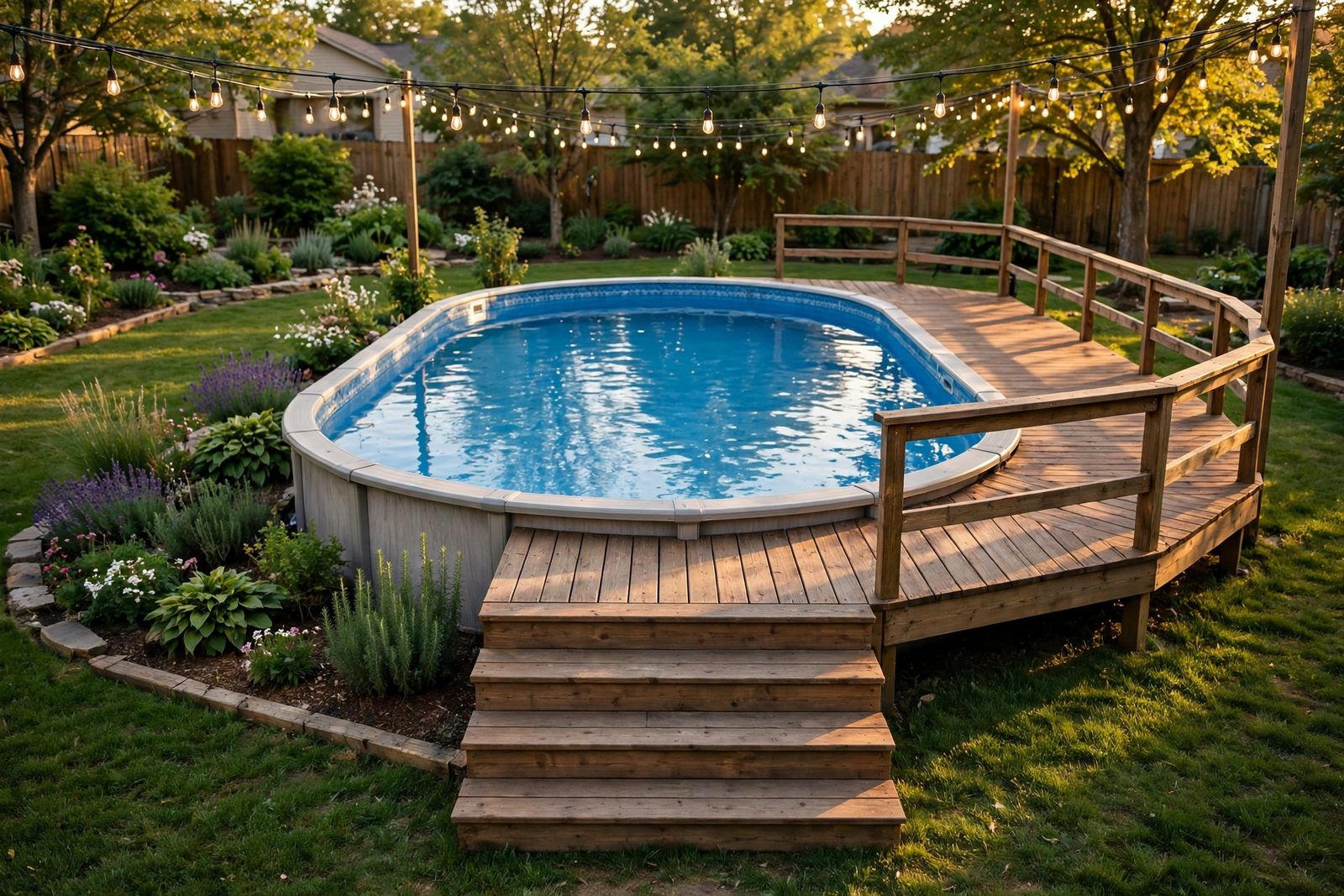
10. Half-surround with seating — $9,000 over 10 years
A deck hugging half the pool with built-in benches and a dining zone. Best for: families who entertain at the pool 3 or more nights a week. Typical cost: $8,000 to build, plus $1,000 of maintenance. Downside: the highest cost on this list, and it still leaves half the pool wall exposed. The stat that puts it last: $900 per year all-in, more than double the floating deck.
How These 10 Ideas Were Ranked
By 10-year total cost, nothing else. Each total adds the build cost, 10 years of maintenance, and the rebuilds the material actually needs. Pressure-treated wood needs sealing every 2 years at $150 a job, which is $750 in a decade. Pallet wood rots in 3 years, so it gets rebuilt 3 times. Rubber tile needs nothing. That is why a $200 pallet deck ends up costing twice as much as a $400 tile job. If your only goal is the lowest day-1 price, buy pallets. If your goal is the lowest cost per summer of use, buy the idea with the lowest 10-year total.
1 Worked Example: A 12×16 Ft Side Platform, Line by Line
A 12 by 16 ft side platform for a 24 ft round pool costs $3,120 in materials and takes 40 to 56 hours for a first-time DIY builder. The line items: framing lumber $900, decking boards $700, hardware and hangers $250, rails and gate $600, entry stairs $400, stain and sealer $120, permit $150. Total: $3,120. A pro crew adds $2,200 to $3,600 in labor for the same deck. The 3 numbers that move the total most are the decking boards, the rails and gate, and the stairs. Cut the stairs to a simple 3-step run and the total drops $200. Skip the rails on a deck under 30 in. high, where your code allows it, and the total drops $600. Pressure-treated wood lasts approximately 10 to 15 years with diligent maintenance, so budget $150 every 2 years for sealing or the 10-year total climbs past $3,900. If you want the same math for the whole project, our pool deck cost guide breaks down every material per square foot.
3 Budget Mistakes That Cost the Most to Fix
The most expensive mistake is attaching the deck to the pool wall. Above-ground pool walls are not structural, and a deck bolted to one voids the pool warranty and bends the wall as the deck moves. The fix is rebuilding the deck freestanding with a 1 to 3 in. gap, which costs $1,500 to $4,000 depending on size. Build freestanding from day 1 and leave the gap.
The second mistake is skipping rails and a gate on an elevated deck to save money. An inspector fails the deck, and adding rails after the fact costs more than building them in: professional railing installation costs around $1,000 on its own, plus the gate hardware. Price the rails and the self-closing gate into the first budget, not the second one.
The third mistake is building straight onto bare dirt with no drainage base. Ground-contact framing in standing water rots in 3 years instead of 15, and the rebuild costs the full $2,500 platform price again. A gravel base and 6 in. of airflow under the frame cost $150 in gravel and add 10 years to the frame. That is the best $150 in the whole build.
Which Idea Should You Pick First? 4 Questions That Decide It
Four questions sort the 10 ideas into a buying order. Question 1: do you already have a sound deck? If yes, pick rubber tile or integrate the pool into it. Both cost under $1,800 over 10 years. Question 2: is your budget under $500? If yes, pick gravel and pavers. It is the only real surround under $1,500 that lasts a decade. Question 3: do you rent, or is the pool temporary? If yes, pick the pallet platform or gravel. Both come apart without a trace. Question 4: do you want a real deck with chairs? If yes, pick the single-side platform. It is the cheapest framed deck at $3,250 over 10 years, and entry-level composite costs about $2 to $5 per linear foot and lasts 25 to 35 years, so upgrading the boards later doubles the deck life for about $400 more. Our pool deck safety codes guide covers the rail, gate, and barrier rules to check before you build.
Pre-Build Checklist: 8 Checks Before You Order
Run these 8 checks before you spend anything. They take 30 minutes and catch the 3 mistakes above.
- [ ] Pool height measured: deck surface must sit 1 to 3 in. below the pool rim, never above it
- [ ] Gap confirmed: 1 to 3 in. between deck edge and pool wall, so the liner can be replaced
- [ ] Footing plan: concrete blocks or piers, never bare posts on dirt, and below frost depth in cold areas
- [ ] Rail and gate priced: rails, balusters, and a self-closing gate are in the first budget, not the second
- [ ] Permit checked: many areas require a permit for permanent structures over 200 sq ft or over 30 in. high
- [ ] Lumber grade: ground-contact framing treated to UC4A, not above-ground UC3B
- [ ] Drainage base: 3 to 4 in. of gravel under the frame, with airflow gaps between boards
- [ ] Budget buffer: 20 percent contingency on the materials total, because lumber prices move
6 Questions About Above-Ground Pool Decks on a Budget
What is the cheapest above-ground pool deck to build?
Pressure-treated wood on a single-side platform. Pressure-treated wood costs about $1 to $2 per linear foot, and an 8 by 12 ft platform costs $2,500 to build. Gravel with pavers is cheaper at $800, but it is a surround, not a deck.
How much does a small above-ground pool deck cost?
$2,500 to $3,300 for a small framed deck: an 8 by 12 ft side platform at $2,500, or a 12 by 12 ft floating deck at $3,300. A pro crew adds $2,200 to $3,600 in labor. A gravel surround for the same pool costs $600 to $800.
Can I build an above-ground pool deck myself?
Yes for a platform or floating deck under 200 sq ft: 40 to 56 hours for a first-timer with a circular saw, drill, and level. Hire a pro for wraparound decks, multi-level decks, and anything with complex curved framing.
Do I need a permit for an above-ground pool deck?
In many areas, yes for permanent structures over 200 sq ft or over 30 in. high. Low floating decks and gravel surrounds usually need none. Confirm the threshold with your city before you order lumber.
How long does a pressure-treated pool deck last?
Pressure-treated wood lasts approximately 10 to 15 years with diligent maintenance, which means sealing every 2 years. Skip the sealing and the life drops to 5 to 7 years in wet, sunny yards.
Should the deck touch the pool wall?
No. Leave a 1 to 3 in. gap between the deck edge and the pool wall. The gap lets you replace the liner, lets the pool flex with water pressure, and keeps the deck warranty intact. A deck attached to the wall voids the pool warranty.
Editorial Note: This guide was researched and written by our small editorial team under the pen name Dave Hendrick. We are homeowners and researchers, not licensed contractors. Prices are typical national ranges, not quotes — confirm locally before you buy.