
Choosing between kool deck vs acrylic lace coatings determines your summer barefoot comfort. The right surface keeps your concrete deck cool and slip resistant. Authentic Mortex Kool Deck lowers surface temperatures by up to 28 degrees Fahrenheit using natural stone aggregates. In contrast, acrylic lace coatings form a resilient resin shield. They cost less to install and resist saltwater stains effectively.
Both pool deck resurfacing methods create textured, slip-resistant finishes. However, homeowners often confuse their formulation, durability, and maintenance requirements. This contractor guide breaks down barefoot heat tests and wet slip ratings. You will also discover exact installed costs and repair steps. This information will help you select the ideal finish for your pool surround.
Quick Comparison: Mortex Kool Deck vs Acrylic Lace Coating
The table below summarizes the key engineering, financial, and performance metrics between authentic cementitious Kool Deck and acrylic lace knockdown coatings.
| Performance Feature | Authentic Mortex Kool Deck | Acrylic Lace Knockdown Coating |
|---|---|---|
| Primary Composition | Natural marble aggregate, volcanic stone, white Portland cement | Waterborne acrylic polymer resin, silica sand, color pigments |
| Application Timing | Troweled directly into fresh, uncured concrete during pour | Sprayed and knocked down over existing cured concrete slabs |
| Barefoot Surface Temperature | 20 to 28 degrees Fahrenheit cooler than plain concrete | 10 to 18 degrees Fahrenheit cooler than plain concrete |
| Wet Slip Resistance (ANSI A326.3) | DCOF 0.58 to 0.65 (High traction wet profile) | DCOF 0.50 to 0.56 (Moderate traction wet profile) |
| Installed Cost Per Square Foot | $6.00 to $11.00 (New pour application) | $4.00 to $7.50 (Resurfacing over existing slab) |
| Expected Lifespan | 15 to 25 years with proper penetrating sealers | 8 to 12 years before requiring a protective color recoat |
| Saltwater Pool Resistance | Moderate (Sensitive to salt crystallization if unsealed) | High (Impermeable acrylic resin repels salt water) |
| Stain and Oil Resistance | Moderate (Porous natural aggregate requires sealing) | High (Resists barbecue grease, sun tan oils, and leaf tannins) |
If you are also evaluating manufactured stone or modular options, consult our detailed comparison of travertine vs concrete pavers for pool decks to explore thermal differences.
Related: Pool Covers for Above Ground Pools with Decks: Types & Cost
What Is Authentic Mortex Kool Deck?
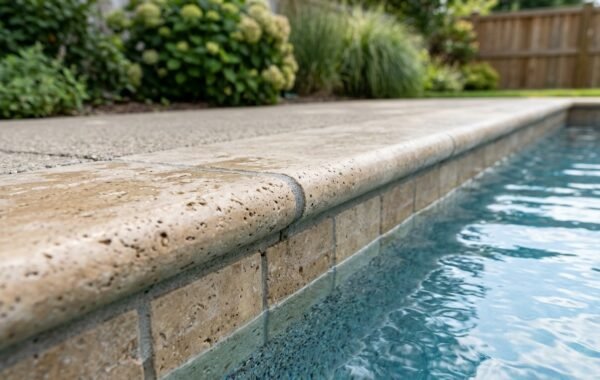
Mortex Kool Deck is a patented cementitious topping invented in 1962. It consists of crushed white marble, natural volcanic aggregate, mineral pigments, and Portland cement. Installers apply the powder mixture directly onto freshly poured concrete while the base slab is still wet.
The crew floats the topping into the wet concrete cream. Next, they texture the surface and knock down high spots with a pool trowel. Authentic Kool Deck cures monolithically with the fresh slab. As a result, it becomes an inseparable chemical part of your concrete.
The secret behind its heat dissipation lies in its thermal porosity. The volcanic stone aggregate reflects solar infrared rays efficiently. In addition, it dissipates stored thermal energy into the ground faster than synthetic coatings.
What Is Acrylic Lace Knockdown Coating?
Acrylic lace is often called knockdown texture or spray deck. Contractors install this polymer coating over both new and existing concrete. The system combines high-grade acrylic resins, fine quartz sand, and Portland cement with liquid latex bonding agents.
Contractors prep the existing concrete slab through diamond grinding or acid etching. Next, they spray the acrylic slurry through a hopper gun to create splatter droplets across the deck. The sprayed texture sets partially after five to ten minutes. Then, installers run a flat trowel across the ridges to create a smooth lace pattern.
Finally, workers seal the surface with two coats of pigmented acrylic deck paint. This non-porous topcoat protects the texture from moisture penetration. It also creates a clean, uniform satin luster.
Barefoot Heat Test: Surface Temperatures Compared
Summer heat is a primary concern for swimming pool owners with small children and pets. Bare feet feel pain on surfaces at 115 degrees Fahrenheit. Direct skin contact above 125 degrees can cause burns within one minute.
The test data below displays actual deck temperatures under full midday sun. All readings were recorded on a 95-degree summer afternoon.
| Deck Surface Material | Recorded Surface Temperature | Barefoot Comfort Level |
|---|---|---|
| Standard Gray Poured Concrete | 134 degrees Fahrenheit | Extremely painful; immediate blistering risk |
| Dark Stamped Concrete (Sealed) | 142 degrees Fahrenheit | Dangerous; impossible to walk barefoot |
| Acrylic Lace Coating (Light Tan/Beige) | 118 degrees Fahrenheit | Tolerable for brief walks; warm to skin |
| Authentic Mortex Kool Deck (White/Ivory) | 108 degrees Fahrenheit | Comfortable barefoot walking; cool to touch |
| Tumbled Ivory Travertine Pavers | 106 degrees Fahrenheit | Coolest natural stone surface available |
Kool Deck clearly outperforms acrylic lace in extreme southern climates. Read our complete ranking of pool deck materials by heat resistance to see more tests.
Wet Slip Resistance and Safety Standards
Pool surroundings must maintain high traction when wet to comply with national safety standards. The ANSI A326.3 Standard requires a wet DCOF above 0.42. However, reputable pool contractors target 0.55 or higher for wet decks.
Authentic Kool Deck achieves a wet DCOF between 0.58 and 0.65 naturally. Its open aggregate pores absorb surface moisture quickly. Consequently, bare feet stay in direct contact with textured stone edges.
Acrylic lace delivers a wet DCOF of 0.50 to 0.56. While its knockdown profile breaks up hydroplaning, slick acrylic topcoats can reduce grip. Therefore, professional installers always mix micronized polymer beads, such as SharkGrip, into the final acrylic clear coat. For detailed application steps, review our recommendations for the best non-slip coating for wet concrete pool decks.
Durability, Saltwater Exposure and Maintenance
Chemical exposure around chlorinated and saltwater pools impacts the lifespan of your deck finish.
Saltwater pools generate sodium chloride splash-out that seeps into porous surfaces. As water evaporates, salt crystals expand inside microscopic pores. Kool Deck has a porous mineral structure. Therefore, apply a penetrating silane-siloxane sealer every two to three years to prevent salt damage.
Conversely, acrylic lace coatings feature a non-porous polymer barrier that naturally resists saltwater penetration. However, topical acrylic coatings are susceptible to delamination if hydrostatic moisture pushes up from beneath the slab.
Routine maintenance differs between both surfaces:
- Kool Deck Cleaning: Wash with neutral pH cleaners and light fan-spray pressure washing. Keep pressure under 1,800 PSI to avoid dislodging aggregate edges.
- Acrylic Lace Cleaning: Withstands pressure washing up to 2,500 PSI. In addition, you can spot-clean grease and oils with mild household degreasers.
- Sealer Requirements: Review our comprehensive step-by-step instructions on how to seal a pool deck for every surface chemistry.
Repair Costs and Patching Realities
Concrete slabs crack over time due to soil movement and shrinkage. How each coating responds to crack repairs is an important factor for homeowners. Before any patch goes on, good crews grind the edges to a surface profile set by the International Concrete Repair Institute so the new material bonds.
Patching authentic Kool Deck requires skilled workmanship. Because original Kool Deck fades evenly under sunlight over years, fresh cementitious patch kits dry in a noticeably different shade. Contractors can inject flexible elastomeric sealants into cracks. However, matching the aged color requires recoloring the entire deck slab. For diagnosis steps, read our guide on how to fix cracks in a concrete pool deck.
In contrast, acrylic lace is exceptionally easy to repair and blend. A contractor can grind out the crack and apply matching acrylic texture. Then, rolling fresh deck paint blends the repair seamlessly.
Contractor Verdict: Which Coating Should You Choose?
Follow these practical guidelines to pick the right coating for your home:
Choose Authentic Mortex Kool Deck if:
- You are pouring brand new concrete slabs around your pool.
- You live in an intense summer climate with regular 95-degree to 110-degree Fahrenheit days where barefoot heat is the primary concern.
- You want a natural mineral surface that bonds permanently to concrete without the risk of topical peeling or bubbling.
Choose Acrylic Lace Knockdown Coating if:
- You are renovating an existing cured concrete pool deck with cosmetic stains or minor cracks.
- You manage a saltwater pool system and want superior protection against chemical bleaching.
- You want lower installation costs ($4.00 to $7.50 per square foot) and the flexibility to change deck paint colors every decade.
Frequently Asked Questions
Hover or tap any question below to reveal the answer.
Can you apply Kool Deck over existing dry concrete?
For existing concrete pool decks, contractors install acrylic lace knockdown coatings or modified polymer resurfacing overlays.
How much cooler is Kool Deck compared to regular concrete?
As a result, bare feet remain comfortable even in direct summer sun.
Does acrylic lace coating peel off?
Surface failure only occurs when applied over dirty, unetched, or damp concrete.
How often does an acrylic lace pool deck need repainting?
In northern climates, the coating lasts 8 to 10 years.