
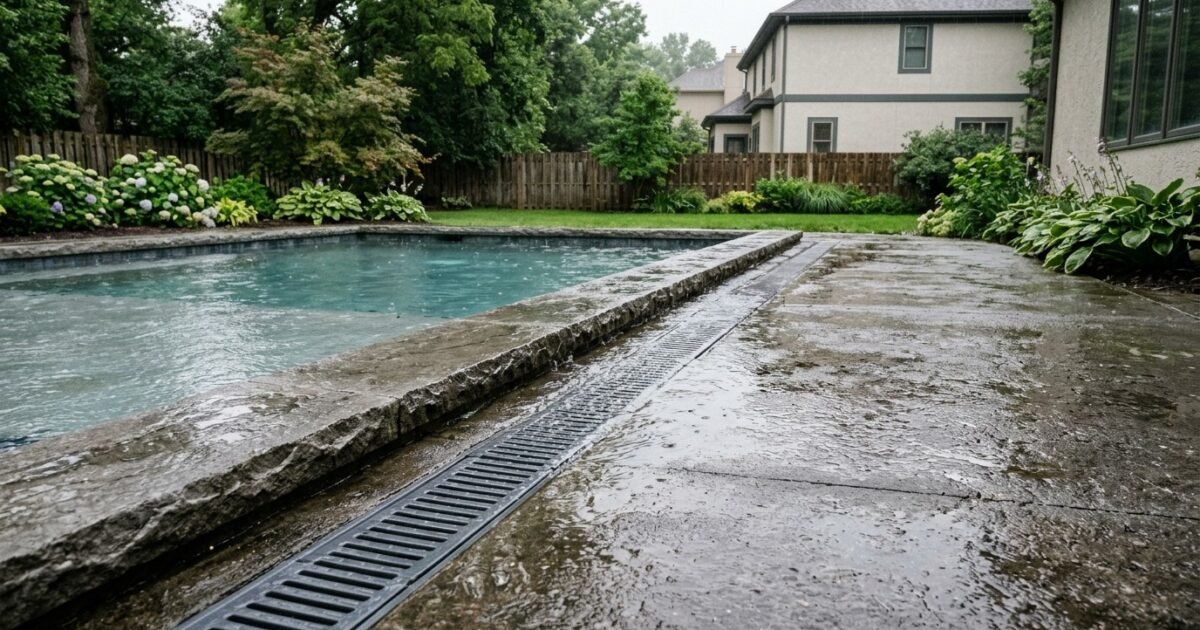
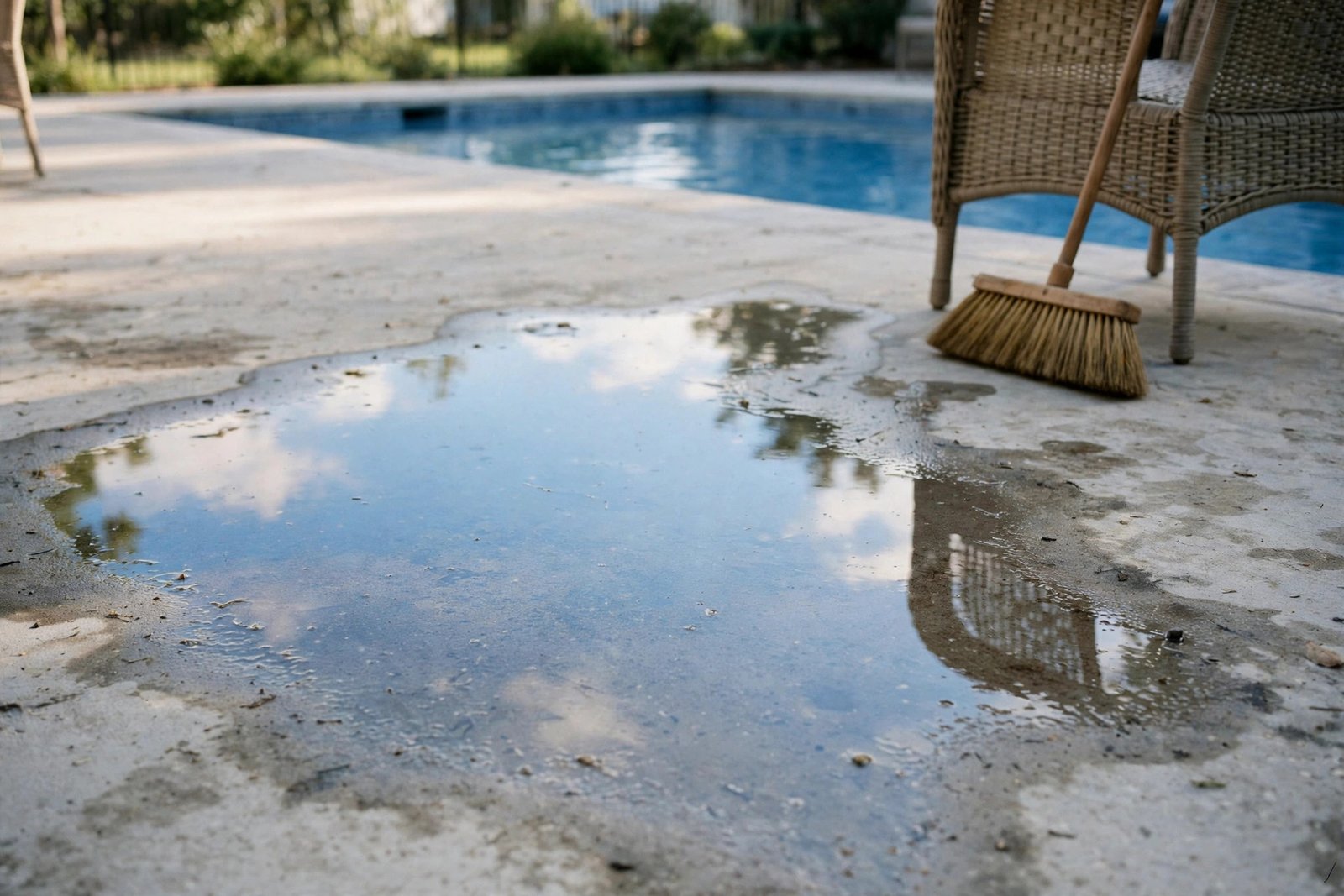
Standing puddles on a pool deck are more than a slip hazard. They are an engineering failure. Water that pools against house foundations, seeps beneath coping stones, or drains backward into the pool water brings fertilizer, dirt, and bacteria that wreck water chemistry and crack concrete.
Proper drainage requires two coordinated systems: a precise surface slope that sheds water away from the coping, and a channel collection system that moves rainwater off the property.
Code Slope Requirements: The 1/4-Inch Rule
Local building codes and the ANSI/APSP/ICC-5 residential pool standard set strict minimum slopes for residential pool decks:
- Textured Concrete & Pavers: Minimum slope of 1/4 inch per horizontal foot (approx. a 2% grade) sloping away from the water edge.
- Smooth Troweled Surfaces: Minimum slope of 1/8 inch per foot (allowed only on non-porous smooth finishes, rarely used outdoors).
- Maximum Allowable Slope: Slopes should never exceed 1/2 inch per foot (4%) to prevent furniture tipping and uncomfortable walking angles for bare feet.
For a standard 8-foot-wide pool deck surround, a 1/4-inch-per-foot slope means the outer perimeter edge must sit exactly 2 inches lower than the coping edge adjacent to the pool water.
How to Test Your Deck Slope with a Level and a Tape
A 4 ft. level and a tape measure tell you the fall in under five minutes. Set the level on the deck with one end toward the pool and the other toward the outer edge. Lift the outer end until the bubble centers, then measure the gap under the lifted end. That gap over 4 ft. is your fall. A 1-inch gap means 1/4 inch per foot, which matches the minimum slope in the section above. Less than 1 inch means water will sit instead of sheeting off.
Test at least four spots: near two corners, at the middle of the longest run, and at the lowest edge you can see. For a second check, run a garden hose at the high edge and watch where the water goes. It should move away from the coping and reach the drain line or the outer edge within 20 to 30 minutes. Water that still sits after half an hour marks the low spot you need to fix. Confirm the local pool deck safety codes before you build or regrade.
The 4 Common Pool Deck Drain Systems Compared
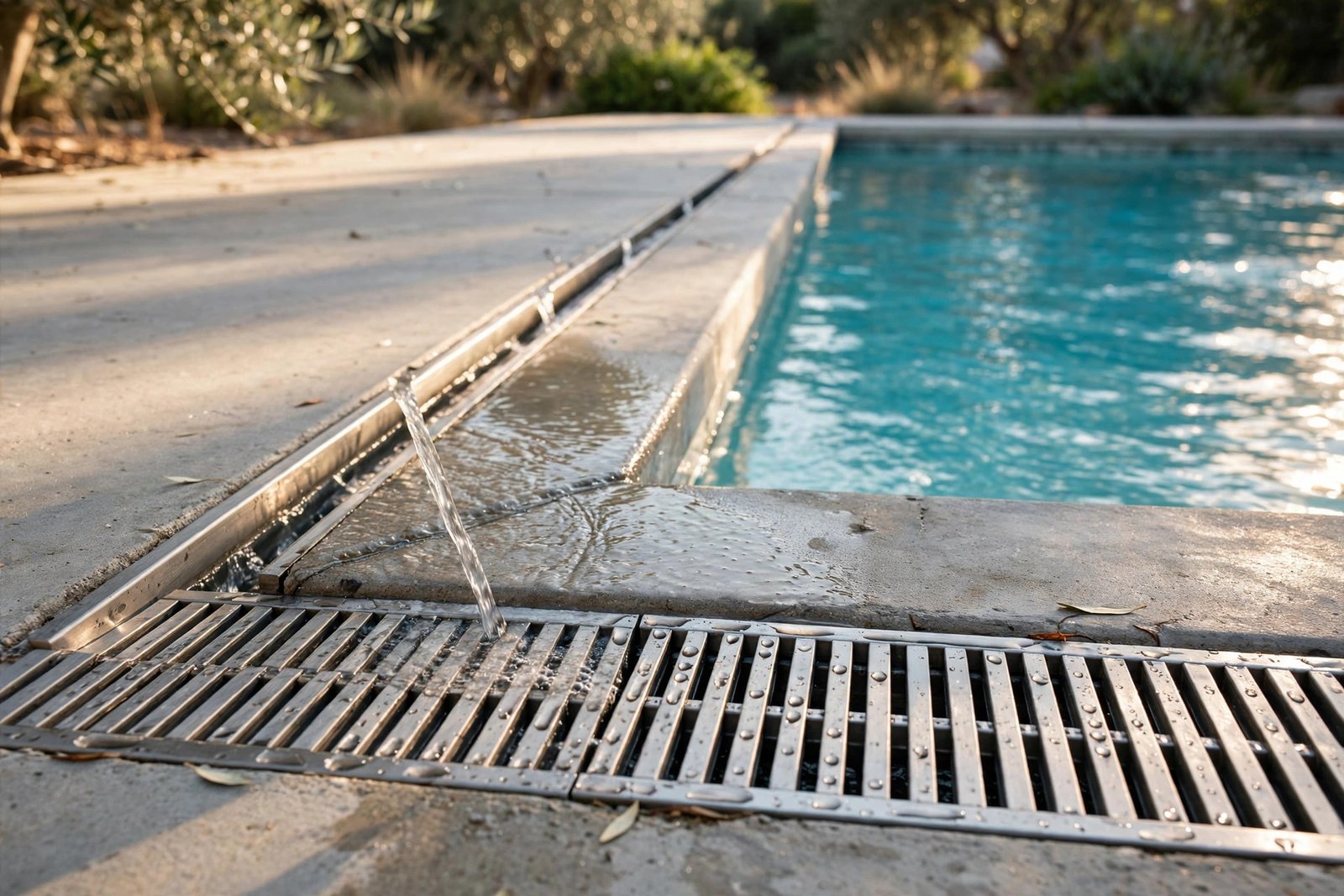
When deck slope sends water toward a house, retaining wall, or lawn boundary, you must install an integrated collection drain. Here are the four primary systems used in modern pool construction:
| Drain Type | Installed Cost / Lin. Ft. | Flow Rate Capacity | Aesthetic Profile | Best Application |
|---|---|---|---|---|
| Deck-O-Drain / Mini Profile | $12 – $22 | Moderate (10–18 GPM) | Flush PVC strip (1.5″ wide) | Poured concrete patios |
| Trench Drain (Channel Grate) | $25 – $45 | High (30–65 GPM) | Removable grate (3″–5″ wide) | Heavy runoff / patio transitions |
| Slot Drain (Architectural) | $45 – $85 | High (25–50 GPM) | Minimalist 0.5″ slot line | Luxury modern paver decks |
| French Drain (Perimeter Gravel) | $18 – $30 | High subsurface | Hidden in grass or river stone | Yard edge / lawn transition |
1. Deck-O-Drain: The Concrete Standard
Deck-O-Drain is a rigid PVC expansion joint drain installed flush into poured concrete slabs during the pour. Measuring 1.5 inches wide by 3 inches deep, it acts simultaneously as an expansion joint to prevent slab cracking and as a drainage conduit.
Pros: Affordable, sits completely flush, easy to color-match to tan or gray concrete.
Cons: The top grates are permanently molded into the PVC channel and cannot be removed. If pine needles, sand, or dog hair clog the channel, you must flush it with high-pressure hose nozzles from cleanout ports at either end.
2. Removable Grate Trench Drains
Channel trench drains (such as NDS Spee-D or Pro Series) feature a heavy-duty polymer U-channel topped with removable plastic, brass, or stainless steel decorative grates.
These drains are essential where large roof overhangs dump rainwater directly onto the pool deck, or where an elevated patio slopes down toward the pool surround. Because the grates snap off, cleaning debris takes seconds with a garden trowel.
3. Micro-Slot Drains for Luxury Pavers
Slot drains (such as Stegmeier or architectural stainless systems) are the preferred choice for contemporary porcelain and travertine decks. The collection throat is hidden below the surface, exposing only an unobtrusive 1/2-inch open slot at the surface. Paver decks also shed water through their joints and base, so follow the Interlocking Concrete Pavement Institute guidelines for base depth and compaction.
They blend seamlessly into paver grout lines and do not break the visual flow of premium stone. However, they require careful installation during the sub-base phase and periodic pressure-jet clearing to keep the narrow throat free of leaf debris.
Drain Maintenance: What to Clean, and How Often
A drain that never gets cleaned stops being a drain. Clean the grates and the channel once a month during swim season, and again after every heavy storm. Deck-O-Drain flushes clean from its end cleanout ports with a garden hose. Removable grates lift out by hand, so scoop the channel with a trowel and hose it down. Slot drains need a pressure-jet pass through the narrow throat.
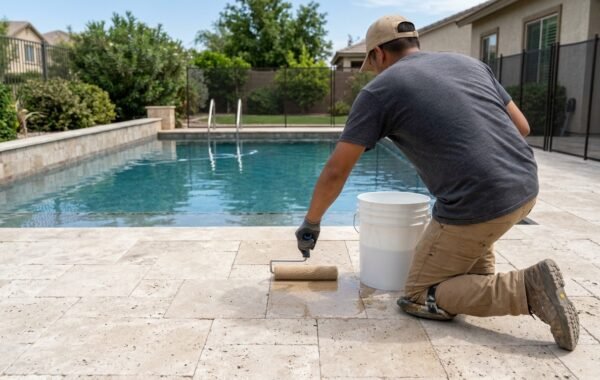
Three signs tell you a drain is clogged before the next storm does. Water stands on the deck longer than 30 minutes after rain, water sheets over the grate instead of dropping through it, or a sour smell rises near the drain line. Standing water also works into small cracks in the slab, so check for new cracking at the same time you clear the channel. Sealing the slab also keeps splash water from soaking in and carrying grit into the drain.
Where Should Pool Deck Runoff Drain?
Building codes strictly forbid directing chlorinated or chemically treated pool deck runoff into:
- Directly into the pool: Deck water carries lawn fertilizers, dog feces, sunscreen, and debris that consume free chlorine and spike phosphates, causing algae blooms.
- Neighboring property lines: Discharging concentrated runoff across property boundaries violates municipal stormwater drainage bylaws.
- Municipal sanitary sewer lines: Connecting deck drains to house sewer lines is illegal in almost all jurisdictions.
Approved Discharge Destinations: Run drainage pipe (4-inch smooth-wall PVC or corrugated pipe) to a dedicated dry well, on-site catch basin, pop-up emitter in a lawn swale at least 10 feet away from structures, or an approved municipal storm drain catch basin.
How to Fix Standing Water on an Existing Pool Deck
If your existing deck already suffers from standing birdbaths or poor slope, you have three retrofitting solutions:
- Concrete Saw-Cut Trenching: A contractor cuts a 4-inch-wide trench through the existing concrete, sets a modular channel drain in place, ties it to a 4-inch discharge pipe, and pours concrete around it. Cost: $1,800 to $3,500.
- Surface Polymer Overlays: For shallow puddles (under 1/2 inch deep), contractors apply a self-leveling polymer-modified cement overlay to rebuild the 1/4-inch-per-foot pitch before applying a decorative non-slip knockdown texture.
- Core-Drilled Deck Drains: Core-drilling 2-inch holes through low spots in the concrete slab connected to underground weeping gravel beds can drain small standing areas without cutting long channels.
Pick the fix by the shape of the problem. A long low strip or a deck that slopes the wrong way across a wide area needs a saw-cut trench. A shallow puddle under 1/2 inch deep takes a concrete pool deck resurfacing overlay that rebuilds the pitch, finished with a non-slip pool deck coating so the new surface still grips when wet. One or two small low spots take a core-drilled drain. Weigh the $1,800 to $3,500 saw-cut fix against how much a pool deck costs to replace outright.
Frequently Asked Questions
Hover or tap any question below to reveal the answer.
How long can water sit on a pool deck before causing damage?
Standing water that persists for hours fosters black algae growth, causes surface efflorescence (white mineral crusts), and erodes the sand sub-base beneath pavers.
Can I install a pool deck drain myself?
However, setting Deck-O-Drain inside a fresh concrete slab requires experienced masonry crews.
Why is my pool deck draining into the pool?
Settling is typically caused by poorly compacted backfill soil after pool wall excavation. Mudjacking or polyurethane foam injection can lift settled outer slab edges back to proper slope.
What pipe size is required for pool deck drainage?
Small 2-inch lines quickly clog with pool leaves and cannot handle sudden torrential downpours.
How do I pick the right drain system for my pool deck?
Deck-O-Drain suits poured concrete patios at to per linear foot, and it doubles as an expansion joint. Removable-grate trench drains suit heavy runoff and spots where roof overhangs dump rain onto the deck, at to per linear foot. Slot drains suit luxury paver decks at to per linear foot, and French drains suit yard edges at to per linear foot. All four move water through a 4-inch discharge pipe to a dry well, catch basin, or pop-up emitter.