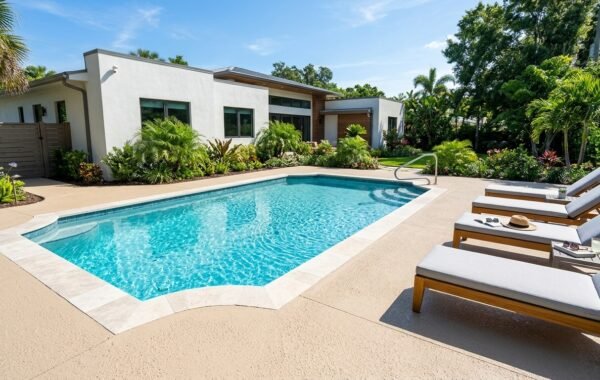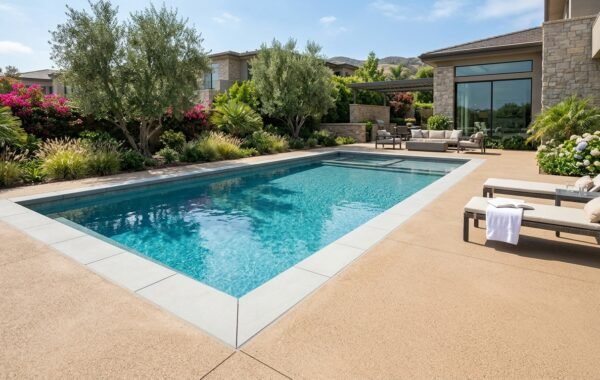

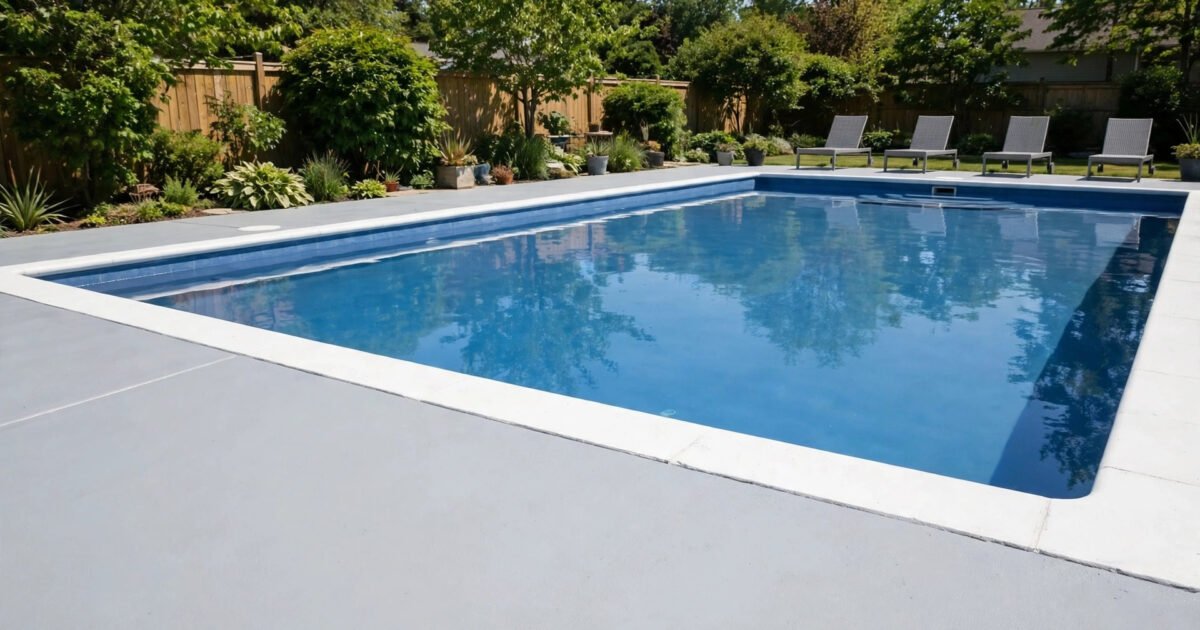
Painting a pool deck costs $3 to $8.50 per square foot, and a 400 square foot deck takes about 3 days and $390 to $450 in materials if you do it yourself. The paint is the easy part. The prep decides whether it lasts 5 years or peels in 5 months, and the grip additive decides whether the deck is safe to walk on wet. This guide paints a 400 square foot concrete deck step by step: clean and etch, prime, 2 coats with a grip additive in the final coat, and a sealer. If your deck needs a new surface rather than a new color, read our concrete pool deck resurfacing guide first — paint hides a stain, it does not fix a failing slab.
What You Will Need: 7 Tools and 5 Materials
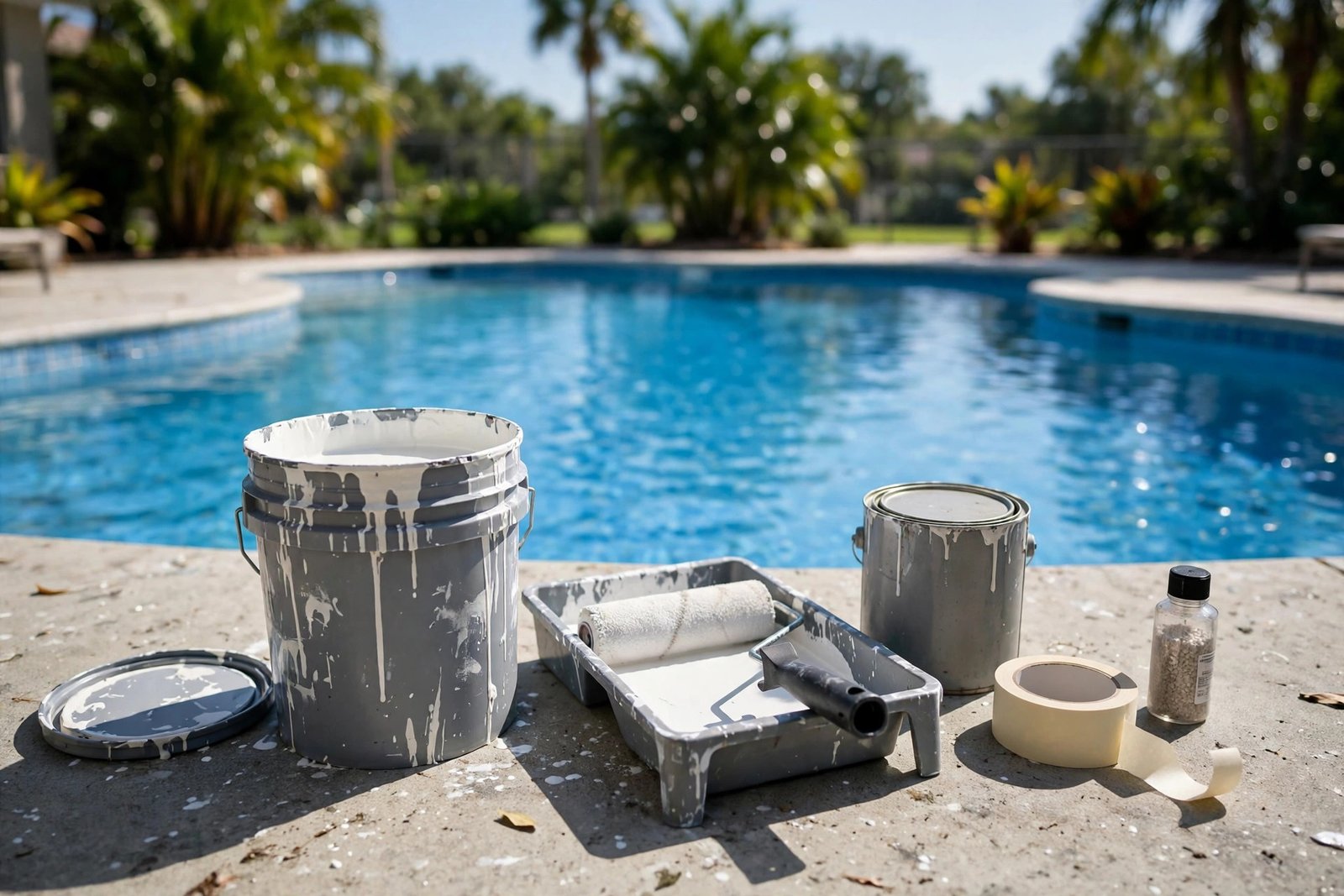
Buy the paint after you measure the deck, not before — the amount depends on your square footage and the coverage on the can. Tools: pressure washer (rent one if you do not own one), 3 inch stiff brush, 3/8 inch nap roller with an extension pole, 3 inch angled brush for cut-in, 5 gallon bucket and paint tray, painter’s tape, and a moisture meter or a plastic sheet for the tape test. Materials for a 400 square foot deck: 1 five-gallon pail of deck-rated paint, 1 gallon of concrete primer, 4 bottles of grip additive, concrete patch for cracks, and degreaser or concrete etcher.
Step 1: Decide in 10 Minutes Whether Your Deck Is Worth Painting
Walk the deck and look for 4 things. Several cracks across the slab, cracks that are growing, sections that have shifted or heaved, or surface spalling where the top layer flakes off — any one of those means the slab is moving or failing, and paint will not hold. In that case, get a resurfacing or replacement quote instead of a paint pail. A sound deck with stains, fading, or a color you no longer like is a paint job.
Run the tape test for moisture. Tape a 2 foot square of clear plastic to the deck, seal all 4 edges, and leave it for 24 hours. If water beads under the plastic, the slab is holding moisture and paint will lift. Wait for a dry stretch and test again. New concrete needs 28 days to cure before any coating goes on — that number comes from the product data, and painting sooner traps moisture under the paint.
Paint, resurface, or replace? Use this branch: deck sound, budget under $500, and you want a new color — paint it. Deck sound, budget $500 to $1,000, and you want the longest life — paint it with a 1-part epoxy and a sealer. Deck rough or cracked across the surface — resurface it, and read our pool deck coatings guide for the options. Deck heaving or spalling — replace the slab, do not paint it.
Step 2: Clean, Etch, and Patch the Concrete in 1 Day
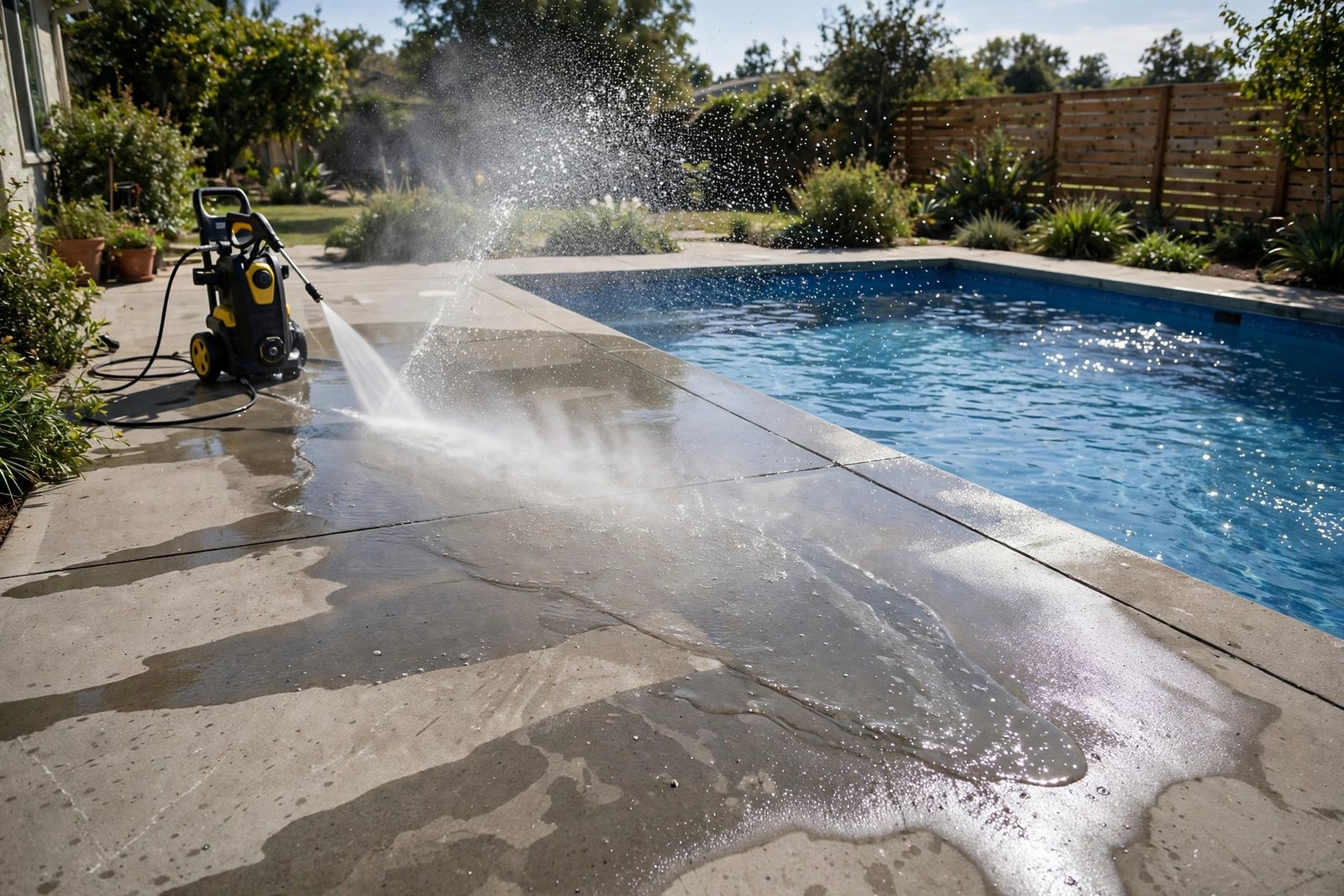
Paint sticks to clean concrete and peels off dirty concrete, so this step is the whole job in disguise. Pressure wash the full deck, then scrub any oil or sunscreen stains with degreaser — pool decks collect both. Etch the surface with a concrete etcher per the label, which opens the pores so the primer can bite. Rinse twice and let the deck dry fully before you prime. If you can still see a dark stain after washing, scrub it again; paint will not cover a stain that washing cannot remove.
Patch the cracks now, not after the first coat. Fill hairline cracks with concrete patch, tool it flat, and let it dry 8 hours before you paint over it. For cracks wider than 1/4 inch or a crack that runs across the whole slab, read our pool deck crack repair guide first — a wide crack is a movement problem, and paint will split along it within a season. Sweep the deck one last time before you prime. Dust on the surface is a bond breaker, and it costs nothing to remove.
Step 3: Prime the Deck With 1 Coat
Prime the whole deck with 1 coat of concrete primer, rolled with a 3/8 inch nap roller. Primer costs about $100 a gallon, and a 400 square foot deck needs 1 gallon at typical coverage. Cut in at the coping and the pool edge with a 3 inch brush first, then roll the field in 4 foot sections, keeping a wet edge so the laps do not show. Let the primer dry per the label before the first coat — usually 4 hours, but check the can, because humidity stretches dry times.
Do not skip the primer to save $100. Primer is what bonds the paint to the concrete, and it is also what stops the concrete from drinking the first coat unevenly. An unprimed deck takes a third coat to look even, and that third coat costs more than the primer did. If the old paint is sound and well stuck, scuff it with 80-grit sandpaper and spot-prime the bare patches instead of priming the whole deck.
Step 4: Add 3.2 Ounces of Grip Additive per Gallon
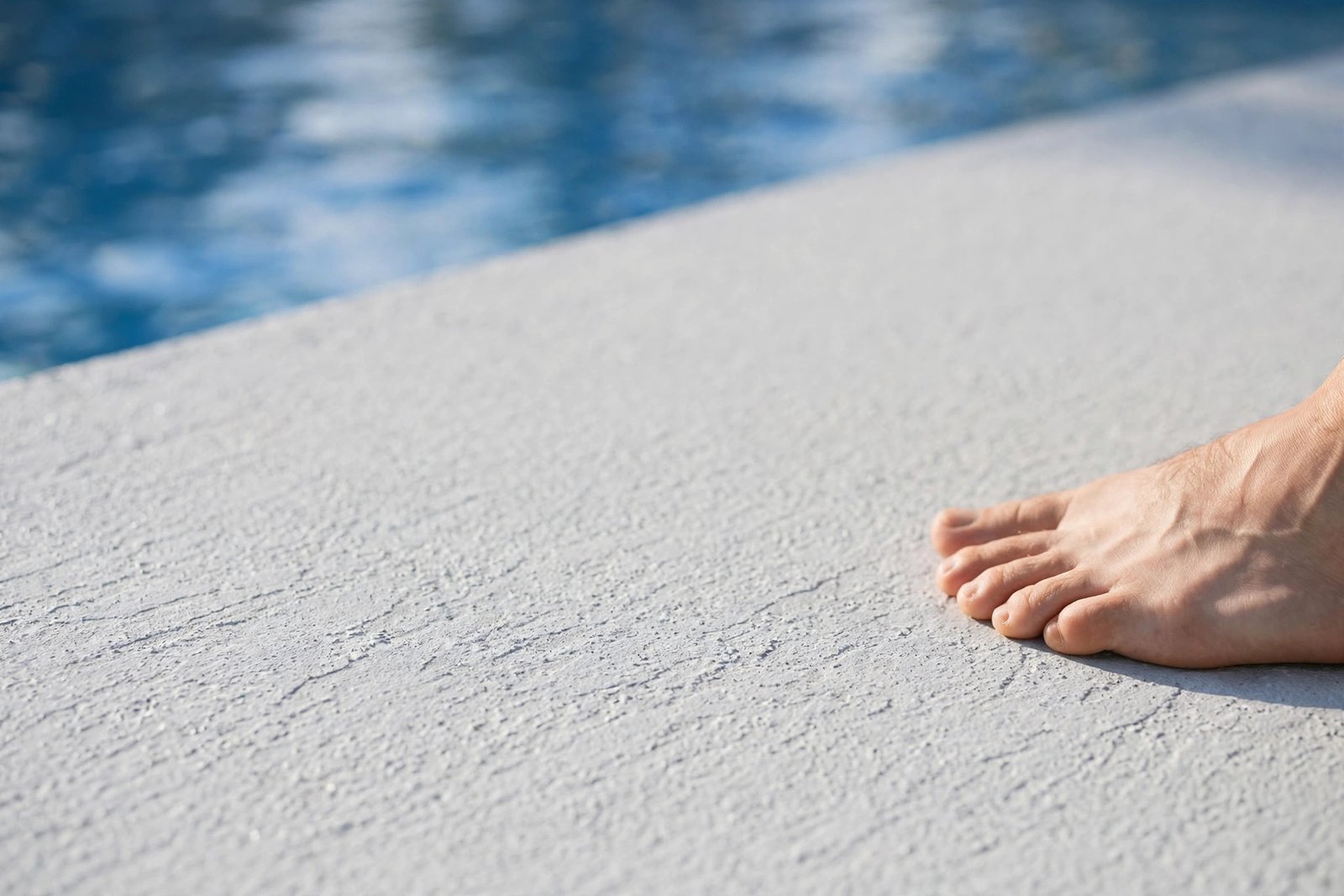
Painted concrete is slippery when wet, and a pool deck is wet most of the day. That is why the grip additive is not optional. Stir one 3.2-ounce bottle of grip additive into each gallon of paint, and put it in the final coat only. The bottles cost $12 to $18 each, and our 400 square foot deck needs 4 bottles — 1 per gallon of paint — so $48 to $72 total. Stir it in well and re-stir every 15 minutes while you roll, because the grit settles to the bottom of the tray.
The numbers explain why this matters. The generally accepted target for exterior wet surfaces is 0.55 wet DCOF, while the code floor where tested is 0.42. Untreated painted concrete measured 0.29 wet DCOF in one independent panel test — below both numbers — and the same test measured 0.61 with a grip additive mixed in. That test is one maker’s panel, not a lab standard, but it shows the scale of the change: additive moves a painted deck from slippery to grippy. Acrylic coatings themselves carry no published DCOF figure, so do not trust a paint can that claims a slip rating without a test behind it.
Step 5: Roll the First Coat in 2 to 3 Hours
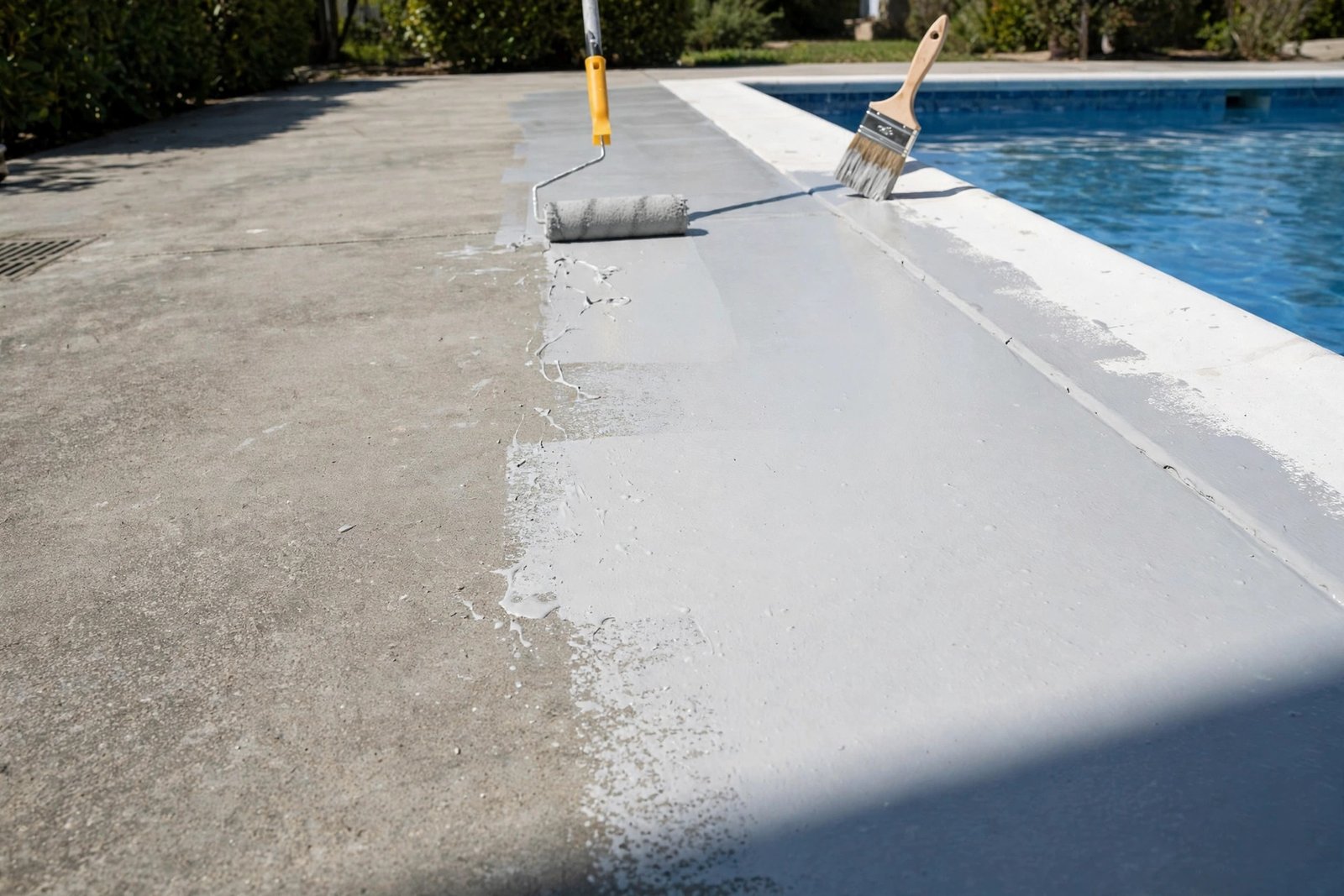
Start at the far end of the deck and work toward the exit so you never paint yourself into a corner. Cut in at the coping, the skimmer lids, and the pool edge with a 3 inch brush, then roll the field with a 3/8 inch nap roller on an extension pole. Roll in 4 foot sections and keep a wet edge. One coat takes 2 to 3 hours on a 400 square foot deck, including the cut-in.
One 5-gallon pail of deck paint costs $178 and covers about 2,000 square feet, so 1 pail covers our deck twice with paint to spare. A stain pail costs $173 and covers 2,000 to 3,000 square feet per bucket. Either way, buy 1 pail, not 2 — the leftover covers touch-ups for years. Work in the morning and stop by mid-afternoon: paint goes on best between 50 and 90 degrees, and a hot afternoon deck will dry the paint before it levels. Let the first coat dry about 4 hours before the second coat.
Step 6: Roll the Second Coat and Seal It in 24 Hours

Roll the second coat the same way as the first, with the grip additive mixed in. Two coats are the rule, not a suggestion: the product data calls for 2 coats at a coverage of 200 to 300 square feet per gallon on concrete floors, applied between 50 and 90 degrees. One coat looks fine on day 1 and wears through at the traffic paths by year 2. Our deck needs 2 gallons per coat at that coverage, so 4 gallons for 2 coats — and the 5-gallon pail covers it with a gallon to spare.
Seal the deck after the second coat dries. Roll 1 coat of concrete sealer, again with grip additive in it, and keep everyone off the deck for about 24 hours while it cures. Reseal every 2 to 3 years after that — it is a 2-hour job that doubles the life of the paint under it. For the full sealing routine, read our how to seal a pool deck guide. Wait a full day before moving furniture back, and a full week before dragging heavy planters across the new surface.
Which Paint Should You Use? 3 Types Compared
Three deck-rated paints cover almost every pool deck, and the choice is budget vs wear life. Epoxy paint lasts 5 to 15 years, the longest of any deck paint, which is why it is the default pick for a deck that gets daily use.
| Paint type | Verified price and coverage | Wear life | Best for |
|---|---|---|---|
| Acrylic concrete stain (BEHR Premium) | $173 per 5 gal; 2,000-3,000 sq ft per pail | Recoat about every 5 years | Budget refresh, color change |
| 1-part epoxy concrete paint (BEHR Porch and Patio) | $178 per 5 gal; 2,000 sq ft per pail | 5-15 years | Hard-wearing deck, best all-round |
| H&C Colortop acrylic (Sherwin-Williams) | 200-300 sq ft per gal; 2 coats; apply 50-90 F | Not stated in the product data | Pool-chemical resistant finish |
One warning that saves a costly mistake: pool-interior epoxy paints are not deck paints. Ramuc EP at $119.95 a gallon, Olympic Zeron at $129.95, and Poxolon 2 at $199.49 are made for the inside of the pool shell — they are formulated for constant submersion, not for foot traffic, sun, and a grip additive. Using one on a deck gives you a slick, expensive surface that wears fast. Buy a paint that lists pool decks on the label.
What Painting Costs Over 10 Years
Paint is the cheapest option per job, but it is not a once-and-done job. The table prices a 400 square foot deck over 10 years: paint needs 2 cycles, an overlay needs 1 job, and pavers need 1 job. Paint totals are materials only for a DIY job; overlay and paver totals are installed prices.
| Option | Cost per job (400 sq ft) | Jobs in 10 years | 10-year total |
|---|---|---|---|
| Paint (DIY materials) | $390-$450 | 2 (repaint about every 5 years) | $780-$900 |
| Acrylic overlay | $1,600-$3,200 ($4-$8 per sq ft) | 1 (say it lasts the full 10 years) | $1,600-$3,200 |
| Concrete pavers | $4,800-$8,000 ($12-$20 per sq ft) | 1 | $4,800-$8,000 |
Paint costs about a fifth of pavers over 10 years, and about half of an overlay. The trade is your time: 3 days per paint cycle, twice in 10 years, against a pro job you never touch again. For the full deck budget picture, see our how much does a pool deck cost guide.
5 Reasons Paint Peels, and the Fix for Each
1. Painted over dirty or oily concrete. Sunscreen and oil stop paint from bonding. The fix is a strip, a degrease, and a repaint — typically $200 to $400 in materials for 400 square feet. Avoid it by degreasing before you etch.
2. Skipped the etch. Smooth concrete will not hold paint. The fix is an etch and a recoat, typically $150 to $250. Avoid it by etching per the label and rinsing twice.
3. Painted too soon on new concrete. Concrete under 28 days old is still curing, and the moisture pushes paint off from underneath. The fix is to wait, strip, and repaint, typically $200 to $350. Avoid it by waiting the full 28 days.
4. No grip additive under a sealed topcoat. The deck looks good and skates when wet. The fix is a new topcoat with grip additive mixed in, typically $60 to $90. Avoid it by adding 1 bottle per gallon in the final coat.
5. Wrong paint — pool-interior epoxy on a deck. It wears fast under foot traffic and stays slick. The fix is a strip and a repaint with a deck-rated paint, typically $300 to $500. Avoid it by checking the label for pool decks before you buy.
When to Repaint: the 5 Year Schedule
Paint does not fail all at once — it fades at the traffic paths first, then chalks, then lifts at the edges. Reseal every 2 to 3 years, which takes about 2 hours and keeps the color from chalking. Repaint about every 5 years, or sooner if the traffic paths show bare concrete. Touch up chips as you find them: a small brush and the leftover paint from the pail takes 10 minutes and stops a chip from becoming a peel. Keep the leftover pail sealed and out of the sun; it stays good for touch-ups for 2 to 3 years.
Pre-Paint Verification Checklist: 8 Checks
Run this list before you buy paint. Every item is a yes or no — a no means stop and fix it first.
- Deck sound: no growing cracks, no heaving, no spalling. Yes / no.
- Moisture tape test passed (24 hours, no water under the plastic): yes / no.
- New concrete cured 28 days or more: yes / no.
- Deck pressure washed, degreased, etched, rinsed twice, and fully dry: yes / no.
- Cracks patched and dry 8 hours: yes / no.
- Paint is deck-rated and lists pool decks on the label: yes / no.
- Primer, grip additive (4 bottles for 400 sq ft), and sealer on hand: yes / no.
- Weather window: 50-90 F, no rain for 48 hours, 3 dry days ahead: yes / no.
6 Questions About Swimming Pool Deck Paint
How long does pool deck paint last?
Epoxy paint lasts 5 to 15 years, and acrylic stain lasts about 5 years before it needs a recoat. Resealing every 2 to 3 years stretches both. Sun and traffic paths wear first.
Can I paint over an old painted deck?
Yes, if the old paint is sound and well stuck. Clean it, scuff it with 80-grit sandpaper, spot-prime the bare patches, and roll 2 coats. Strip any peeling areas first — new paint will not hold old paint that is already lifting.
What is the best paint for a pool deck?
A 1-part epoxy concrete paint is the best all-round pick: it wears longest and costs $178 for a 5-gallon pail. An acrylic stain at $173 a pail is the budget pick for a color refresh. Both must list pool decks on the label.
How much does it cost to paint a 400 sq ft pool deck?
About $390 to $450 in materials if you do it yourself: 1 pail of paint, 1 gallon of primer, 4 bottles of grip additive, and consumables. A pro-inclusive price runs $3 to $8.50 per square foot.
Is painted concrete slippery when wet?
Yes, without a grip additive. Stir 1 bottle of grip additive per gallon into the final coat, and put it in the sealer too. That moves a painted deck from slippery to grippy under bare feet.
Can I use pool paint on my pool deck?
No. Pool-interior epoxy paints like Ramuc and Olympic are made for the inside of the pool shell, not for foot traffic and sun. They wear fast on a deck and stay slick. Use a deck-rated paint instead.
Editorial Note: This guide was researched and written by our small editorial team under the pen name Dave Hendrick. We are homeowners and researchers, not licensed contractors. Prices are typical national ranges, not quotes — confirm locally before you buy.